📘 English Grammar + AI Awareness + Prompt Engineering (Basics Level)
🧠 Target: Concept Clarity
📅 Duration: ( 16 Weeks)
English + Hindi for better understanding

🎯 Topic( 1 ):- Introduction to English Grammar + What is AI?

DAY :- 1

Week :- ( 1 ) :-  Introduction to English Grammar + What is AI?

Day :- ( 1 ) :- 🎯 Topics Covered:
• What is Grammar?
• Sentence, Subject & Predicate
• Types of Sentences
• What is AI? What is ChatGPT?
• AI Practice Prompts


🔶 📚 English Grammar Part (व्याकरण भाग)

🔸 What is Grammar? (व्याकरण क्या है?)

Grammar is the set of rules that helps us to form correct sentences in any language.
व्याकरण वह नियमों का समूह है जिससे हम सही वाक्य बनाते हैं।

📌 Examples:

  • I am a student.

  • He plays cricket.

  • They are going to school.


🔸 What is a Sentence? (वाक्य क्या होता है?)

A sentence is a group of words that makes complete sense.
वाक्य शब्दों का ऐसा समूह है जो पूरा अर्थ देता है।

Examples:

  • She is reading a book.

  • यह एक वाक्य है क्योंकि इसका अर्थ स्पष्ट है।


🔸 Subject and Predicate (कर्ता और विधेय)

Every sentence has two parts:

  1. Subject (कर्ता) – Who/what the sentence is about.
    Example: Ravi is eating.

  2. Predicate (विधेय) – What is said about the subject.
    Example: Ravi is eating.


🔸 Types of Sentences (वाक्य के प्रकार)

TypeHindi NameExampleउदाहरण
1. Assertiveकथनात्मकI like tea.मुझे चाय पसंद है।
2. Interrogativeप्रश्नवाचकDo you like tea?क्या तुम्हें चाय पसंद है?
3. Imperativeआदेशात्मकClose the door.दरवाज़ा बंद करो।
4. Exclamatoryविस्मयादिबोधकWhat a beautiful flower!कितना सुंदर फूल है!

🤖 Introduction to AI & ChatGPT (ए.आई. और चैटजीपीटी का परिचय)

🔸 What is AI? (AI क्या है?)

AI (Artificial Intelligence) is a technology that allows machines to think, learn, and act like humans.
AI एक ऐसी तकनीक है जो मशीनों को इंसानों की तरह सोचने और समझने की क्षमता देती है।

🔸 What is ChatGPT?

ChatGPT is an AI chatbot created by OpenAI that can answer questions, write content, and talk like a human.
ChatGPT एक AI चैटबॉट है जो इंसानों की तरह बातचीत कर सकता है और जानकारी दे सकता है।


🧠 Prompt Task (प्रॉम्प्ट अभ्यास):

Use this with ChatGPT:
👉 "What is Grammar?"
✅ ChatGPT will reply with a simple definition and examples.


✍️ Practice Task for Students:

🔹 Write 3 types of sentences and check with ChatGPT:

  1. Assertive: I am learning English.

  2. Interrogative: Are you a student?

  3. Exclamatory: What a nice book!

👉 Now use this prompt:
"Check if my 3 sentences are correct types (assertive, interrogative, exclamatory)."


🧠 Flashcard Quick Revision:

  • Q: What is Grammar?
    A: Rules to form correct sentences.

  • Q: What is Subject?
    A: The person or thing doing the action.

  • Q: Give one exclamatory sentence.
    A: What a great movie!


📌 Summary Points:

  • Grammar helps form correct sentences.

  • A sentence = Subject + Predicate

  • Sentence types: Assertive, Interrogative, Imperative, Exclamatory

  • AI = Artificial Intelligence

  • ChatGPT = AI chatbot that talks and teaches
DAY :- 2

Week :- ( 1 ) :-  Introduction to English Grammar + What is AI?

Day :- ( 2 ) :- 🎯 Topics Covered:
• Introduction to Parts of Speech (भाषा के अंग)
• Noun (संज्ञा) – Types & Examples
• Pronoun (सर्वनाम) – Types & Use
• Prompt Task: Ask ChatGPT to give 5 sentences using Noun and Pronoun
• Practice Task: Identify Noun & Pronoun in given sentences


🔶 📚 What are Parts of Speech? (भाषा के अंग क्या हैं?)

Parts of Speech are the basic building blocks of English grammar. They tell us the role of each word in a sentence.
Parts of Speech वो शब्द होते हैं जो यह बताते हैं कि वाक्य में हर शब्द क्या काम कर रहा है।

➡️ कुल 8 Parts of Speech होते हैं:

  1. Noun (संज्ञा)

  2. Pronoun (सर्वनाम)

  3. Verb (क्रिया)

  4. Adjective (विशेषण)

  5. Adverb (क्रिया विशेषण)

  6. Preposition (पूर्वसर्ग)

  7. Conjunction (संयोजक)

  8. Interjection (विस्मयादिबोधक)


🔵 Noun (संज्ञा)

A noun is the name of a person, place, thing, or idea.
Noun वह शब्द होता है जो किसी व्यक्ति, स्थान, वस्तु या भावना का नाम बताता है।

🔹 Types of Nouns (संज्ञा के प्रकार):

  1. Proper Noun – Specific name (e.g., Ram, Delhi)
    ➤ Ram is a good boy.

  2. Common Noun – General name (e.g., boy, city)
    ➤ The boy is playing.

  3. Collective Noun – Group name (e.g., team, class)
    ➤ The team is winning.

  4. Abstract Noun – Idea, quality (e.g., love, honesty)
    ➤ Honesty is the best policy.

  5. Material Noun – Material/substance (e.g., gold, water)
    ➤ Gold is expensive.


🟢 Pronoun (सर्वनाम)

A pronoun is a word that replaces a noun to avoid repetition.
Pronoun वह शब्द है जो noun की जगह प्रयोग होता है।

🔹 Examples:

  • Ram is my friend. He lives in Delhi.
    (Here, He replaces Ram)

🔹 Common Pronouns:

I, You, He, She, It, We, They, Me, Us, Him, Her, Them

🔹 Types of Pronouns:

  1. Personal Pronoun – I, you, he, she

  2. Demonstrative Pronoun – this, that, these, those

  3. Reflexive Pronoun – myself, yourself

  4. Relative Pronoun – who, whom, which

  5. Interrogative Pronoun – who? what?

  6. Possessive Pronoun – mine, yours, his


🤖 Prompt Task (ChatGPT के साथ अभ्यास):

👉 Ask:
"Give 5 simple sentences using both noun and pronoun."
ChatGPT will reply with examples like:

  • Riya is my sister. She is smart.

  • This is a dog. It is barking.


✍️ Practice Task for Students:

Identify Noun and Pronoun in the following sentences:

  1. Rahul is a student. He studies well.

  2. The book is new. It is very interesting.

  3. The children are playing. They are happy.

➡️ Use this prompt with ChatGPT:
"Identify the nouns and pronouns in these sentences."


🧠 Flashcard Quick Revision:

  • Q: What is a noun?
    A: Name of person, place, thing, idea.

  • Q: What is a pronoun?
    A: A word that replaces a noun.

  • Q: Example of Proper Noun?
    A: India, Ravi, Ganga

  • Q: Pronoun for ‘Ravi’?
    A: He


📌 Summary Points:

  • Parts of Speech = 8 types

  • Noun = Name of person/place/thing

  • Pronoun = Word used instead of noun

  • Types of Nouns = Proper, Common, Abstract, etc.

  • Pronouns include: I, You, He, She, They, etc.

DAY :- 3

Week :- ( 1 ) :-  Introduction to English Grammar + What is AI?

Day :- ( 3 ) :- 🎯 Topics Covered:
• Verb (क्रिया) – Definition & Types
• Adjective (विशेषण) – Definition & Usage
• Prompt Task: Ask ChatGPT to give sentences using Verb and Adjective
• Practice Task: Identify Verb & Adjective from sentences


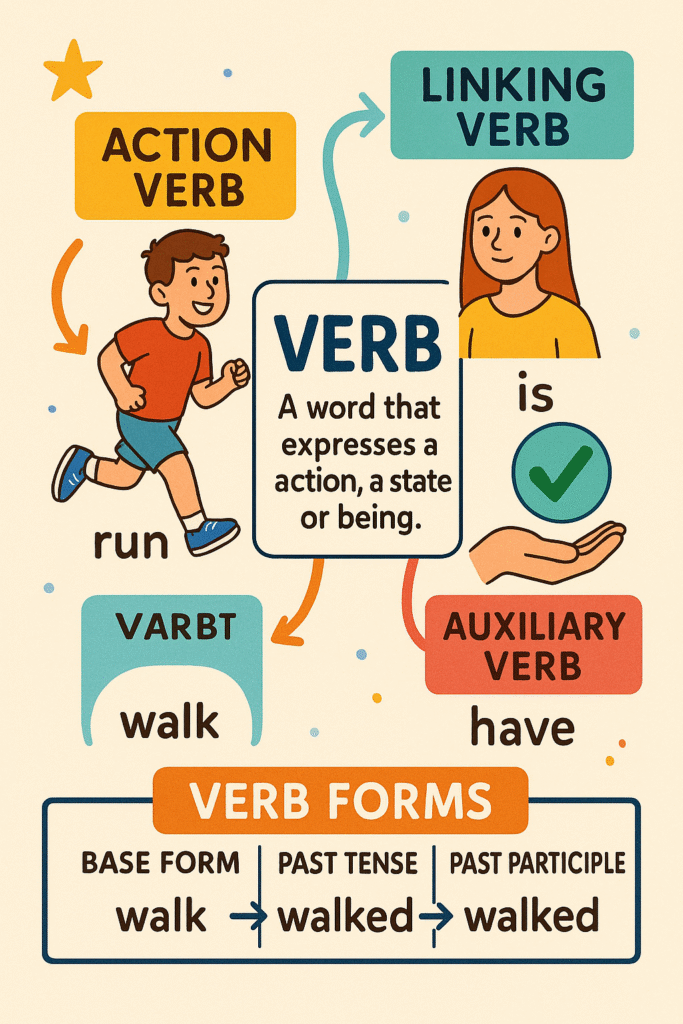
🔶 📚 What is a Verb? (Verb क्या होता है?)

A Verb is a word that shows action or state of being.
Verb वह शब्द है जो किसी क्रिया या कार्य को दर्शाता है।

🔹 Examples:

  • He runs fast. (Action)

  • She is happy. (State of being)

🔹 Types of Verbs (क्रिया के प्रकार):

  1. Main Verb (मुख्य क्रिया) – shows the main action
    ➤ She writes a letter.

  2. Helping Verb (सहायक क्रिया) – helps main verb
    ➤ She is writing a letter.

  3. Transitive Verb – needs an object
    ➤ He reads a book.

  4. Intransitive Verb – doesn’t need an object
    ➤ He sleeps peacefully.


🟢 What is an Adjective? (Adjective क्या होता है?)

An Adjective is a word that describes a noun or pronoun.
Adjective वह शब्द है जो किसी संज्ञा या सर्वनाम की विशेषता बताता है।

🔹 Examples:

  • She is a smart girl.

  • This is a blue pen.

  • They are happy kids.

🔹 Types of Adjectives (विशेषण के प्रकार):

  1. Quality – big, small, honest

  2. Quantity – some, many, few

  3. Number – one, two, first

  4. Demonstrative – this, that, these

  5. Interrogative – which, what

  6. Possessive – my, his, their


🤖 Prompt Task (ChatGPT अभ्यास):

Ask:
"Write 3 sentences using Verb and Adjective together."
ChatGPT will reply like:

  • He drinks cold water.

  • The baby cries loudly.

  • She looks happy.


✍️ Practice Task for Students:

Identify Verb and Adjective in the following sentences:

  1. Riya sings a sweet song.

  2. The dog is angry.

  3. They play in the big ground.

➡️ Use this prompt with ChatGPT:
"Identify the verbs and adjectives in these sentences."


🧠 Flashcard Quick Revision:

  • Q: What is a Verb?
    A: A word that shows action or state of being.

  • Q: Example of Verb?
    A: Run, is, eat, sleep

  • Q: What is an Adjective?
    A: A word that describes a noun or pronoun.

  • Q: Example of Adjective?
    A: Tall, red, happy, three


📌 Summary Points:

  • Verb = Action or state

  • Types of Verbs = Main, Helping, Transitive, Intransitive

  • Adjective = Describes a noun/pronoun

  • Types of Adjectives = Quality, Quantity, Number, etc.

DAY :- 4

Week :- ( 1 ) :-  Introduction to English Grammar + What is AI?

Day :- ( 4 ) :- 🎯 Topics Covered:
• Adverb (क्रिया विशेषण) – Definition & Types
• Pronoun (सर्वनाम) – Definition & Types
• Prompt Task: Ask ChatGPT to list adverbs and pronouns in a paragraph
• Practice Task: Identify adverbs & pronouns in sample sentences


🔶 📚 What is an Adverb? (Adverb क्या होता है?)

An Adverb is a word that modifies a verb, an adjective, or another adverb.
Adverb वह शब्द होता है जो किसी क्रिया, विशेषण या दूसरे क्रिया विशेषण की विशेषता बताता है।

🔹 Examples:

  • He runs quickly.

  • She is very beautiful.

  • They arrived late.

🔹 Types of Adverbs (क्रिया विशेषण के प्रकार):

  1. Adverb of Manner (कैसे?) – slowly, quickly, beautifully

  2. Adverb of Place (कहाँ?) – here, there, outside

  3. Adverb of Time (कब?) – now, yesterday, soon

  4. Adverb of Frequency (कितनी बार?) – always, never, often

  5. Adverb of Degree (कितना?) – very, quite, too


🟢 What is a Pronoun? (Pronoun क्या होता है?)

A Pronoun is a word used in place of a noun.
Pronoun वह शब्द है जो noun के स्थान पर प्रयोग होता है।

🔹 Examples:

  • Riya is smart. She is a good student.

  • I love my dog. It is very cute.

🔹 Types of Pronouns (सर्वनाम के प्रकार):

  1. Personal Pronoun – I, you, he, she, it, we, they

  2. Possessive Pronoun – mine, yours, his, hers, ours, theirs

  3. Reflexive Pronoun – myself, yourself, himself

  4. Demonstrative Pronoun – this, that, these, those

  5. Relative Pronoun – who, which, that

  6. Interrogative Pronoun – who, what, which

  7. Indefinite Pronoun – someone, everyone, anything, nothing


🤖 Prompt Task (ChatGPT अभ्यास):

Ask ChatGPT:
"Write a short paragraph and list all the adverbs and pronouns in it."

Sample Reply ChatGPT दे सकता है:

  • He quickly ran into the house because he was afraid.
    → Adverb: quickly, Pronoun: he


✍️ Practice Task for Students:

Identify the Adverbs and Pronouns in the following sentences:

  1. She speaks clearly.

  2. I will meet you tomorrow.

  3. They always arrive late.

  4. This is my book.

  5. We love our family.

➡️ Use this prompt with ChatGPT:
"Find all adverbs and pronouns in these sentences."


🧠 Flashcard Quick Revision:

  • Q: What is an Adverb?
    A: A word that modifies a verb, adjective, or another adverb.

  • Q: Example of Adverb?
    A: Slowly, very, now

  • Q: What is a Pronoun?
    A: A word that replaces a noun.

  • Q: Example of Pronoun?
    A: I, he, she, it, this, mine


📌 Summary Points:

  • Adverb answers how, when, where, how often, how much

  • Pronoun replaces a noun to avoid repetition

  • Common types: Personal, Reflexive, Demonstrative, Interrogative


DAY :- 5

Week :- ( 1 ) :-  Introduction to English Grammar + What is AI?

Day :- ( 5 ) :- 🎯 Topics Covered:
• Preposition (संबंधबोधक) – Definition & Examples
• Conjunction (संयोजक) – Definition & Examples
• Prompt Task: Ask ChatGPT to create 5 sentences using prepositions and conjunctions
• Practice Task: Identify prepositions and conjunctions in given sentences


🔷 What is a Preposition? (Preposition क्या होता है?)

A Preposition is a word placed before a noun or pronoun to show its relation with another word in the sentence.
Preposition वह शब्द होता है जो noun या pronoun से पहले आता है और उसका संबंध वाक्य के अन्य शब्दों से दर्शाता है।

🔹 Examples:

  • The book is on the table.

  • He walked into the room.

  • We sat under a tree.

🔹 Common Prepositions:

in, on, at, by, for, with, from, to, into, under, over, beside, between


🔷 What is a Conjunction? (Conjunction क्या होता है?)

A Conjunction is a word that joins words, phrases, or sentences.
Conjunction वह शब्द होता है जो दो शब्दों, वाक्यांशों या वाक्यों को जोड़ता है।

🔹 Examples:

  • I want tea and coffee.

  • She is tired, but she will work.

  • He ran fast because he was late.

🔹 Common Conjunctions:

and, but, or, because, so, although, if, while, unless, since


🤖 Prompt Task (ChatGPT अभ्यास):

Ask ChatGPT:
"Make 5 sentences using at least one preposition and one conjunction in each."

Expected Output:

  • She sat on the chair and waited.

  • We went into the shop because it was raining.


✍️ Practice Task for Students:

Identify Prepositions and Conjunctions in these sentences:

  1. The cat is under the table.

  2. I was late because the bus broke down.

  3. He jumped over the wall and ran away.

  4. We will go if it doesn’t rain.

  5. She lives in Delhi but works in Mumbai.

➡️ ChatGPT Prompt:
"Find all prepositions and conjunctions in these sentences."


🧠 Flashcard Quick Revision:

  • Q: What is a Preposition?
    A: A word that shows the relationship of a noun/pronoun with another word.

  • Q: Example of Preposition?
    A: in, on, under, beside

  • Q: What is a Conjunction?
    A: A word that joins two words, phrases, or sentences.

  • Q: Example of Conjunction?
    A: and, but, or, because


📌 Summary Points:

  • Prepositions show location, direction, time, or relation.
    (e.g., in, on, at, under)

  • Conjunctions connect parts of a sentence.
    (e.g., and, but, because, if)

  • Practice helps in identifying these in complex sentences.

DAY :- 6

Week :- ( 1 ) :-  Introduction to English Grammar + What is AI?

Day :- ( 6 ) :- 🎯 Topics Covered:
• Interjection (विस्मयादिबोधक) – Definition, Examples
• Recap of Week 1 Topics
• Prompt Practice + Self-Evaluation
• Flashcard Revision


🔷 What is an Interjection? (Interjection क्या होता है?)

An Interjection is a word or phrase that expresses a sudden feeling or emotion.
Interjection वह शब्द होता है जो अचानक होने वाले भावों या अनुभवों को व्यक्त करता है।

🔹 Examples:

  • Wow! That’s amazing.

  • Oh! I forgot my notebook.

  • Alas! He is no more.

  • Hurray! We won the match.

🔹 Common Interjections:

Oh!, Wow!, Hurray!, Alas!, Ouch!, Hey!, Ah!, Oops!


🧠 Flashcard Style Learning:

  • Q: What is an Interjection?
    A: A word used to express strong emotions or sudden feelings.

  • Q: Example of Interjection?
    A: Oh!, Hurray!, Alas!


🔁 Week 1 Recap – Quick Overview (सप्ताह 1 का पुनरावर्तन):

✅ Day 1:

  • What is Grammar?

  • Sentence, Subject & Predicate

  • Types of Sentences

  • What is AI? What is ChatGPT?

✅ Day 2:

  • Noun: Types and Examples

  • Proper Noun, Common Noun, Abstract etc.

  • Prompt task with ChatGPT: Identify types of nouns

✅ Day 3:

  • Pronoun: Definition and types

  • Adjective: Describing words

  • Prompt task: Replace nouns with pronouns

✅ Day 4:

  • Verb (क्रिया): Action words

  • Adverb (क्रिया विशेषण): How action is done

  • Prompt: Make sentence and identify verbs & adverbs

✅ Day 5:

  • Preposition: Relationship word

  • Conjunction: Joining word

  • Prompt: Sentences with both

✅ Day 6 (Today):

  • Interjection

  • Revision + Prompt + Flashcards


🤖 Prompt Practice Task – Weekly Review via ChatGPT:

Ask ChatGPT:

"Give me a quiz with 10 questions to test my knowledge of parts of speech – noun, pronoun, verb, adjective, adverb, preposition, conjunction, interjection."

➡️ You will receive 10 practice questions. Try to solve, then verify your answers.


✍️ Self-Practice Sentences:

Identify the parts of speech in the following:

  1. Wow! She danced beautifully.

  2. He lives in Mumbai and works in Pune.

  3. They are playing cricket in the park.

  4. She is a brilliant student.

  5. Oh! I missed the class today.

➡️ Use ChatGPT to check and verify:
"Identify all parts of speech in these sentences."


📌 Summary Points:

  • Interjections show emotions like surprise, joy, sorrow.

  • Total 8 Parts of Speech are covered:
    Noun, Pronoun, Verb, Adjective, Adverb, Preposition, Conjunction, Interjection

  • ChatGPT can help revise and test your understanding.

  • Flashcard practice improves recall quickly.

Grammar + ChatGPT Basics MCQs SET (1 to 15)

📘 MCQs – Week 1 (Day 1 to Day 6)

Total Questions: 15
Chapters Covered:

  • Grammar Introduction

  • Sentence, Subject & Predicate

  • Types of Sentences

  • Parts of Speech (Noun to Interjection)

  • Introduction to AI and ChatGPT


✅ Q1. What is Grammar? (Grammar क्या होता है?)

A. Only writing rules
B. Rules of language structure
C. Vocabulary
D. Speaking skills

Answer: B
📝 Explanation: Grammar is the set of rules that governs the structure of sentences.
व्याकरण वाक्य निर्माण के नियमों का समूह होता है।


✅ Q2. Which of these is a complete sentence? (इनमें से कौन पूरा वाक्य है?)

A. Playing football
B. My best friend
C. She is a teacher
D. Beautiful garden

Answer: C
📝 Explanation: “She is a teacher” has subject + verb + object = Complete sentence.
इस वाक्य में subject (She), verb (is) और object (a teacher) है।


✅ Q3. Which part of this sentence is the subject: "The cat slept on the mat"?

A. Slept
B. On the mat
C. The cat
D. Mat

Answer: C
📝 Explanation: The subject tells who is doing the action – here it is "The cat".
Subject वह होता है जो कार्य कर रहा हो।


✅ Q4. Which is an Interrogative sentence? (प्रश्नवाचक वाक्य कौन-सा है?)

A. She is happy
B. What is your name?
C. Wow!
D. Please sit down

Answer: B
📝 Explanation: Interrogative sentence asks a question and ends with a question mark.
प्रश्नवाचक वाक्य प्रश्न करता है, जैसे – What is your name?


✅ Q5. What type of sentence is this: “Please open the door.”?

A. Assertive
B. Interrogative
C. Imperative
D. Exclamatory

Answer: C
📝 Explanation: Imperative sentences give commands or make requests.
आज्ञा देने वाले या निवेदन वाले वाक्य Imperative होते हैं।


✅ Q6. Choose the Common Noun from the following:

A. India
B. Rahul
C. Girl
D. Taj Mahal

Answer: C
📝 Explanation: “Girl” is a general name and hence a Common Noun.
Girl सामान्य नाम है, इसलिए यह Common Noun है।


✅ Q7. Which of the following is a Proper Noun?

A. City
B. School
C. Ram
D. Teacher

Answer: C
📝 Explanation: Ram is a specific name of a person.
Ram किसी विशेष व्यक्ति का नाम है, इसलिए Proper Noun है।


✅ Q8. Which word is a Pronoun in the sentence: "She is reading a book"?

A. Reading
B. She
C. Book
D. Is

Answer: B
📝 Explanation: “She” is used in place of a girl/woman – it’s a Pronoun.
She नाम के स्थान पर उपयोग हुआ है, इसलिए Pronoun है।


✅ Q9. Which of the following is an Adjective? (Adjective चुनें):

A. Quickly
B. Beautiful
C. Under
D. Them

Answer: B
📝 Explanation: “Beautiful” describes a noun, so it’s an adjective.
Beautiful संज्ञा को विशेषता देता है।


✅ Q10. Identify the Adverb: "He runs fast."

A. He
B. Runs
C. Fast
D. None

Answer: C
📝 Explanation: “Fast” tells how he runs – manner adverb.
Fast क्रिया (runs) की विशेषता बता रहा है।


✅ Q11. What is the Preposition in: "The cat is under the table"?

A. Cat
B. Is
C. Under
D. Table

Answer: C
📝 Explanation: “Under” shows the relationship of cat and table.
Under दो वस्तुओं के बीच संबंध दिखा रहा है।


✅ Q12. Which sentence uses a Conjunction? (Conjunction वाला वाक्य कौन-सा है?)

A. He is tall
B. I like mangoes and apples
C. This is my bag
D. Sit down please

Answer: B
📝 Explanation: “And” joins two nouns – conjunction used.
And दो शब्दों को जोड़ता है, यह Conjunction है।


✅ Q13. Identify the Interjection in this sentence: "Wow! You sang so well!"

A. Wow
B. You
C. Sang
D. Well

Answer: A
📝 Explanation: “Wow!” expresses emotion – it is an Interjection.
Wow! भाव को व्यक्त करता है – Interjection है।


✅ Q14. What does ChatGPT stand for?

A. Chat General Prompt Technology
B. Chat Generative Pre-trained Transformer
C. Chat Guide Prompt Tool
D. None of the above

Answer: B
📝 Explanation: ChatGPT = Chat Generative Pre-trained Transformer (AI Model by OpenAI).
ChatGPT एक AI मॉडल है जो मानव जैसी बातचीत करता है।


✅ Q15. Which of these is NOT a type of sentence?

A. Assertive
B. Interrogative
C. Declarative
D. Noun

Answer: D
📝 Explanation: Noun is a part of speech, not a sentence type.
Noun वाक्य का प्रकार नहीं है, यह Parts of Speech है।


🎯 Final Score & Revision Tip:

  • ✅ 13–15: Excellent – You have understood Week 1 topics clearly.

  • ✅ 10–12: Good – Revise Interjection/Adverb/Preposition again.

  • ✅ Below 10: Revisit flashcards + ChatGPT prompts from Week 1.

📌 Tip:
Try asking ChatGPT:
“Make 5 MCQs on Parts of Speech and correct me if I’m wrong.”
It will help build interactive grammar skills with AI.

REVISION NOTES

📘 WEEK 1 – REVISION NOTES

🗓️ Day 1 to Day 6
🎯  Introduction to English Grammar + What is AI & ChatGPT


📍 1. What is Grammar? / व्याकरण क्या है?

  • Grammar is the system of a language.
    व्याकरण किसी भाषा का नियमों का समूह होता है।

  • It helps us to form correct sentences.
    यह हमें सही वाक्य बनाने में मदद करता है।

  • Example: "He go to school" ❌ → "He goes to school" ✅


📍 2. Sentence / वाक्य

  • A sentence is a group of words that makes complete sense.
    वाक्य वह शब्दों का समूह होता है जो पूरा अर्थ देता है।

  • It must begin with a capital letter and end with a full stop, question mark, or exclamation mark.
    यह हमेशा बड़े अक्षर से शुरू होता है और अंत में पूर्ण विराम, प्रश्नवाचक या विस्मयादिबोधक चिन्ह आता है।

📝 Examples:

  • She is a doctor.

  • What is your name?

  • Wow! That’s amazing!


📍 3. Subject and Predicate / कर्ता और विधेय

  • Subject (कर्ता): The person or thing we talk about.
    वह हिस्सा जिससे वाक्य की बात शुरू होती है।

  • Predicate (विधेय): The part that tells something about the subject.
    वह हिस्सा जो subject के बारे में कुछ बताता है।

📝 Example:

  • Ravi plays cricket.
    Ravi = Subject, plays cricket = Predicate


📍 4. Types of Sentences / वाक्य के प्रकार

  • Assertive Sentence (विधिवाचक वाक्य): Statement
    → She goes to school.

  • Interrogative Sentence (प्रश्नवाचक वाक्य): Question
    → Do you play cricket?

  • Imperative Sentence (आज्ञावाचक वाक्य): Command/Request
    → Sit down. / Please help me.

  • Exclamatory Sentence (विस्मयादिबोधक वाक्य): Emotion
    → Wow! What a day!


📍 5. What is AI? / AI क्या है?

  • AI stands for Artificial Intelligence.
    AI का पूरा नाम Artificial Intelligence (कृत्रिम बुद्धिमत्ता) है।

  • It is the ability of machines to think and act like humans.
    यह मशीनों की इंसानों की तरह सोचने और काम करने की क्षमता है।

  • Example: ChatGPT, Siri, Google Assistant


📍 6. What is ChatGPT? / चैटजीपीटी क्या है?

  • ChatGPT is an AI tool developed by OpenAI.
    ChatGPT एक AI टूल है जिसे OpenAI ने बनाया है।

  • It understands your questions and gives helpful answers.
    यह आपके सवालों को समझकर जवाब देता है।

  • You can use it to learn, write, translate, solve problems, and much more.
    आप इसका उपयोग सीखने, लिखने, अनुवाद करने, समस्याएं हल करने आदि के लिए कर सकते हैं।


📍 7. Prompt Engineering (Basic Introduction)

  • Prompt = Your question or command to AI.
    Prompt वो निर्देश होता है जो आप AI को देते हैं।

  • Example:
    “Write a sentence using the word ‘smart’”
    “Grammar kya hota hai?”


📍 8. Practice & AI Integration

  • Practice sentence types with ChatGPT.
    → Type: “Make 3 Interrogative Sentences”

  • Use ChatGPT to check grammar:
    → Prompt: “Is this sentence correct – He go to market?”


✅ Week 1 Key Takeaways / मुख्य बिंदु

  • Grammar helps in correct sentence formation.

  • Sentences have structure: Subject + Predicate

  • There are 4 types of sentences in English.

  • AI is machine intelligence, ChatGPT is an AI assistant.

  • Students can use AI to practice and check their grammar.


🎯 Topic( 2 ):- Nouns + AI Instructions​

DAY :- 1

🎯 Week ( 2 ):-  Nouns + AI Instructions​

Day :- ( 1 ) :- 🎯 Topics Covered:

  • What is a Noun?
  • Types of Nouns
  • Countable & Uncountable Nouns
  • How to Ask Simple Questions to ChatGPT

📖 Part 1: English Grammar – Nouns (संज्ञा)

🔹 What is a Noun? (संज्ञा क्या होती है?)

  • A noun is the name of a person, place, thing, or idea.
    Noun वह शब्द होता है जो किसी व्यक्ति, स्थान, वस्तु या विचार का नाम होता है।

Examples / उदाहरण:
Boy, Delhi, Table, Honesty


🔹 Types of Nouns (संज्ञा के प्रकार)

  1. Common Noun (सामान्य संज्ञा)

    • Names of general things or people.

    • उदाहरण: city, girl, car, book

  2. Proper Noun (व्यक्तिवाचक संज्ञा)

    • Specific names of people, places.

    • उदाहरण: Ravi, Mumbai, India

  3. Collective Noun (समूहवाचक संज्ञा)

    • A group of people or things as one unit.

    • उदाहरण: team, army, family

  4. Abstract Noun (भाववाचक संज्ञा)

    • Qualities, feelings, or ideas.

    • उदाहरण: honesty, love, bravery


🔹 Countable and Uncountable Nouns (गणनीय और अगणनीय संज्ञा)

  1. Countable Nouns (गिन सकने योग्य)

    • Things you can count: 1 pen, 2 apples

    • उदाहरण: chair, pen, book

  2. Uncountable Nouns (गिन नहीं सकने योग्य)

    • Things you cannot count: water, milk

    • उदाहरण: sugar, rice, honesty


🤖 Part 2: AI Skill – ChatGPT से कैसे Simple सवाल पूछें?

🔸 ChatGPT से अच्छे से सवाल पूछने के टिप्स:

  • Clear and simple language इस्तेमाल करें।

  • Specific रहें – vague सवाल मत पूछें।

  • हमेशा polite रहें (Hi, please, thank you).

Examples of Simple Prompts:

  • “Give 5 examples of Common Nouns.”

  • “What is the difference between Proper and Common Noun?”

  • “Is water countable or uncountable?”


📝 Prompt Task of the Day

💬 Ask ChatGPT:
“Give 5 examples of Proper Nouns”
फिर जवाब को कॉपी करो और अपनी नोटबुक में लिखो।


🧠 Practice Task

  1. अपने आसपास की 10 चीज़ों के नाम लिखो।

  2. उन्हें ChatGPT में paste करके पूछो:
    "Sort these into Common, Proper, Collective or Abstract Nouns."


✅ Daily Learning Outcome / आज का सीख:

  • I can identify nouns and their types.

  • I can ask ChatGPT basic grammar questions confidently.


DAY :- 2

🎯 Week ( 2 ):-  Nouns + AI Instructions​

Day :- ( 2 ) :- 🎯 Topics Covered:

  • Deep Explanation of Collective and Abstract Nouns
  • More Practice with Countable and Uncountable Nouns
  • How to Ask Creative Prompts using ChatGPT

📖 Part 1: English Grammar – Collective & Abstract Nouns

🔹 Collective Nouns (समूहवाचक संज्ञा) – विस्तार से समझें

  • A collective noun is a word that represents a group of people, animals, or things as one unit.
    समूहवाचक संज्ञा वह होती है जो व्यक्तियों, जानवरों या वस्तुओं के समूह को एक इकाई के रूप में दर्शाती है।

Examples / उदाहरण:

  • army (soldiers का समूह)

  • class (students का समूह)

  • bouquet (flowers का समूह)

📌 Note: एक collective noun हमेशा singular माना जाता है जब वह एक unit के रूप में काम करता है।


🔹 Abstract Nouns (भाववाचक संज्ञा) – विस्तार से समझें

  • An abstract noun refers to an idea, quality, or state.
    Abstract noun वो होते हैं जो किसी भावना, गुण या अवस्था को दर्शाते हैं। इन्हें हम छू या देख नहीं सकते।

Examples / उदाहरण:

  • honesty (ईमानदारी)

  • courage (साहस)

  • love (प्रेम)

  • knowledge (ज्ञान)

📌 Note: Abstract nouns feelings और ideas को represent करते हैं। इन्हें केवल महसूस किया जा सकता है।


🔹 Practice: Countable & Uncountable Noun Sorting Task

🔸 नीचे दिए गए शब्दों को countable और uncountable में बांटिए:

  1. milk

  2. table

  3. sugar

  4. students

  5. air

  6. books

  7. gold

  8. bottle

🧠 ChatGPT Prompt Task:
Paste these into ChatGPT and ask:
“Sort these nouns into Countable and Uncountable categories.”


🤖 Part 2: AI Skill – ChatGPT में Creative Prompt कैसे पूछें?

✅ Tips for Creative AI Questions:

  1. हमेशा examples माँगिए:
    “Give 5 examples of Abstract Nouns used in sentences.”

  2. अपनी खुद की list बनाकर check करवाइए:
    “Check if these nouns are countable or not: milk, book, oil, banana”

  3. Explanation भी पूछिए:
    “Why is water an uncountable noun?”


📝 Prompt Task of the Day

💬 Ask ChatGPT:
“Give 5 Abstract Nouns and use them in short sentences.”


🧠 Practice Task

  1. अपनी नोटबुक में 5 collective nouns और 5 abstract nouns लिखिए।

  2. ChatGPT से पूछिए:
    “Make creative sentences using these nouns.”


✅ Daily Learning Outcome / आज का सीख:

  • I can now clearly explain collective and abstract nouns.

  • I can creatively use ChatGPT to learn grammar more effectively.


क्या आप Day 3 का lesson भी शुरू करना चाहेंगे?

DAY :- 3

🎯 Week ( 2 ):-  Nouns + AI Instructions​

Day :- ( 3 ) :- 🎯 Topics Covered:

  • Using Different Types of Nouns in Sentences
  • Sorting and Classifying Nouns
  • Smart Questions to Ask ChatGPT for Practice

📖 Part 1: English Grammar – Using Nouns in Sentences

🔹 Recap of Noun Types (संज्ञा के प्रकार की पुनरावृत्ति)

  • Common Noun: names general people/things – boy, city, pen

  • Proper Noun: specific names – Ravi, Delhi, Monday

  • Collective Noun: group of things/people – team, army

  • Abstract Noun: emotions/qualities – honesty, love

  • Countable/Uncountable:
    Countable – books, pens
    Uncountable – water, milk


📝 Using Nouns in Sentences (वाक्य में संज्ञा का प्रयोग)

🔹 Examples:

  • Common: A boy is reading a book.
    (एक लड़का किताब पढ़ रहा है।)

  • Proper: Ravi is going to Delhi.
    (रवि दिल्ली जा रहा है।)

  • Collective: The team won the match.
    (टीम ने मैच जीत लिया।)

  • Abstract: Honesty is the best policy.
    (ईमानदारी सबसे अच्छी नीति है।)

  • Uncountable: Milk is good for health.
    (दूध सेहत के लिए अच्छा होता है।)


✅ Task 1 – Practice Sentences (अभ्यास कार्य)

Write 1 sentence each using these nouns:

  1. Proper Noun:

  2. Common Noun:

  3. Collective Noun:

  4. Abstract Noun:

  5. Countable & Uncountable pair:

फिर ChatGPT से कहिए:
“Check these sentences and improve them with grammar feedback.”


🤖 Part 2: AI Practice – Noun Sorting with ChatGPT

🧠 Prompt Skill of the Day:

Ask Smart Sorting Prompts like:

  • “Classify the following nouns into their types: river, army, sugar, Rahul, honesty.”

  • “Tell me which are countable and uncountable: milk, bottle, chairs, air.”

📌 Tip: Try giving your own examples to ChatGPT. Then ask it to sort and explain why.


🧩 Practice Task (AI + Grammar Integration)

  1. Make a list of 10 nouns around you (घर के आसपास से).
    Example: table, light, happiness, school, crowd

  2. Ask ChatGPT:
    “Sort these nouns as Common/Proper/Abstract/Collective/Countable/Uncountable.”

  3. Bonus: Ask ChatGPT to make a short paragraph using all these nouns.


✅ Daily Learning Outcome / आज का सीख:

  • I can use various types of nouns in sentences.

  • I can ask intelligent AI prompts to revise grammar.

DAY :- 4

🎯 Week ( 2 ):-  Nouns + AI Instructions​

Day :- ( 4 ) :- 🎯 Topics Covered:

  • Countable vs. Uncountable Nouns
  • Use of Articles ("a", "an", "some", "much", "many")
  • Practice with AI Prompts

📖 Part 1: Countable and Uncountable Nouns (गणनीय और अगणनीय संज्ञा)

🔹 Countable Nouns (गिन सकने योग्य संज्ञा)

  • जिन वस्तुओं को हम गिन सकते हैं

  • Examples: apple, book, car, chair

  • Singular और Plural दोनों रूप होते हैं
    Example: 1 apple, 2 apples

🔹 Uncountable Nouns (ना गिन सकने योग्य संज्ञा)

  • जिन्हें हम गिन नहीं सकते

  • Examples: water, rice, air, sugar

  • हमेशा singular माने जाते हैं
    Example: Water is essential for life.


📌 Use of Articles with Nouns (Articles का प्रयोग)

  • “A / An” – सिर्फ countable singular nouns के साथ

    • a book, an apple

  • “Some” – countable plural और uncountable दोनों के लिए

    • some books, some water

  • “Many” – सिर्फ countable plural nouns के लिए

    • many chairs, many pencils

  • “Much” – सिर्फ uncountable nouns के लिए

    • much sugar, much water


✅ Examples in Sentences (वाक्य में प्रयोग)

  • I have two books. ✅ (Countable)

  • He drank some milk. ✅ (Uncountable)

  • There aren’t many apples left. ✅ (Countable – Plural)

  • She doesn’t eat much rice. ✅ (Uncountable)


📝 Practice Task – Fill in the Blanks (खाली स्थान भरिए):

  1. I don’t have ___ water.

  2. She bought ___ bananas.

  3. He has ___ idea.

  4. We need ___ sugar for the recipe.

  5. There are ___ people in the hall.

Use ChatGPT to check your answers!

Ask Prompt:
“Check these fill-in-the-blanks and explain if article use is correct.”


🤖 Part 2: AI Practice – Smart Noun Prompts

🔹 Prompt of the Day:

Ask ChatGPT:
“Give 5 examples of Countable Nouns and 5 of Uncountable Nouns with example sentences.”

Bonus: Ask:
“Which articles are used with countable vs uncountable nouns? Give rules.”


🎯 Learning Task with ChatGPT (AI + Grammar Integration)

  1. Make two lists – Countable and Uncountable Nouns (minimum 5 each).

  2. Ask ChatGPT:
    “Make sentences using these nouns correctly with articles.”

  3. Ask:
    “Explain when to use ‘many’, ‘much’, ‘some’, ‘any’ with examples.”


✅ Daily Learning Outcome / आज का सीख

  • I can now identify and use Countable and Uncountable Nouns correctly.

  • I can use “a”, “an”, “some”, “many”, “much” properly.

  • I can ask ChatGPT to correct and explain articles and noun usage.

DAY :- 5

🎯 Week ( 2 ):-  Nouns + AI Instructions​

Day :- ( 5 ) :- 🎯 Topics Covered:

  • What is an Abstract Noun?
  • Common Abstract Noun Examples
  • Practice with Prompts to ChatGPT

📖 Part 1: What is an Abstract Noun? (Abstract Noun क्या होता है?)

🔹 Definition (परिभाषा):
An abstract noun is the name of a quality, idea, emotion, or state that cannot be seen, touched, or measured.
Abstract noun वह संज्ञा होती है जो किसी भावना, गुण, विचार या स्थिति को दर्शाती है, जिसे हम देख या छू नहीं सकते।


🧠 Examples of Abstract Nouns (उदाहरण)

Abstract NounMeaning (Hindi)
Honestyईमानदारी
Loveप्रेम
Angerगुस्सा
Freedomस्वतंत्रता
Kindnessदयालुता
Successसफलता

✅ How to Identify Abstract Nouns?

  • They are not physical things

  • They often come from adjectives or verbs:

    • KindKindness

    • BraveBravery

    • DecideDecision


📌 Examples in Sentences (वाक्य में प्रयोग):

  • Honesty is the best policy.
    (ईमानदारी सबसे अच्छी नीति है।)

  • She showed great kindness to the poor.
    (उसने गरीबों के लिए बहुत दया दिखाई।)

  • Freedom is our basic right.
    (स्वतंत्रता हमारा मूल अधिकार है।)


📝 Practice Task: Abstract Noun Fill in the Blanks

Fill in with an abstract noun:

  1. His __________ was appreciated by all.

  2. You need a lot of __________ to succeed.

  3. The soldiers fought for __________.

  4. Her __________ made everyone happy.

  5. __________ is important in every relationship.

Check your answers with ChatGPT.


🤖 Part 2: AI Practice – Ask Smart Grammar Questions

🔹 Prompt of the Day:

Ask ChatGPT:
“Give me 10 examples of Abstract Nouns with sentences.”
And also ask:
“How is an Abstract Noun different from a Common Noun?”


🎯 AI Learning Task – Interact With ChatGPT

  1. Make a list of 5 adjectives or verbs.

  2. Ask ChatGPT:
    “Convert these into abstract nouns.”
    Example: strong → strength, hate → hatred

  3. Ask:
    “Can you make one sentence for each abstract noun in my list?”


✅ Daily Learning Outcome / आज का सीख

  • I understand what abstract nouns are and how they are formed.

  • I can recognize and use abstract nouns in sentences.

  • I can use ChatGPT to explore grammar rules with examples.

DAY :- 6

🎯 Week ( 2 ):-  Nouns + AI Instructions​

Day :- ( 6 ) :- 🎯 Topics Covered:

  • What are Countable and Uncountable Nouns?
  • Common Examples
  • Practice Sorting with ChatGPT

📖 Part 1: What are Countable Nouns? (Countable Nouns क्या होते हैं?)

🔹 Definition (परिभाषा):
Nouns that can be counted as one, two, three… are called countable nouns.
Countable noun वे संज्ञाएं होती हैं जिन्हें हम गिन सकते हैं।

✅ Examples (उदाहरण):

  • Apple → 1 apple, 2 apples

  • Book → 1 book, 5 books

  • Chair, Student, Pen, Bottle, Bag


📖 What are Uncountable Nouns? (Uncountable Nouns क्या होते हैं?)

🔹 Definition (परिभाषा):
Nouns that cannot be counted individually are called uncountable nouns.
Uncountable noun वे संज्ञाएं होती हैं जिन्हें हम गिन नहीं सकते।

🚫 We do not use a/an with uncountable nouns.
इनके साथ "a/an" नहीं लगता।

✅ Examples (उदाहरण):

  • Water (पानी)

  • Sugar (चीनी)

  • Rice (चावल)

  • Air, Milk, Information, Advice


📊 Comparison Table (तुलना तालिका)

Countable NounsUncountable Nouns
ApplesSugar
PensWater
ChairsAir
FriendsRice
BottlesOil

📝 Grammar Tip: Use of "Much" vs. "Many"

  • Many → Countable Nouns
    Ex: How many apples are there?

  • Much → Uncountable Nouns
    Ex: How much water do you need?


🎯 Practice Sentences

  1. I have many books in my bag.

  2. There is much milk in the glass.

  3. How many friends do you have?

  4. Don’t put too much salt in the food.

  5. We need some sugar and some bottles of water.


🤖 Part 2: AI Practice – Sorting Nouns with ChatGPT

📌 Prompt Task:

Ask ChatGPT:
“Here is a list of nouns. Please sort them into countable and uncountable categories.”

🔸 Example List:
Milk, Chair, Honesty, Student, Water, Pen, Information, Bag, Rice, Kindness


🧠 Interactive Practice Steps:

  1. Make a list of 10 nouns around you (from your room or classroom).

  2. Type to ChatGPT:
    “Are these nouns countable or uncountable?”

  3. ChatGPT will sort and explain why.


✅ Daily Learning Outcome / आज का सीख

  • I understand the difference between countable and uncountable nouns.

  • I can identify them and use the right words like "many" and "much".

  • I used ChatGPT to classify nouns correctly and learn with explanation.

Grammar + ChatGPT Basics MCQs SET (1 to 15)

🧠 Week 2 – MCQs: Nouns + AI (Set of 15)

Total Questions: 15
Focus Areas: Types of Nouns, Countable/Uncountable Nouns, ChatGPT interaction


✅ Q1. Which of the following is a Common Noun?

A. India
B. Dog
C. Amazon River
D. Sunday
Answer: B. Dog
Explanation:

  • English: A "Dog" is a general name for an animal, so it is a Common Noun.

  • Hindi: "Dog" किसी जानवर का सामान्य नाम है, इसलिए यह Common Noun है।


✅ Q2. Which one is a Proper Noun?

A. Country
B. River
C. Ganga
D. Water
Answer: C. Ganga
Explanation:

  • English: "Ganga" is a specific name of a river, hence it's a Proper Noun.

  • Hindi: "Ganga" एक खास नदी का नाम है, इसलिए यह Proper Noun है।


✅ Q3. What type of noun is ‘Team’?

A. Abstract
B. Common
C. Collective
D. Proper
Answer: C. Collective
Explanation:

  • English: "Team" refers to a group, so it is a Collective Noun.

  • Hindi: "Team" एक समूह को दर्शाता है, इसलिए यह Collective Noun है।


✅ Q4. Which noun is Countable?

A. Sugar
B. Water
C. Pen
D. Rice
Answer: C. Pen
Explanation:

  • English: "Pen" can be counted (1 pen, 2 pens), so it is countable.

  • Hindi: "Pen" को गिना जा सकता है, इसलिए यह Countable Noun है।


✅ Q5. Which of these is an Abstract Noun?

A. Love
B. Tree
C. Book
D. Apple
Answer: A. Love
Explanation:

  • English: "Love" is a feeling, not a physical object.

  • Hindi: "Love" एक भावना है, जिसे देखा या छुआ नहीं जा सकता।


✅ Q6. Which sentence contains a Proper Noun?

A. She has a blue pen.
B. They live in Delhi.
C. The boy is running.
D. I have a notebook.
Answer: B. They live in Delhi.
Explanation:

  • English: "Delhi" is a specific name of a place, a Proper Noun.

  • Hindi: "Delhi" एक खास जगह का नाम है, इसलिए यह Proper Noun है।


✅ Q7. Identify the Uncountable Noun:

A. Milk
B. Chair
C. Ball
D. Spoon
Answer: A. Milk
Explanation:

  • English: "Milk" cannot be counted in numbers (1 milk, 2 milks), it is uncountable.

  • Hindi: "Milk" को संख्या में नहीं गिना जा सकता, यह Uncountable Noun है।


✅ Q8. Which noun category does ‘Courage’ belong to?

A. Common
B. Proper
C. Abstract
D. Countable
Answer: C. Abstract
Explanation:

  • English: "Courage" is a feeling/quality, not a physical thing.

  • Hindi: "Courage" एक गुण है, इसे देखा नहीं जा सकता।


✅ Q9. Which is not a type of noun?

A. Proper
B. Abstract
C. Definite
D. Collective
Answer: C. Definite
Explanation:

  • English: "Definite" is not a noun type.

  • Hindi: "Definite" कोई noun की category नहीं है।


✅ Q10. Identify the noun in: “Children are playing.”

A. Are
B. Playing
C. Children
D. None
Answer: C. Children
Explanation:

  • English: "Children" is a name of people, so it's a noun.

  • Hindi: "Children" लोगों का नाम है, यह noun है।


✅ Q11. What is the noun in: “Happiness is important.”

A. Happiness
B. Important
C. Is
D. None
Answer: A. Happiness
Explanation:

  • English: "Happiness" is an abstract noun (feeling).

  • Hindi: "Happiness" एक भावना (Abstract Noun) है।


✅ Q12. Which is a Collective Noun?

A. Crowd
B. Girl
C. Table
D. House
Answer: A. Crowd
Explanation:

  • English: "Crowd" means a group of people.

  • Hindi: "Crowd" लोगों के समूह को दर्शाता है।


✅ Q13. What is ChatGPT?

A. Mobile
B. AI Chatbot
C. Search Engine
D. Video App
Answer: B. AI Chatbot
Explanation:

  • English: ChatGPT is an AI-based chatbot created by OpenAI.

  • Hindi: ChatGPT एक AI chatbot है, जिसे OpenAI ने बनाया है।


✅ Q14. Which question is good to ask ChatGPT?

A. Tell me joke
B. What is the meaning of noun?
C. Play cricket
D. Give me tea
Answer: B. What is the meaning of noun?
Explanation:

  • English: ChatGPT answers educational or text-based questions.

  • Hindi: ChatGPT केवल जानकारी या टेक्स्ट वाले सवालों का उत्तर देता है।


✅ Q15. Which of the following is a Proper Noun?

A. City
B. Car
C. Mumbai
D. Teacher
Answer: C. Mumbai
Explanation:

  • English: "Mumbai" is a specific city name, a Proper Noun.

  • Hindi: "Mumbai" एक खास शहर का नाम है, इसलिए यह Proper Noun है।

REVISION NOTES

✅ Week 2: Revision Notes

🗓️ Topics Covered:

  1. What is a Noun? (संज्ञा क्या है?)

  2. Types of Nouns (संज्ञा के प्रकार)

  3. Countable and Uncountable Nouns

  4. ChatGPT से Simple सवाल कैसे पूछें?

  5. Prompt Practice with AI (प्रॉम्प्ट प्रैक्टिस)


📘 1. What is a Noun? (संज्ञा क्या होती है?)

  • Definition (परिभाषा):
    A noun is the name of a person, place, thing, idea, or quality.
    संज्ञा किसी व्यक्ति, स्थान, वस्तु, विचार या गुण का नाम होती है।

  • Examples:
    Ram, Delhi, book, love, honesty
    राम, दिल्ली, किताब, प्रेम, ईमानदारी


📘 2. Types of Nouns (संज्ञा के प्रकार)

🔹 Common Noun (जातिवाचक संज्ञा)

  • General names for people or things.

  • उदाहरण: boy, city, river

  • Examples: ladka, shehar, nadi

🔹 Proper Noun (व्यक्तिवाचक संज्ञा)

  • Specific names.

  • उदाहरण: Amit, Mumbai, Ganga

  • Examples: Amit, Mumbai, Ganga

🔹 Collective Noun (समूहवाचक संज्ञा)

  • A group of people, animals, or things.

  • उदाहरण: team, bunch, army

  • Examples: team, bunch, army

🔹 Abstract Noun (भाववाचक संज्ञा)

  • Names of qualities or ideas.

  • उदाहरण: beauty, bravery, love

  • Examples: सुंदरता, बहादुरी, प्रेम


📘 3. Countable and Uncountable Nouns (गणनीय और अगणनीय संज्ञाएँ)

🔹 Countable Nouns (गिनने योग्य)

  • Can be counted.

  • उदाहरण: 1 apple, 2 pens

  • Examples: apple, pen, chair

🔹 Uncountable Nouns (न गिनने योग्य)

  • Cannot be counted directly.

  • उदाहरण: water, sugar, milk

  • Examples: pani, cheeni, doodh


🤖 4. ChatGPT से Simple सवाल कैसे पूछें?

  • Tip 1: Use clear and short language
    साफ और छोटा वाक्य लिखें।

  • Tip 2: Be direct
    सीधे सवाल करें जैसे – “What is a noun?”

  • Tip 3: Avoid spelling mistakes
    शब्दों की सही स्पेलिंग लिखें।

  • Tip 4: Ask for examples
    उदाहरण माँगें जैसे – “Give 5 examples of collective nouns.”


🔍 5. AI Prompt Practice (AI के साथ प्रैक्टिस)

💬 Prompt Task:

🟢 Ask ChatGPT: “Give 5 examples of Proper Nouns.”
ChatGPT से पूछें: "Proper Nouns के 5 उदाहरण दो।”

📝 Practice Task:

  • Make a list of nouns around you (जैसे – fan, school, teacher)

  • Use ChatGPT to sort them into types (Proper, Common, etc.)


📌 Summary Points (सारांश बिंदु)

  • संज्ञा (Noun) किसी व्यक्ति, वस्तु, स्थान, भावना या गुण का नाम होती है।

  • संज्ञा के प्रकार – Common, Proper, Collective, Abstract

  • Countable nouns को गिना जा सकता है, uncountable को नहीं।

  • ChatGPT से बात करने के लिए आसान, सीधा और स्पष्ट भाषा का प्रयोग करें।

  • AI का प्रयोग करके आप अपनी English grammar की practice बेहतर बना सकते हैं।

🎯 Topic( 3 ):- Pronouns + Talking to ChatGPT​

DAY :- 1

🎯 Week ( 3 ) :-  Pronouns + Talking to ChatGPT​

Day :- ( 1 ) Topics Covered:

  • What is a Pronoun? Types of Pronouns
  • Pronoun-Antecedent Agreement
  • ChatGPT से Pronoun के Examples पूछना
  • Prompt & Practice Task

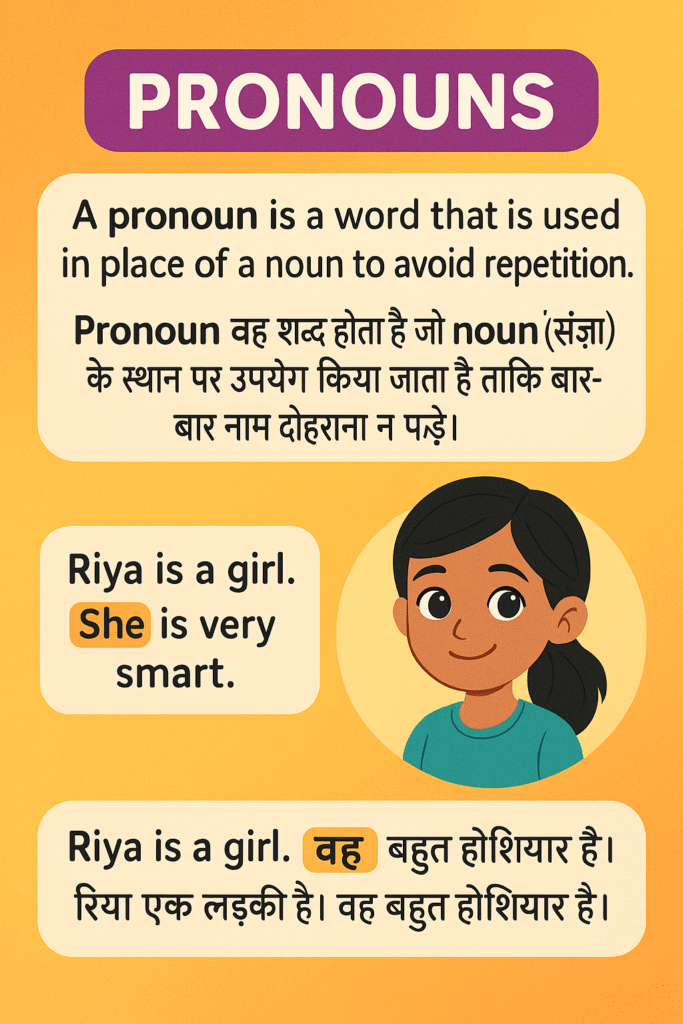
✅ 1. What is a Pronoun? (Pronoun क्या होता है?)

Definition (परिभाषा):
A pronoun is a word that is used in place of a noun to avoid repetition.
Pronoun वह शब्द होता है जो noun (संज्ञा) के स्थान पर उपयोग किया जाता है ताकि बार-बार नाम दोहराना न पड़े।

Example:

  • Riya is a girl. She is very smart.
    रिया एक लड़की है। वह बहुत होशियार है।
    (यहाँ “She” एक pronoun है जो “Riya” की जगह आया है।)


✅ 2. Types of Pronouns (Pronouns के प्रकार)

🔹 Personal Pronouns (व्यक्तिगत सर्वनाम)

  • Refer to a specific person or thing.

  • Examples: I, you, he, she, we, they, it

  • उदाहरण: मैं, तुम, वह, हम, वे

🔹 Reflexive Pronouns (निजवाचक सर्वनाम)

  • Reflect back to the subject.

  • Examples: myself, yourself, himself, herself, itself, ourselves, yourselves, themselves

  • उदाहरण: खुद, स्वयं

  • Example Sentence: She hurt herself. (उसने खुद को चोट पहुँचाई।)

🔹 Demonstrative Pronouns (संकेतवाचक सर्वनाम)

  • Point out specific things.

  • Examples: this, that, these, those

  • उदाहरण: यह, वह, ये, वे

🔹 Interrogative Pronouns (प्रश्नवाचक सर्वनाम)

  • Used for asking questions.

  • Examples: who, what, which, whom

  • उदाहरण: कौन, क्या, कौन सा

🔹 Possessive Pronouns (अधिकारवाचक सर्वनाम)

  • Show ownership.

  • Examples: mine, yours, his, hers, ours, theirs

  • उदाहरण: मेरा, तुम्हारा, उसका, उनका

🔹 Indefinite Pronouns (अनिश्चयवाचक सर्वनाम)

  • Refer to unspecified things or people.

  • Examples: someone, anyone, everything, nothing

  • उदाहरण: कोई, सब कुछ, कुछ नहीं


✅ 3. Pronoun-Antecedent Agreement (सर्वनाम और उसका संबंध)

Explanation:
A pronoun must agree with its antecedent (the noun it replaces) in number and gender.
Pronoun अपने antecedent (जिस noun को रिप्लेस करता है) के gender और number से मेल खाना चाहिए।

Examples:

  • Ravi is hungry. He wants food. (Correct)

  • Ravi is hungry. They wants food. ❌ (Wrong – Ravi is singular)


🤖 4. Using ChatGPT for Pronoun Practice

✅ Prompt Task:

“Explain reflexive pronouns with examples.”
ChatGPT से पूछें: "Reflexive Pronouns को उदाहरण सहित समझाओ।"

ChatGPT देगा:

Reflexive pronouns are words that refer back to the subject.
Examples: myself, himself, herself, itself, ourselves, yourselves, themselves.


✍️ 5. Practice Task (AI Assisted)

  1. Write 5 sentences using different types of pronouns.
    विभिन्न प्रकार के Pronoun का उपयोग करके 5 वाक्य लिखें।

    Examples:

    • I love my dog. (Personal)

    • This is my book. (Demonstrative)

    • She made it herself. (Reflexive)

    • Whom do you want to meet? (Interrogative)

    • That phone is mine. (Possessive)

  2. Copy-paste your sentences into ChatGPT and ask:
    👉 "Which type of pronoun is used in each sentence?"
    👉 "क्या आप मेरे वाक्यों में प्रयुक्त pronoun का प्रकार बता सकते हैं?"


📌 Summary Points (सारांश बिंदु)

  • Pronoun एक ऐसा शब्द है जो noun की जगह आता है।

  • Pronouns के कई प्रकार होते हैं: Personal, Reflexive, Demonstrative, Possessive, आदि।

  • Pronoun का अपने antecedent से मेल होना जरूरी है (जैसे singular-singular, male-he आदि)।

  • ChatGPT से आप pronoun के examples और types की practice कर सकते हैं।

DAY :- 2

🎯 Week ( 3 ) :-  Pronouns + Talking to ChatGPT​

Day :- ( 2 ) :-  Topics Covered:

  • Personal and Reflexive Pronouns – Identification and Usage

✅ 1. Personal Pronouns (व्यक्तिगत सर्वनाम)

🔸 Definition (परिभाषा):

Personal pronouns refer to a specific person or thing.
Personal Pronoun वे शब्द होते हैं जो किसी विशेष व्यक्ति या वस्तु की ओर इशारा करते हैं।

🔸 Forms of Personal Pronouns:

PersonSubject FormObject FormHindi Meaning
First PersonI / Weme / usमैं / हम
Second PersonYouyouतुम / आप
Third PersonHe / She / It / Theyhim / her / it / themवह / वे / इन्हें / उनको

✅ Examples:

  • I am going to school. (मैं स्कूल जा रहा हूँ।)

  • She is my friend. (वह मेरी दोस्त है।)

  • They helped me. (उन्होंने मेरी मदद की।)


✅ 2. Reflexive Pronouns (निजवाचक सर्वनाम)

🔸 Definition (परिभाषा):

Reflexive pronouns are used when the subject and the object are the same.
जब कर्ता (Subject) और कर्म (Object) एक ही व्यक्ति हो, तो Reflexive Pronoun का प्रयोग होता है।

🔸 Reflexive Pronoun List:

  • Myself (मैंने स्वयं)

  • Yourself (तुमने स्वयं)

  • Himself (उसने स्वयं - पुरुष)

  • Herself (उसने स्वयं - स्त्री)

  • Itself (उसने स्वयं - वस्तु/जानवर)

  • Ourselves (हमने स्वयं)

  • Yourselves (आपने स्वयं)

  • Themselves (उन्होंने स्वयं)

✅ Examples:

  • I hurt myself. (मैंने खुद को चोट पहुंचाई।)

  • She prepared the food herself. (उसने खाना खुद बनाया।)

  • They cleaned the room themselves. (उन्होंने कमरा खुद साफ किया।)


🧠 3. How to Identify Personal vs Reflexive Pronoun? (पहचान कैसे करें?)

Pronoun TypeHow Used?Example
Personal PronounReplaces nounHe is a teacher.
Reflexive PronounRefers back to the subjectHe taught himself.

🤖 4. ChatGPT से Practice कैसे करें?

✅ Prompts to Try with ChatGPT:

  • "Give me 5 sentences using personal pronouns."

  • "Explain the difference between personal and reflexive pronouns with examples."

  • "Translate these pronoun sentences into Hindi."

  • "Correct my pronoun sentences: ‘She hurt her.’"


✍️ 5. Practice Task (AI Assisted):

Step 1: नीचे दिए गए वाक्य को पूरा करें:

  1. I made this cake by ____.

  2. She taught ____ to swim.

  3. They enjoyed ____ at the party.

  4. We helped ____ to succeed.

  5. He introduced ____ in the meeting.

Step 2: अपने जवाब ChatGPT को भेजें और पूछें:
👉 “Are these reflexive pronouns used correctly?”
👉 “क्या ये वाक्य reflexive pronoun के अनुसार सही हैं?”


📌 Summary Points (सारांश बिंदु)

  • Personal Pronouns एक व्यक्ति/वस्तु को दर्शाते हैं – जैसे I, we, you, he, she, it, they.

  • Reflexive Pronouns में action करने वाला और action प्राप्त करने वाला एक ही होता है – जैसे myself, yourself, himself, herself, etc.

  • ChatGPT का प्रयोग करके आप pronoun की practice और sentence correction कर सकते हैं।

DAY :- 3

🎯 Week ( 3 ) :-  Pronouns + Talking to ChatGPT​

 Day :- ( 3 ) :- Topics Covered:

  • Demonstrative and Indefinite Pronouns – Usage + Practice with ChatGPT

✅ 1. Demonstrative Pronouns (संकेतवाचक सर्वनाम)

🔸 Definition (परिभाषा):

Demonstrative pronouns point to specific things or people.
Demonstrative Pronoun वे शब्द होते हैं जो किसी विशेष वस्तु या व्यक्ति की ओर इशारा करते हैं।

🔸 Main Words:

  • This (यह – पास की वस्तु/एकवचन)

  • That (वह – दूर की वस्तु/एकवचन)

  • These (ये – पास की चीज़ें/बहुवचन)

  • Those (वे – दूर की चीज़ें/बहुवचन)

✅ Examples:

  • This is my book. (यह मेरी किताब है।)

  • That was a good movie. (वह एक अच्छी फिल्म थी।)

  • These are my friends. (ये मेरे दोस्त हैं।)

  • Those were her shoes. (वे उसके जूते थे।)


✅ 2. Indefinite Pronouns (अनिश्चयवाचक सर्वनाम)

🔸 Definition (परिभाषा):

Indefinite pronouns refer to people or things not specifically known or mentioned.
Indefinite Pronoun वे शब्द होते हैं जो किसी विशेष व्यक्ति या वस्तु का नाम लिए बिना सामान्य रूप में प्रयोग होते हैं।

🔸 Common Indefinite Pronouns:

  • Someone, Anyone, Everyone, No one

  • Something, Anything, Everything, Nothing

  • Each, Few, Many, All, Some

✅ Examples:

  • Someone is knocking at the door. (कोई दरवाज़ा खटखटा रहा है।)

  • Nothing is impossible. (कुछ भी असंभव नहीं है।)

  • Everyone is welcome. (हर कोई स्वागत योग्य है।)

  • All were happy. (सभी खुश थे।)


🧠 3. Difference Between Demonstrative and Indefinite Pronouns

TypeRefers ToExamples
Demonstrative PronounSpecific object or personThis, That, These, Those
Indefinite PronounUnspecific/Unknown things or peopleSomeone, Anyone, Nothing

🤖 4. Practice with ChatGPT – AI Integration

✅ Prompt Ideas (ChatGPT से पूछें):

  • “Give me 5 examples of demonstrative pronouns in sentences.”

  • “Correct this sentence: ‘This are my books.’”

  • “Explain the difference between ‘someone’ and ‘everyone’ with examples.”

  • “Translate: ‘Nothing is permanent.’ into Hindi.”


✍️ 5. Practice Task (AI Assisted Activity)

Step 1: नीचे दिए गए वाक्य को पूरा करें:

  1. _______ is better than that.

  2. I saw _______ in the room.

  3. _______ were waiting outside.

  4. Is there _______ to eat?

  5. _______ is making noise.

Step 2: ChatGPT को यह पूछें:
👉 “Are these pronouns correct?”
👉 “Can you improve my sentences using demonstrative and indefinite pronouns?”


📌 Summary Points (सारांश बिंदु)

  • Demonstrative Pronouns किसी विशेष वस्तु की ओर इशारा करते हैं – this, that, these, those.

  • Indefinite Pronouns किसी अनिश्चित व्यक्ति या वस्तु को दर्शाते हैं – someone, nothing, everything, all, etc.

  • ChatGPT का इस्तेमाल करके आप अलग-अलग वाक्यों में इनका अभ्यास कर सकते हैं।

DAY :- 4

🎯 Week ( 3 ) :-  Pronouns + Talking to ChatGPT​

 Day :- ( 4 ) :- Topics Covered:

  • Interrogative Pronouns and Relative Pronouns – Usage + Practice with ChatGPT

✅ 1. Interrogative Pronouns (प्रश्नवाचक सर्वनाम)

🔸 Definition (परिभाषा):

Interrogative pronouns are used to ask questions.
Interrogative Pronouns वे शब्द होते हैं जो सवाल पूछने के लिए प्रयोग होते हैं।

🔸 Main Interrogative Pronouns:

  • Who (कौन)

  • Whom (किसे/किसको)

  • Whose (किसका)

  • Which (कौन-सा)

  • What (क्या)

✅ Examples:

  • Who is your teacher? (तुम्हारा शिक्षक कौन है?)

  • Whom did you call? (तुमने किसे बुलाया?)

  • Whose book is this? (यह किताब किसकी है?)

  • Which is your bag? (कौन-सा बैग तुम्हारा है?)

  • What is your name? (तुम्हारा नाम क्या है?)


✅ 2. Relative Pronouns (सम्बन्धवाचक सर्वनाम)

🔸 Definition (परिभाषा):

Relative pronouns join two clauses and relate to a noun mentioned before.
Relative Pronouns वे शब्द होते हैं जो दो वाक्यों को जोड़ते हैं और पहले बताए गए noun से संबंध रखते हैं।

🔸 Common Relative Pronouns:

  • Who, Whom, Whose, Which, That

✅ Examples:

  • The girl who won the race is my sister.
    (लड़की जिसने दौड़ जीती, मेरी बहन है।)

  • The book that you gave me is interesting.
    (जो किताब तुमने मुझे दी, वह रोचक है।)

  • He is the boy whose father is a doctor.
    (वह लड़का है जिसका पिता डॉक्टर है।)


🧠 3. Difference Between Interrogative and Relative Pronouns

TypePurposeExamples
Interrogative PronounTo ask questionsWho, What, Whose, Which
Relative PronounTo relate one clause to anotherWho, Which, That, Whose, Whom

🤖 4. Practice with ChatGPT – AI Integration

✅ Prompt Ideas (ChatGPT से पूछें):

  • “Make 5 questions using interrogative pronouns.”

  • “Give sentences with relative pronouns like ‘who’ and ‘that’.”

  • “Correct this sentence: ‘The boy which is running is fast.’”

  • “What is the difference between ‘which’ and ‘that’?”


✍️ 5. Practice Task (AI Assisted Activity)

Step 1: नीचे दिए गए खाली स्थान भरें:

  1. _______ do you want for lunch?

  2. The man _______ helped me was kind.

  3. _______ is at the door?

  4. This is the pen _______ I lost.

  5. _______ bag is this?

Step 2: ChatGPT से पूछें:
👉 “Are these sentences using the right pronouns?”
👉 “Can you help me correct or improve them?”


📌 Summary Points (सारांश बिंदु)

  • Interrogative Pronouns सवाल पूछने के लिए होते हैं – who, what, which, etc.

  • Relative Pronouns दो वाक्यों को जोड़ते हैं – who, whose, that, etc.

  • AI (ChatGPT) से सवाल पूछकर आप Grammar को मजेदार और इंटरैक्टिव बना सकते हैं।

DAY :- 5

🎯 Week ( 3 ) :-  Pronouns + Talking to ChatGPT​

 Day :- ( 5 ) :- Topics Covered:

  • Emphatic Pronouns and Distributive Pronouns – Explanation + Practice with ChatGPT

✅ 1. Emphatic Pronouns (बल देने वाले सर्वनाम)

🔸 Definition (परिभाषा):

Emphatic Pronouns are used to emphasize the subject of the sentence.
Emphatic Pronouns का प्रयोग subject पर ज़ोर देने के लिए किया जाता है।

🔸 Common Emphatic Pronouns:

Myself, Yourself, Himself, Herself, Itself, Ourselves, Yourselves, Themselves

➡️ ये Reflexive Pronouns जैसे ही होते हैं, लेकिन कार्य subject पर जोर देने के लिए होते हैं।

✅ Examples:

  • I myself completed the project.
    (मैंने खुद ही प्रोजेक्ट पूरा किया।)

  • She herself opened the door.
    (उसने खुद दरवाज़ा खोला।)

  • They themselves cleaned the room.
    (उन्होंने खुद कमरा साफ किया।)


✅ 2. Distributive Pronouns (विभाजक सर्वनाम)

🔸 Definition (परिभाषा):

Distributive Pronouns refer to persons or things one at a time.
Distributive Pronouns का प्रयोग व्यक्तियों या वस्तुओं को एक-एक करके व्यक्त करने के लिए होता है।

🔸 Main Distributive Pronouns:

Each, Either, Neither

✅ Examples:

  • Each of the students got a medal.
    (हर छात्र को एक मेडल मिला।)

  • Either of the roads leads to the station.
    (दोनों में से कोई भी सड़क स्टेशन तक जाती है।)

  • Neither of them was present.
    (दोनों में से कोई भी मौजूद नहीं था।)


🔄 3. Difference Between Emphatic and Distributive Pronouns

TypeUseExamples
Emphatic PronounsEmphasis on subjectI myself did it.
Distributive PronounsOne by one referenceEach of them was selected.

🤖 4. Practice with ChatGPT – AI Integration

✅ Prompt Ideas (ChatGPT से पूछें):

  • “Give 5 sentences using emphatic pronouns.”

  • “What is the difference between reflexive and emphatic pronouns?”

  • “Explain distributive pronouns with real-life examples.”

  • “Correct this: ‘Each student have a pen.’”


✍️ 5. Practice Task (AI Assisted Activity)

Step 1: Fill in the blanks – ChatGPT से चेक करें

  1. I ________ will help you.

  2. ________ of the boys was present.

  3. They ________ completed the task.

  4. ________ of the dresses suits you.

  5. She ________ cleaned the kitchen.

Step 2: Ask ChatGPT

  • “Can you verify if my answers are correct?”

  • “Give me feedback on these sentences.”


📌 Summary Points (सारांश बिंदु)

  • Emphatic Pronouns subject पर ज़ोर डालते हैं (Myself, Himself, etc.)

  • Distributive Pronouns एक-एक करके दर्शाते हैं (Each, Either, Neither)

  • ChatGPT से Grammar के सवाल पूछना सीखें – यह अभ्यास को बेहतर बनाता है।

Grammar + ChatGPT Basics MCQs SET (1 to 15)

✅ Week 3 – Pronouns: MCQs (Set of 15) with Answers & Explanations


Q1. Which of the following is a Personal Pronoun?

A) Each
B) He
C) Who
D) This

✅ Answer: B) He
🔍 Explanation:
"He" is used to refer to a person in place of a noun (boy, man, etc.).
"He" एक personal pronoun है जो किसी व्यक्ति (जैसे लड़का) के लिए प्रयोग होता है।


Q2. Which sentence contains a Reflexive Pronoun?

A) She plays the piano.
B) I saw him yesterday.
C) He hurt himself.
D) We are friends.

✅ Answer: C) He hurt himself.
🔍 Explanation:
"himself" reflects the subject "he". It shows the action is done by and to the same person.
"himself" एक reflexive pronoun है जो subject (he) पर वापसी दर्शाता है।


Q3. What is the demonstrative pronoun in the sentence: "This is my bag"?

A) is
B) bag
C) this
D) my

✅ Answer: C) this
🔍 Explanation:
"This" is pointing towards a specific object.
"This" एक demonstrative pronoun है जो किसी विशेष वस्तु की ओर इशारा करता है।


Q4. Choose the correct sentence:

A) She hurt herself.
B) She hurt himself.
C) She hurt itself.
D) She hurt yourself.

✅ Answer: A) She hurt herself.
🔍 Explanation:
Reflexive pronoun "herself" matches the subject "she".
"She" के साथ सही reflexive pronoun "herself" होता है।


Q5. Identify the Emphatic Pronoun:

A) that
B) each
C) myself (used to stress)
D) them

✅ Answer: C) myself
🔍 Explanation:
When "myself" is used to add emphasis (I myself completed the work), it is emphatic.
जब "myself" जोर देने के लिए प्रयोग होता है तो वो emphatic pronoun होता है।


Q6. Which is a Relative Pronoun?

A) that
B) all
C) few
D) mine

✅ Answer: A) that
🔍 Explanation:
"That" connects a clause to a noun.
"That" एक relative pronoun है जो दो विचारों को जोड़ता है।


Q7. Which of the following is not a pronoun?

A) He
B) Tree
C) This
D) Myself

✅ Answer: B) Tree
🔍 Explanation:
"Tree" is a noun, not a pronoun.
"Tree" एक noun है, pronoun नहीं।


Q8. Choose the sentence with a demonstrative pronoun:

A) I like him.
B) This is delicious.
C) He did it.
D) We are dancing.

✅ Answer: B) This is delicious.
🔍 Explanation:
"This" points to a specific thing (food), making it demonstrative.
"This" एक वस्तु की ओर इशारा करता है – यह demonstrative pronoun है।


Q9. ‘Each’ is what type of pronoun?

A) Personal
B) Reflexive
C) Distributive
D) Demonstrative

✅ Answer: C) Distributive
🔍 Explanation:
"Each" refers to individual items in a group, one at a time.
"Each" distributive pronoun है – यह समूह के हर सदस्य को अलग-अलग दर्शाता है।


Q10. Identify the Interrogative Pronoun in the question: "Who is your teacher?"

A) your
B) teacher
C) is
D) who

✅ Answer: D) who
🔍 Explanation:
"Who" is used to ask a question about a person.
"Who" सवाल पूछने के लिए प्रयोग होता है – यह interrogative pronoun है।


Q11. In the sentence “I enjoyed myself,” the word "myself" is:

A) Relative
B) Reflexive
C) Demonstrative
D) Interrogative

✅ Answer: B) Reflexive
🔍 Explanation:
The subject and the object are the same ("I").
"I" और "myself" एक ही व्यक्ति को दर्शाते हैं – reflexive pronoun है।


Q12. Choose the correct reflexive pronoun for “They”:

A) itself
B) themselves
C) himself
D) ourselves

✅ Answer: B) themselves
🔍 Explanation:
"They" के लिए reflexive pronoun "themselves" होता है।
They → Themselves


Q13. Which sentence uses a relative pronoun?

A) The man who called you is my uncle.
B) This is a red book.
C) He himself did it.
D) Whose is this pen?

✅ Answer: A) The man who called you is my uncle.
🔍 Explanation:
"who" connects the man and the action – it's a relative pronoun.
"who" relative pronoun है जो व्यक्ति और उसकी क्रिया को जोड़ता है।


Q14. Which of the following is an Emphatic Pronoun usage?

A) I myself cooked the food.
B) This is my pen.
C) They hurt themselves.
D) Who are you?

✅ Answer: A) I myself cooked the food.
🔍 Explanation:
"myself" is used to emphasize "I".
यहां "myself" जोर देने के लिए प्रयोग हुआ है – emphatic pronoun है।


Q15. “Whom” is used when the pronoun is:

A) Subject
B) Object
C) Possessive
D) Emphatic

✅ Answer: B) Object
🔍 Explanation:
“Whom” is used for the object of the verb.
"Whom" object के लिए प्रयोग होता है, जैसे – Whom did you meet?


REVISION NOTES

📘 Week 3: Revision Notes – Pronouns + Talking to ChatGPT


🔹 1. What is a Pronoun? (Pronoun क्या होता है?)

  • A Pronoun is a word used instead of a noun.
    (Pronoun वह शब्द होता है जो noun के स्थान पर प्रयोग होता है।)

  • Example / उदाहरण:
    Ram is a boy. He is smart.
    (राम एक लड़का है। वह समझदार है।)


🔹 2. Types of Pronouns (Pronoun के प्रकार)

🟢 a. Personal Pronouns (व्यक्तिगत सर्वनाम)

Used to refer to a specific person or thing.
(किसी व्यक्ति या वस्तु के लिए प्रयुक्त होते हैं।)

  • I, You, He, She, It, We, They

🟢 b. Reflexive Pronouns (प्रतिबिंब सर्वनाम)

When the subject and object are the same.
(जब कर्ता और कर्म एक ही हों।)

  • Myself, Yourself, Himself, Herself, Itself, Ourselves, Yourselves, Themselves

  • Example: I hurt myself.

🟢 c. Demonstrative Pronouns (संकेतवाचक सर्वनाम)

Used to point out something.
(किसी वस्तु की ओर इशारा करने के लिए।)

  • This, That, These, Those

  • Example: This is my book.

🟢 d. Interrogative Pronouns (प्रश्नवाचक सर्वनाम)

Used for asking questions.
(प्रश्न पूछने के लिए प्रयोग होते हैं।)

  • Who, Whom, What, Which, Whose

  • Example: Who are you?

🟢 e. Relative Pronouns (सम्बंधवाचक सर्वनाम)

Used to join clauses.
(दो वाक्यांशों को जोड़ने के लिए।)

  • Who, Whose, Whom, Which, That

  • Example: The boy who came here is my friend.


🔹 3. Pronoun-Antecedent Agreement (सर्वनाम और उसका पूर्वगामी)

  • The pronoun must agree with the antecedent (the noun it replaces) in number and gender.
    (Pronoun और Noun में संख्या और लिंग का मेल होना चाहिए।)

  • Example:

    • The girl lost her pen.

    • The boys are doing their homework.


🔹 4. How to Ask Pronoun Examples from ChatGPT? (ChatGPT से Pronoun के उदाहरण कैसे पूछें?)

  • Simple Prompt:
    “Give 5 examples of reflexive pronouns in sentences.”
    (5 reflexive pronouns के उदाहरण वाक्यों में दीजिए।)

  • Or:
    “Explain the difference between personal and reflexive pronouns with examples.”
    (Personal और Reflexive Pronouns में अंतर समझाइए उदाहरणों सहित।)


🧠 Practice Task

Write 5 sentences using different types of pronouns and verify with ChatGPT.
(5 वाक्य लिखें जिनमें अलग-अलग प्रकार के Pronouns हों और उन्हें ChatGPT से चेक कराएं।)

🎯 Topic(4 ):- Verbs + Action Prompts​

DAY :- 1

🎯 Week (4 ):-  Verbs + Action Prompts​

  • Day 1: What is a Verb? Types + Verb Forms + AI Integration – Action Prompts using Verbs

📘 Week 4: Verbs + Action Prompts

🗓️ Day 1: What is a Verb? Types + Verb Forms +AI Integration – Action Prompts using Verbs


🔹 1. What is a Verb? (Verb क्या होता है?)

  • A Verb is a word that shows action or state of being.
    (Verb वह शब्द होता है जो काम (क्रिया) या अवस्था को दर्शाता है।)

  • Example:

    • Ram runs fast. (राम तेज़ दौड़ता है।)

    • She is happy. (वह खुश है।)


🔹 2. Types of Verbs (Verbs के प्रकार)

🟢 A. Action Verbs (क्रिया करने वाले शब्द)

  • Show physical or mental action.
    (जो किसी कार्य को दिखाते हैं।)

  • Examples: run, eat, jump, think, write
    (दौड़ना, खाना, कूदना, सोचना, लिखना)

🟢 B. Helping Verbs (सहायक क्रिया)

  • Help the main verb to show tense, mood, voice etc.
    (मुख्य क्रिया की सहायता करते हैं।)

  • Examples: is, am, are, was, were, have, has, had, do, does, did, will, shall

🟢 C. Linking Verbs (जोड़ने वाली क्रिया)

  • Link subject to information about the subject.
    (Subject को उसके बारे में जानकारी से जोड़ते हैं।)

  • Examples: is, are, was, become, seem

    • She is a teacher.

    • He became famous.


🔹 3. Verb Forms (क्रिया के रूप)

Verb FormNameHindi ExampleEnglish Example
V1Base formजाना (go)go
V2Past tenseगया (went)went
V3Past participleगया था (gone)gone
  • Example Set:

    • V1 = eat, V2 = ate, V3 = eaten

    • V1 = write, V2 = wrote, V3 = written


🔹 4. AI Integration – Action Prompts using Verbs

✅ Prompt Task:

“Make a story using 5 action verbs.”
(5 action verbs का उपयोग करके एक कहानी बनाइए।)

🧠 Example Output from ChatGPT:

The boy ran to the market, bought fruits, jumped in joy, shared them with friends, and laughed loudly.

✅ Practice:

Create 3 prompts using action verbs and ask ChatGPT to continue the story.

📌 Examples:

  • “Write a short story where a cat climbs, sleeps, eats, plays, and runs.”

  • “Describe a morning routine using 5 action verbs.”

  • “Make a poem with action verbs like swim, dance, fly.”


📝 Summary Points (सारांश)

  • Verb = Action or State

  • Types = Action, Helping, Linking

  • Verb Forms = V1 (Base), V2 (Past), V3 (Past Participle)

  • AI Prompt Practice: Use action verbs to create stories and tasks


DAY :- 2

🎯 Week (4 ):-  Verbs + Action Prompts​

  • Day 2: Transitive & Intransitive Verbs + Using AI to Check Sentence Types

🔹 1. What is a Transitive Verb? (Transitive Verb क्या होता है?)

  • A Transitive Verb requires a direct object to complete its meaning.
    (Transitive Verb को अपना अर्थ पूरा करने के लिए object की आवश्यकता होती है।)

📌 Formula: Subject + Verb + Object

🧠 Examples:

  • He kicked the ball. (उसने गेंद को मारा।) → "ball" is the object

  • She reads a book. (वह किताब पढ़ती है।) → "book" is the object


🔹 2. What is an Intransitive Verb? (Intransitive Verb क्या होता है?)

  • An Intransitive Verb does not need an object.
    (Intransitive Verb को कोई object नहीं चाहिए।)

📌 Formula: Subject + Verb

🧠 Examples:

  • The baby cried. (बच्चा रोया।)

  • They slept peacefully. (वे शांति से सोए।)


🔍 How to Identify the Difference? (कैसे पहचानें?)

  • Transitive: Ask “what?” or “whom?” after the verb. If you get an answer → it's transitive.

    • Example: He plays what? → football ✅ (transitive)

  • Intransitive: No answer to “what?” or “whom?”

    • Example: He runs → runs what? ❌ (no object = intransitive)


🧠 Table Summary:

Verb TypeObject NeededExample Sentence
Transitive✅ YesI ate an apple.
Intransitive❌ NoHe sleeps peacefully.

🤖 AI Prompt Integration:

✅ Prompt Task:

“Tell me whether this sentence has a transitive or intransitive verb: ‘The boy sang a song.’”
(ChatGPT से पूछें कि वाक्य में verb transitive है या intransitive)

🧠 More Prompts to Try:

  • “Classify the verbs in these sentences: ‘She smiled. He wrote a letter.’”

  • “Is ‘jump’ transitive or intransitive in this sentence: ‘She jumped high’?”

  • “Give me 3 transitive and 3 intransitive verb examples.”


✍️ Practice Task:

Write 5 sentences — 3 with transitive verbs and 2 with intransitive verbs.
Then ask ChatGPT:
“Which verbs are transitive and which are intransitive in my sentences?”

📌 Example Sentences:

  1. I watched a movie. ✅

  2. They danced. ❌

  3. She made a cake. ✅

  4. He cried. ❌

  5. We cleaned the room. ✅


📌 Summary Points (सारांश)

  • Transitive Verbs need an object (e.g., eat an apple)

  • Intransitive Verbs do not need an object (e.g., sleep, cry)

  • Use AI (ChatGPT) to verify verb types in your sentences

  • Practice by writing mixed verb sentences and checking them


DAY :- 3

🎯 Week (4 ):-  Verbs + Action Prompts​

  • Day 3: Helping Verbs + AI से Grammar Check

🔹 1. What is a Helping Verb?

Helping Verbs (Auxiliary Verbs) वे verbs होती हैं जो main verb की मदद करती हैं वाक्य के समय (tense), सवाल (question), या स्थिति (possibility) को बताने में।

🧠 English में मुख्य Helping Verbs:

  • Be verbs: is, am, are, was, were, be, being, been

  • Have verbs: has, have, had

  • Do verbs: do, does, did

  • Modals: can, could, will, would, shall, should, may, might, must


🔹 2. Helping Verb + Main Verb का Structure

📌 Formula:
Helping Verb + Main Verb

🧠 Examples:

  • She is playing. (वह खेल रही है।)

  • I have eaten. (मैं खा चुका हूँ।)

  • They will go. (वे जाएंगे।)

  • He does work hard. (वह सच में मेहनत करता है।)


🔍 Why Helping Verbs are Important?

  • Tense बनाने में मदद करते हैं:

    • I am reading. (Present continuous)

    • She was cooking. (Past continuous)

  • Questions बनाने में:

    • Do you like apples?

    • Have you seen the movie?

  • Negative sentences में:

    • He does not sing well.

    • We have not completed the task.


🤖 AI Prompt Integration:

✅ Prompt Task:

“Check this sentence for helping verb usage: ‘She has finished her homework.’”
(ChatGPT से पूछें कि helping verb का प्रयोग सही है या नहीं।)

🧠 More AI Prompts:

  • “List 5 sentences using helping verbs.”

  • “Correct this sentence using proper helping verb: ‘He do play cricket.’”

  • “Make 3 negative sentences with ‘has/have’ as helping verbs.”

  • “Which helping verb is used in this sentence: ‘I will be dancing.’?”


✍️ Practice Task:

  1. Write 5 sentences using helping verbs (is, have, will, do etc.)

  2. Ask ChatGPT:
    “Are my helping verbs correct in these sentences?”

📌 Example Sentences:

  • I am eating food.

  • He does not like tea.

  • They will arrive soon.

  • She has gone to school.

  • We were playing outside.


📌 Summary Points (सारांश)

  • Helping verbs main verb की सहायता करते हैं

  • मुख्य helping verbs: is, am, are, was, have, do, can, must, etc.

  • ये tense, question और negative sentence बनाने में मदद करते हैं

  • ChatGPT से sentences की grammar check कर सकते हैं

  • Practice करके accuracy बढ़ाएं


DAY :- 4

🎯 Week (4 ):-  Verbs + Action Prompts​

  • Day 4: Linking Verbs + ChatGPT से पहचान करना सीखो

🔹 1. What is a Linking Verb?

Linking Verbs वे verbs होती हैं जो subject को उसके बारे में जानकारी (description, condition या identity) से जोड़ती हैं।
ये action नहीं दिखातीं, बल्कि स्थिति या पहचान को दर्शाती हैं।

🧠 Common Linking Verbs:

  • is, am, are, was, were

  • be, being, been

  • become, seem, appear, feel, look, sound, taste, smell


🔍 Examples:

SentenceExplanation (हिंदी में)
She is a doctor."is" subject (She) को "doctor" से जोड़ रहा है – action नहीं है।
The soup smells delicious."smells" खाने की स्थिति (delicious) को subject से जोड़ता है।
You seem tired today."seem" subject की हालत बता रहा है।

🧠 ये verbs “state of being” या “condition” बताते हैं, न कि कोई काम (action)।


🔄 Linking vs Action Verbs

कुछ verbs दोनों roles में हो सकती हैं:

VerbLinking ExampleAction Example
LookYou look happy.He looked at the clock.
SmellFlowers smell good.She smelled the perfume.

👉 समझने के लिए देखें कि verb के बाद क्या आ रहा है:

  • अगर adjective (e.g. happy, tired) है → linking verb

  • अगर object (e.g. book, door) है → action verb


🤖 AI Prompt Integration:

✅ Prompt Task:

“Tell me if ‘feel’ is a linking verb or action verb in this sentence: ‘I feel sick.’”
(ChatGPT से पूछें कि ये sentence में “feel” linking verb है या नहीं।)

🧠 More Prompts:

  • “List 5 linking verbs.”

  • “Differentiate between action and linking verbs with examples.”

  • “Correct this sentence: ‘He feels the cake.’”

  • “Check if the verb in this sentence is linking: ‘She appears confused.’”


✍️ Practice Task:

  1. Write 5 sentences using linking verbs.

  2. Ask ChatGPT:
    “Are these verbs linking verbs or action verbs?”

📌 Example Sentences:

  • He is smart.

  • She looks angry.

  • I am tired.

  • They were excited.

  • It seems difficult.


📌 Summary Points (सारांश)

  • Linking verbs subject को उसकी स्थिति या पहचान से जोड़ते हैं

  • ये कोई action नहीं दिखाते

  • Common linking verbs: is, seem, look, feel, become

  • ChatGPT से linking और action verbs में फर्क पूछ सकते हैं

  • Practice से पहचान और sentence clarity बढ़ेगी

DAY :- 5

🎯 Week (4 ):-  Verbs + Action Prompts​

  • Day 5: Helping Verbs (Auxiliary Verbs) + AI Sentence Creation

🔹 1. What are Helping Verbs?

Helping Verbs (या Auxiliary Verbs) वे verbs होती हैं जो main verb के साथ मिलकर tense, voice, mood आदि को स्पष्ट करती हैं।

🧠 Helping verbs अकेले कोई complete action नहीं दिखाते। ये main verb को support करते हैं।


🔹 Common Helping Verbs:

Primary Helping VerbsModal Helping Verbs
is, am, are, was, were, be, been, beingcan, could, shall, should, will, would, may, might, must

🔍 Examples:

SentenceExplanation (हिंदी में)
She is running."is" helping verb है, जो "running" (main verb) को support कर रहा है।
We have finished the work."have" helping verb है, जो past action को दिखा रहा है।
He can swim."can" modal verb है, जो ability दिखा रहा है।

🔁 Helping Verbs के काम:

  • Tense बनाना (She is eating.)

  • Passive voice में मदद करना (The food was cooked.)

  • Possibility या permission बताना (You may go.)

  • Future या obligation बताना (You should study.)


🔎 Helping vs Main Verb:

Helping VerbMain VerbSentence
iseatingShe is eating dinner.
havedoneThey have done their homework.
willgoI will go to the market.

👉 Main verb के बिना helping verb अधूरा होता है।


🤖 AI Integration: Make Sentences using Helping Verbs

✅ Prompt Task:

“Give 5 sentences using helping verbs with main verbs.”
(ChatGPT से sentence generation करवाएं)

🔹 More Prompts:

  • “Create one sentence using ‘may’ as a helping verb.”

  • “Tell me the helping verb in the sentence: ‘She has gone home.’”

  • “Correct this: ‘He can to go.’”

  • “List 10 helping verbs.”


✍️ Practice Task:

  1. Write 5 sentences using helping verbs + main verbs.

  2. Ask ChatGPT:
    “Check if my helping verbs are used correctly.”

📌 Example Sentences:

  • I am reading a book.

  • She was sleeping.

  • They should arrive soon.

  • We will meet tomorrow.

  • He has eaten already.


📌 Summary Points (सारांश):

  • Helping Verbs main verb को support करते हैं

  • दो प्रकार होते हैं: Primary और Modal

  • Sentence का tense, mood, या voice दर्शाते हैं

  • अकेले Helping Verb sentence को पूरा नहीं बना सकते

  • ChatGPT से Helping Verb practice करके clarity पा सकते हैं

DAY :- 6

🎯 Week (4 ):-  Verbs + Action Prompts​

  • Day 6: Integrated Practice + Creative Verb Prompts via AI

🔹 1. Quick Revision – Verb Concepts

📌 Verb क्या है?
Verb वह शब्द होता है जो किसी क्रिया, कार्य या स्थिति को दर्शाता है।

📌 Types of Verbs:

  • Action Verbs – (Run, Eat, Laugh) → क्रिया को दिखाते हैं

  • Helping Verbs – (is, am, was, have, will) → Main verb की सहायता करते हैं

  • Linking Verbs – (is, seem, become) → Subject को description से जोड़ते हैं

📌 Verb Forms:

  • V1 (base): eat

  • V2 (past): ate

  • V3 (past participle): eaten


🔍 Examples Recap:

TypeSentenceHindi Explanation
ActionShe runs fast.वह तेज दौड़ती है।
HelpingThey have finished homework.उन्होंने काम पूरा कर लिया है।
LinkingHe is happy.वह खुश है।

🔹 2. Practice Activity with ChatGPT

🔸 Task 1: Verb Correction Prompt

🧠 Ask ChatGPT:
“Check if these verbs are correct: He go to school, She playing, They was happy.”

➡ AI Response में ChatGPT गलत verbs को highlight करेगा और सही version बताएगा।


🔸 Task 2: Verb Story Generator

✍️ Create a prompt:
“Write a short story using these 5 verbs: jump, fly, cook, sing, write.”

📚 Example Output:
"Rani jumped over a puddle, then she flew a kite. After that, she cooked lunch, sang a song, and wrote in her diary."


🔹 3. DIY Practice (खुद से अभ्यास)

👉 Students create 3 creative prompts using verbs:

  • “Make a poem using 3 action verbs.”

  • “Tell a joke using helping verbs.”

  • “Create a dialogue using linking verbs.”

Ask ChatGPT to complete them.
फिर ChatGPT से पूछें:
“Which verbs did you use in the response?”


🔹 4. Peer Activity (AI Buddy Work)

📌 Task:
Each student writes 3 sentences –

  • 1 Action Verb

  • 1 Helping Verb

  • 1 Linking Verb

Then ask a friend (or ChatGPT) to identify the verb type.


🔹 5. Bonus Prompts for Fun Learning

  • “Give me 5 verbs used in sports.”

  • “Create a riddle where the answer is a verb.”

  • “Explain the difference between ‘has eaten’ and ‘eats’ with examples.”


📌 Summary Points (सारांश):

  • Verb एक fundamental grammar topic है जो हर sentence में होता है

  • Verbs को पहचानने और classify करने की practice करनी जरूरी है

  • ChatGPT से interaction करके grammar naturally improve होती है

  • Action + Helping + Linking Verb को मिलाकर creative sentences बनाए जा सकते हैं

  • AI से error-checking और fun learning करना students को motivate करता है

Grammar + ChatGPT Basics MCQs SET (1 to 15)

📝 Week 4: Verbs – MCQs (Set of 15)

Topics Covered:

  • What is a Verb?
  • Types of Verbs: Action, Helping, Linking
  • Verb Forms (V1, V2, V3)
  • Usage in Prompts / Sentences

1. Which of the following is an Action Verb?

A. Is
B. Run
C. Has
D. Was

✅ Answer: B. Run
Explanation (Hindi):
'Run' एक Action Verb है जो क्रिया को दर्शाता है (दौड़ना)। बाकी options Helping या Linking Verbs हैं।
Explanation (English):
‘Run’ shows physical activity, so it is an Action Verb. Others are helping verbs.


2. Identify the Helping Verb in the sentence: "She has finished her work."

A. Finished
B. Has
C. Work
D. Her

✅ Answer: B. Has
Explanation (Hindi):
'Has' एक Helping Verb है जो main verb 'finished' को मदद दे रहा है।
Explanation (English):
‘Has’ helps the main verb ‘finished’ in forming present perfect tense.


3. Choose the correct V2 form of the verb 'go'.

A. Goes
B. Gone
C. Went
D. Going

✅ Answer: C. Went
Explanation (Hindi):
'Go' का V2 (past tense) रूप 'Went' होता है।
Explanation (English):
The past tense (V2) of 'go' is 'went'.


4. Which of the following is a Linking Verb?

A. Eat
B. Sing
C. Become
D. Dance

✅ Answer: C. Become
Explanation (Hindi):
‘Become’ subject को उसके state या identity से जोड़ता है, इसलिए यह Linking Verb है।
Explanation (English):
‘Become’ links the subject to a state or identity, so it’s a linking verb.


5. "They are playing football." – What is the Helping Verb?

A. Football
B. Playing
C. Are
D. They

✅ Answer: C. Are
Explanation (Hindi):
'Are' एक Helping Verb है जो 'playing' के साथ continuous tense बना रहा है।
Explanation (English):
‘Are’ is the helping verb that forms the present continuous tense with ‘playing’.


6. Which sentence uses a Verb in Past Tense?

A. I write a letter.
B. She wrote a letter.
C. They are writing a letter.
D. He writes letters.

✅ Answer: B. She wrote a letter.
Explanation (Hindi):
'Wrote' verb का past form है।
Explanation (English):
‘Wrote’ is the past tense (V2) of the verb ‘write’.


7. What is the base form (V1) of the verb 'eaten'?

A. Ate
B. Eating
C. Eaten
D. Eat

✅ Answer: D. Eat
Explanation (Hindi):
'Eat' verb का base form (V1) है।
Explanation (English):
‘Eat’ is the root/base form of the verb. 'Eaten' is V3.


8. Identify the action verb in: "Ravi sings beautifully."

A. Beautifully
B. Sings
C. Ravi
D. None

✅ Answer: B. Sings
Explanation (Hindi):
'Sings' एक Action Verb है क्योंकि यह क्रिया दिखा रहा है।
Explanation (English):
‘Sings’ shows the action performed by Ravi.


9. Which sentence contains a Linking Verb?

A. He became a teacher.
B. They danced well.
C. She bought a car.
D. I saw a movie.

✅ Answer: A. He became a teacher.
Explanation (Hindi):
'Became' subject को identity से जोड़ता है → Linking Verb।
Explanation (English):
‘Became’ links ‘He’ to ‘a teacher’, hence it’s a linking verb.


10. What is the V3 form of 'write'?

A. Writes
B. Written
C. Wrote
D. Writing

✅ Answer: B. Written
Explanation (Hindi):
'Write' का third form (V3) 'Written' होता है।
Explanation (English):
The past participle of ‘write’ is ‘written’.


11. "Am", "Is", "Are" are types of —

A. Action Verbs
B. Modal Verbs
C. Helping Verbs
D. Passive Verbs

✅ Answer: C. Helping Verbs
Explanation (Hindi):
'Am, Is, Are' tense को बनाने में मदद करते हैं, इसलिए ये Helping Verbs हैं।
Explanation (English):
These verbs assist main verbs in forming tense.


12. Which one is NOT a verb?

A. Cook
B. Dance
C. Quickly
D. Eat

✅ Answer: C. Quickly
Explanation (Hindi):
'Quickly' एक adverb है, verb नहीं।
Explanation (English):
‘Quickly’ describes how an action is done; it’s an adverb.


13. Which is correct for future tense using Helping Verb?

A. He will go.
B. He gone.
C. He going.
D. He go.

✅ Answer: A. He will go.
Explanation (Hindi):
‘Will’ एक Helping Verb है जो future tense बनाता है।
Explanation (English):
‘Will’ helps indicate the future action.


14. Choose the verb in the sentence: "She reads every day."

A. She
B. Every
C. Day
D. Reads

✅ Answer: D. Reads
Explanation (Hindi):
‘Reads’ क्रिया को दिखाता है → Verb।
Explanation (English):
‘Reads’ is the verb showing the action.


15. “He has written a letter.” – What type of verb is 'has'?

A. Action Verb
B. Modal Verb
C. Helping Verb
D. Linking Verb

✅ Answer: C. Helping Verb
Explanation (Hindi):
'Has' main verb 'written' की मदद कर रहा है → Helping Verb
Explanation (English):
‘Has’ helps the main verb 'written' form present perfect tense.

REVISION NOTES

🔹 Week 4 – Revision Notes

Chapter Title: Verbs + Action Prompts
विषय: क्रिया और एक्शन प्रोम्प्ट


🔸 1. What is a Verb? | क्रिया क्या है?

  • A verb is a word that shows action, state, or being.
    क्रिया वह शब्द है जो किसी कार्य, स्थिति, या अवस्था को दर्शाता है।

  • Examples:
    Eat (खाना), Run (दौड़ना), Is (है), Think (सोचना)


🔸 2. Types of Verbs | क्रियाओं के प्रकार

🔹 (i) Action Verbs | क्रिया दर्शाने वाली क्रियाएँ

  • These show what the subject does.
    यह बताती हैं कि कर्ता क्या कर रहा है।

  • Example:
    He runs fast. (वह तेज़ दौड़ता है।)

🔹 (ii) Helping Verbs | सहायक क्रियाएँ

  • These verbs help the main verb.
    ये मुख्य क्रिया की मदद करती हैं।

  • Common helping verbs: is, am, are, was, were, will, has, have, do, did
    उदाहरण: He is running. (वह दौड़ रहा है।)

🔹 (iii) Linking Verbs | जोड़ने वाली क्रियाएँ

  • These connect the subject to a subject complement (like identity or condition).
    यह कर्ता को उसकी पहचान या स्थिति से जोड़ती है।

  • Examples: is, are, was, become, seem
    उदाहरण: She is happy. (वह खुश है।)


🔸 3. Verb Forms (V1, V2, V3) | क्रिया के रूप

Verb Formनामउदाहरण
V1Base FormGo
V2Past TenseWent
V3Past ParticipleGone
  • Example:
    I go to school. → I went to school. → I have gone to school.
    (मैं स्कूल जाता हूँ → मैं स्कूल गया → मैं स्कूल गया हूँ।)


🔸 4. Regular and Irregular Verbs | नियमित और अनियमित क्रिया

  • Regular Verbs: Follow the rule of adding “-ed” in past.
    उदाहरण: walk → walked → walked

  • Irregular Verbs: Do not follow the rule.
    उदाहरण: go → went → gone


🔸 5. Using Verbs with AI | ChatGPT में क्रिया कैसे प्रयोग करें

  • आप क्रियाओं का प्रयोग कर सकते हैं कहानी या क्रिया आधारित कार्य पूछने के लिए।

✅ Prompt Examples:

  • "Make a short story using 5 action verbs."

  • "Create a sentence with 'jump' in past tense."

  • "Tell me the V2 and V3 form of 'write'."


🔸 6. Practice Task Review | अभ्यास दोहराव

  • Students wrote 5 action-based prompts for ChatGPT.

  • They observed how ChatGPT used verbs creatively in storytelling.


✨ Summary Points | सारांश बिंदु

  • Verb is the heart of a sentence.

  • Verbs can be Action, Helping, or Linking.

  • Verb Forms: V1, V2, V3 must be remembered.

  • Use action verbs with AI prompts to generate creative writing.

  • Regular verbs end in -ed, irregular verbs do not follow fixed rules.

🎯 Topic( 5 ):- Adjectives + Descriptive Prompts ​

DAY :- 1

🎯 Week ( 5 ):-  Adjectives + Descriptive Prompts ​

 Day :- ( 1 ) Topics Covered:

  1. What is an Adjective? | विशेषण क्या है?
  2. Types of Adjectives | विशेषण के प्रकार
  3. Examples and Practice Sentences | उदाहरण और अभ्यास
  4. AI Prompt Practice | ChatGPT के साथ अभ्यास
  5. Daily Revision & Flashcard Summary

📍 Topics Covered Today

  1. What is an Adjective? | विशेषण क्या है?

  2. Types of Adjectives | विशेषण के प्रकार

  3. Examples and Practice Sentences | उदाहरण और अभ्यास

  4. AI Prompt Practice | ChatGPT के साथ अभ्यास

  5. Daily Revision & Flashcard Summary


🔹 1. What is an Adjective?

An adjective is a word that describes or qualifies a noun or pronoun.
Adjective वह शब्द होता है जो संज्ञा या सर्वनाम की विशेषता बताता है।

📌 Example:

  • She has a beautiful dress.
    (उसके पास एक सुंदर ड्रेस है।)


🔹 2. Types of Adjectives | विशेषण के प्रकार

✅ (i) Adjective of Quality (गुणवाचक विशेषण)

Describes the quality or nature of a noun.
उदाहरण: honest, tall, smart

  • He is a brave boy. (वह एक बहादुर लड़का है।)


✅ (ii) Adjective of Quantity (परिमाणवाचक विशेषण)

Describes how much of something.
उदाहरण: some, much, little

  • She drank some milk. (उसने थोड़ा दूध पिया।)


✅ (iii) Adjective of Number (संख्यावाचक विशेषण)

Describes how many or in what order.
उदाहरण: one, two, first, second

  • He has two dogs. (उसके पास दो कुत्ते हैं।)


✅ (iv) Demonstrative Adjective (संकेतवाचक विशेषण)

Points to a specific thing.
उदाहरण: this, that, these, those

  • That house is big. (वह घर बड़ा है।)


🔸 3. Examples and Practice Sentences

  1. I saw a red balloon. (Adjective of Quality)

  2. He has many books. (Adjective of Quantity)

  3. These flowers are fresh. (Demonstrative Adjective)

  4. I ate three mangoes. (Adjective of Number)


🔸 4. AI Prompt Practice (with ChatGPT)

🧠 Prompt Task:
"Describe a beautiful park using 5 adjectives."

📌 Example ChatGPT Output:

"The park was green, peaceful, clean, wide, and colorful."

🎯 Student Practice:

  • Ask ChatGPT:
    “Describe your school using 4 adjectives.”
    “What are 3 adjectives for a scary movie?”
    “Give 5 adjectives for your best friend.”


📝 5. Daily Revision Summary (Flashcard Style)

  • Adjective = Describing word

  • Types: Quality, Quantity, Number, Demonstrative

  • Examples: beautiful, much, three, this

  • Use adjectives with nouns/pronouns

  • AI Practice: Use prompts to describe places, people, or things.


✅ Homework / Practice Work:

  1. Write 5 sentences using different types of adjectives.

  2. Ask ChatGPT:
    “Describe your favorite food with adjectives.”

DAY :- 2

🎯 Week ( 5 ):-  Adjectives + Descriptive Prompts ​

 Day :- ( 2 ) Topics Covered:

  1. What are Degrees of Comparison? | तुलना की तीन अवस्थाएं क्या होती हैं?
  2. Positive, Comparative, and Superlative Degrees
  3. Rules and Examples | नियम और उदाहरण
  4. AI Prompt Task
  5. Daily Revision & Flash Summary

📍 Topics Covered Today

  1. What are Degrees of Comparison? | तुलना की तीन अवस्थाएं क्या होती हैं?

  2. Positive, Comparative, and Superlative Degrees

  3. Rules and Examples | नियम और उदाहरण

  4. AI Prompt Task

  5. Daily Revision & Flash Summary


🔹 1. What are Degrees of Comparison?

Adjectives change form to show comparison between two or more things. These are called Degrees of Comparison.
Adjective के रूप बदल कर जब हम तुलना करते हैं, उसे Degrees of Comparison कहते हैं।


🔹 2. तीन प्रकार | Types of Comparison

✅ (i) Positive Degree (साधारण अवस्था)

👉 Used when no comparison is made.
📌 Example:

  • He is tall.
    (वह लंबा है।)


✅ (ii) Comparative Degree (तुलनात्मक अवस्था)

👉 Used when two things or persons are compared.
📌 Example:

  • He is taller than his brother.
    (वह अपने भाई से लंबा है।)


✅ (iii) Superlative Degree (सर्वाधिक अवस्था)

👉 Used when more than two things are compared.
📌 Example:

  • He is the tallest boy in the class.
    (वह कक्षा में सबसे लंबा लड़का है।)


🔸 3. Rules for Forming Comparatives & Superlatives

➤ One-syllable adjectives:

Add -er and -est

  • Tall → Taller → Tallest

  • Small → Smaller → Smallest

➤ Adjectives ending in 'y':

Change 'y' to 'i' and add -er/-est

  • Happy → Happier → Happiest

  • Busy → Busier → Busiest

➤ Long adjectives (2+ syllables):

Use more and most

  • Beautiful → More beautiful → Most beautiful

  • Important → More important → Most important


🔸 4. Practice Sentences (Examples)

  1. This road is long. (Positive)

  2. That road is longer than this one. (Comparative)

  3. This is the longest road in the city. (Superlative)

  4. She is smart.

  5. He is smarter than her.

  6. Riya is the smartest girl in the class.


🤖 5. AI Prompt Practice (ChatGPT Task)

🧠 Prompt:
“Write three sentences using tall, taller, and tallest.”

📌 Example ChatGPT Output:

"My brother is tall. My father is taller. But my uncle is the tallest."

🎯 Student Practice Prompts:

  • “Compare ‘happy’ using all degrees.”

  • “Make 3 sentences using fast, faster, fastest.”

  • “What is the comparative and superlative form of ‘good’?”


📝 6. Flashcard Summary (Revision)

  • Positive: No comparison (e.g. clean)

  • Comparative: Two compared (e.g. cleaner)

  • Superlative: More than two (e.g. cleanest)

  • Use ‘more/most’ for long words

  • Irregular Examples:

    • Good → Better → Best

    • Bad → Worse → Worst


✅ Homework / Practice Work:

  1. Write 5 sets of adjectives in all three degrees.

  2. Use ChatGPT to make a comparison story using any 3 adjectives.

DAY :- 3

🎯 Week ( 5 ):-  Adjectives + Descriptive Prompts ​

 Day :- ( 3 ) Topics Covered:

  1. Describing People with Adjectives | व्यक्तियों का वर्णन
  2. Describing Places with Adjectives | स्थानों का वर्णन
  3. Describing Things with Adjectives | वस्तुओं का वर्णन
  4. Adjective Position Rules
  5. AI Prompt Practice: Descriptive Writing
  6. Flashcard-Style Summary

🔹 1. Describing People with Adjectives

Adjectives help us describe someone’s appearance, personality, or behavior.
Adjectives का उपयोग हम किसी व्यक्ति के रूप, स्वभाव या चाल-ढाल को बताने में करते हैं।

🧾 Examples:

  • She is a kind girl. (Personality)

  • He has brown eyes. (Appearance)

  • They are honest workers. (Behavior)

📌 Common Adjectives for People:

  • Beautiful, tall, friendly, rude, intelligent, lazy, brave, polite


🔹 2. Describing Places with Adjectives

We describe a place by its size, beauty, noise, or environment.
हम किसी स्थान को उसके आकार, सुंदरता, शांति या वातावरण के अनुसार बताते हैं।

🧾 Examples:

  • It’s a quiet village.

  • The park was green and peaceful.

  • This is a famous historical place.

📌 Useful Adjectives:

  • Crowded, peaceful, noisy, spacious, ancient, modern, clean


🔹 3. Describing Things with Adjectives

We describe objects by their shape, size, color, use, or material.
किसी वस्तु को हम उसके रंग, आकार, उपयोग या सामग्री से पहचानते हैं।

🧾 Examples:

  • I have a round table.

  • This is a blue bottle.

  • That’s a wooden chair.

📌 Common Adjectives:

  • Large, soft, smooth, colorful, plastic, shiny, old, new


🔸 4. Adjective Position Rules (Adjective कहाँ आता है?)

🔹 Adjective usually comes before a noun:
👉 She has a sweet voice.
👉 He bought a new phone.

🔹 Sometimes comes after verbs like 'is', 'are', 'was':
👉 The sky is blue.
👉 You are kind.


🤖 5. AI Prompt Practice – Descriptive Writing

🧠 Prompt Task:
“Describe your best friend using 5 adjectives.”

💬 Example ChatGPT Output:

My best friend is funny, helpful, kind, honest, and smart.

🧠 Prompt 2:
“Describe your favorite place using adjectives.”

My favorite place is a quiet, green, and beautiful park with fresh air and soft grass.

🎯 Student Practice Prompts:

  • “Describe your school bag using 3 adjectives.”

  • “Describe your classroom using 5 adjectives.”

  • “Make ChatGPT describe a magical place using adjectives.”


📝 6. Flashcard Summary (Revision)

  • Adjectives describe people, places, and things.

  • They tell about quality, color, size, shape, behavior, etc.

  • Placement: Before nouns (a tall boy), after verbs (He is tall)

  • Use AI to write descriptive sentences and stories.


📚 Homework / Practice Work:

  1. Write 2 sentences each for describing a person, a place, and a thing.

  2. Use ChatGPT to describe your dream house with 5+ adjectives.

DAY :- 4

🎯 Week ( 5 ):-  Adjectives + Descriptive Prompts ​

Day :- ( 4 ) Topics Covered:

  1. What is the correct order of adjectives? | Adjective का सही क्रम क्या होता है?
  2. Using Multiple Adjectives in a Sentence
  3. Adjective Order Formula
  4. Examples and AI Prompt Practice
  5. Flashcard-Style Summary

🔹 1. What is the Order of Adjectives?

जब एक से ज़्यादा adjectives एक ही noun को describe करते हैं, तो उनका एक सही क्रम (correct order) होता है।
When more than one adjective describes the same noun, they follow a specific order.


🔸 2. Adjective Order Formula:

👉 Opinion ➝ Size ➝ Age ➝ Shape ➝ Color ➝ Origin ➝ Material ➝ Purpose + Noun

📌 Hindi Explanation:
राय ➝ आकार ➝ उम्र ➝ आकृति ➝ रंग ➝ उत्पत्ति ➝ सामग्री ➝ उद्देश्य + संज्ञा


🔸 3. Examples Based on Order:

  1. A beautiful small old round red Indian wooden cooking table
    ➤ Opinion = beautiful
    ➤ Size = small
    ➤ Age = old
    ➤ Shape = round
    ➤ Color = red
    ➤ Origin = Indian
    ➤ Material = wooden
    ➤ Purpose = cooking
    ➤ Noun = table

  2. An interesting big young American singer
    ➤ Opinion = interesting
    ➤ Size = big
    ➤ Age = young
    ➤ Origin = American
    ➤ Noun = singer

  3. ❌ Wrong: A red beautiful bag
    ✅ Correct: A beautiful red bag


🔸 4. AI Prompt Practice (Multiple Adjective Writing)

🧠 Prompt Task 1:
"Describe a magical creature using 6 adjectives in correct order."
Example Answer from AI:

A friendly large ancient blue Chinese stone warrior dragon.

🧠 Prompt Task 2:
"Make a sentence using at least 4 adjectives to describe your school."

My school is a big modern clean peaceful place.


🎯 Practice Prompts for Students:

  • “Describe your dream house using 5 adjectives.”

  • “Ask ChatGPT to describe a beautiful flower in proper adjective order.”

  • “Use adjectives to describe a magical city.”


📝 5. Flashcard-Style Summary (Revision)

  • Adjective order matters when using more than one adjective.

  • Correct order is: Opinion, Size, Age, Shape, Color, Origin, Material, Purpose + Noun

  • Example: A beautiful small red Italian leather bag

  • Use AI prompts to build complex, ordered descriptions.


📚 Homework / Practice Work:

  1. Write 3 sentences with 3–5 adjectives in proper order.

  2. Prompt ChatGPT: "Describe a hero with 6 adjectives."

  3. Make your own prompt: "Describe a forest..."

DAY :- 5

🎯 Week ( 5 ):-  Adjectives + Descriptive Prompts ​

Day :- ( 5 ) Topics Covered:

  1. What are Degrees of Comparison? | Comparison की तीन अवस्थाएँ
  2. Types: Positive, Comparative, Superlative
  3. Rules for Formation
  4. Examples + AI Interaction Prompts
  5. Flashcard-style Summary

🔹 1. What are Degrees of Comparison?

जब हम दो या दो से अधिक चीज़ों की तुलना करते हैं, तो हम adjectives के तीन degrees का प्रयोग करते हैं।
When we compare two or more things, we use the degrees of comparison of adjectives.


🔸 2. Three Types of Comparison:

➤ 1. Positive Degree – केवल किसी चीज़ की विशेषता बताता है।

(Just tells quality, no comparison)
👉 Example: Ravi is tall.
➡️ रवि लंबा है।

➤ 2. Comparative Degree – दो चीजों के बीच तुलना करता है।

(Used to compare two things)
👉 Example: Ravi is taller than Aman.
➡️ रवि, अमन से लंबा है।

➤ 3. Superlative Degree – तीन या अधिक चीजों में से सबसे ऊँचे स्तर को दर्शाता है।

(Shows the highest degree among three or more)
👉 Example: Ravi is the tallest boy in the class.
➡️ रवि कक्षा में सबसे लंबा लड़का है।


🔸 3. Rules for Forming Degrees

🔹 (a) One-syllable words → Add -er / -est

  • Tall → Taller → Tallest

  • Small → Smaller → Smallest

🔹 (b) Words ending with ‘e’ → Add -r / -st

  • Large → Larger → Largest

  • Wise → Wiser → Wisest

🔹 (c) Two-syllable or longer adjectives → Use more / most

  • Beautiful → More beautiful → Most beautiful

  • Important → More important → Most important


🧠 4. AI Prompt Practice Tasks

📌 Prompt Task 1:

“Compare two cities using comparative degree.”
🟢 Example AI Output: Delhi is bigger than Jaipur.

📌 Prompt Task 2:

“Describe the best student using superlative degree.”
🟢 Example: Rahul is the most intelligent student in the class.

📌 Prompt Task 3:

“Give 5 examples of positive, comparative, and superlative adjectives.”

📝 Practice Sentences:

  1. Positive: The room is clean.

  2. Comparative: The room is cleaner than before.

  3. Superlative: This is the cleanest room in the house.


📘 Flashcard-Style Summary

  • Positive Degree – No comparison (e.g. fast)

  • Comparative Degree – Compares two (e.g. faster)

  • Superlative Degree – Compares all / shows the best (e.g. fastest)

  • Use “more” and “most” for longer adjectives (e.g. more intelligent → most intelligent)

  • Practice with ChatGPT to get comparative examples instantly!


📚 Homework / Self-Practice:

  1. Write 3 sets of Positive–Comparative–Superlative examples.

  2. Prompt ChatGPT: "Make a list of 10 superlative adjectives."

  3. Make your own prompt: "Compare two friends based on 3 qualities."

DAY :- 6

🎯 Week ( 5 ):-  Adjectives + Descriptive Prompts ​

 Day :- ( 6 ) Topics Covered:

  1. Full Recap of Week 5 Topics
  2. Adjective-based Creative Writing Practice
  3. AI Activity: Descriptive Prompts with ChatGPT
  4. Flashcard-Style Quick Quiz
  5. Homework & Self Practice

🔸 1. WEEK 5 RECAP – 📚 REVISION NOTES

🔹 What is an Adjective?

Adjective वह शब्द होता है जो किसी noun या pronoun की विशेषता बताता है।
An adjective is a word that describes a noun or pronoun.

🔹 Types of Adjectives:

  • Adjective of Quality (गुण): He is brave.

  • Adjective of Quantity (मात्रा): I drank some water.

  • Adjective of Number (संख्या): He has two brothers.

  • Demonstrative Adjective (संकेतवाचक विशेषण): That boy is my friend.

🔹 Degrees of Comparison:

  • Positive – simple quality (e.g. tall)

  • Comparative – compares two (e.g. taller)

  • Superlative – compares all / highest degree (e.g. tallest)

🔹 Formation Rules:

  • Short words: tall → taller → tallest

  • Long words: beautiful → more beautiful → most beautiful


🔸 2. AI Creative Practice Challenge

✍️ Prompt Task 1: Describe a beautiful place

Prompt for ChatGPT:
👉 “Describe a magical forest using at least 5 adjectives.”

📌 Expected AI Output:
The magical forest was green, silent, mysterious, ancient, and beautiful.

✍️ Prompt Task 2: Make Your Own Prompt

🔹 Example: "Describe your dream house using 5 quality adjectives."


🔸 3. Flashcard-Style Quick Quiz 🎯

✔️ Q1. Identify the adjective in this sentence:
The girl is intelligent.
✅ Answer: intelligent

✔️ Q2. Change into Comparative:
He is tall.
✅ Answer: He is taller.

✔️ Q3. Fill in the blank:
This is the ___ book I’ve ever read.
✅ Answer: best

✔️ Q4. Which type of adjective is ‘some’ in ‘some rice’?
✅ Answer: Adjective of Quantity

✔️ Q5. Make ChatGPT describe a festival using adjectives.


🔸 4. Homework & Self-Practice Tasks

📘 Creative Tasks:

  • Write 1 paragraph about your favourite park using at least 5 adjectives.

  • Use ChatGPT Prompt: "Describe your best friend using 5 adjectives of quality."

  • Practice 10 adjectives and convert each into comparative and superlative forms.

📚 Worksheet-style Writing Task:

  • Fill in the blanks:

    • She is ___ (tall) than her brother.

    • This is the ___ (good) movie.

    • The ___ (happy) child won the prize.


Grammar + ChatGPT Basics MCQs SET (1 to 15)

✅ Week 5: Adjectives + Descriptive Prompts
📚 MCQs: Set of 15 with Answers + Detailed Explanation


🔸 MCQ-1

Q.1: Which of the following is an adjective?
A) Quickly
B) Beautiful
C) Loudly
D) Tomorrow
✅ Answer: B) Beautiful
📝 Explanation:
"Beautiful" एक विशेषण (Adjective) है जो किसी noun की विशेषता बताता है। Quickly और Loudly adverbs हैं, Tomorrow एक noun है।
"Beautiful" describes a noun, so it is an adjective.


🔸 MCQ-2

Q.2: Identify the Adjective in the sentence – “The red ball bounced away.”
A) Bounced
B) Ball
C) Red
D) Away
✅ Answer: C) Red
📝 Explanation:
"Red" शब्द ball (noun) की विशेषता बता रहा है, इसलिए यह adjective है।
"Red" is describing the noun "ball", so it's an adjective.


🔸 MCQ-3

Q.3: “She has two cats.” – The adjective “two” is of which type?
A) Adjective of Quantity
B) Demonstrative Adjective
C) Adjective of Number
D) Adjective of Quality
✅ Answer: C) Adjective of Number
📝 Explanation:
“Two” संख्या दर्शा रहा है, इसलिए यह Number का adjective है।
"Two" shows a number – it’s an Adjective of Number.


🔸 MCQ-4

Q.4: What is the Superlative degree of “beautiful”?
A) Beautifuller
B) More beautiful
C) Most beautiful
D) Beautyfulest
✅ Answer: C) Most beautiful
📝 Explanation:
“Beautiful” एक long adjective है, इसलिए उसके लिए Superlative होगा – “most beautiful”.
Long adjectives use "most" for superlative.


🔸 MCQ-5

Q.5: Which of these is NOT an adjective?
A) Heavy
B) Tall
C) Friend
D) Sweet
✅ Answer: C) Friend
📝 Explanation:
“Friend” एक noun है, बाकी तीन adjectives हैं।
“Friend” is a noun, others describe qualities.


🔸 MCQ-6

Q.6: Which adjective shows quality?
A) Some
B) Tall
C) Few
D) This
✅ Answer: B) Tall
📝 Explanation:
“Tall” गुण (Quality) को दर्शाता है।
"Tall" shows quality of a noun.


🔸 MCQ-7

Q.7: Adjective of Quantity is used with –
A) Countable nouns only
B) Uncountable nouns only
C) Both
D) Neither
✅ Answer: B) Uncountable nouns only
📝 Explanation:
Adjective of Quantity जैसे – “some”, “much” – uncountable nouns के साथ प्रयोग होते हैं।
Quantity adjectives are used with uncountable nouns.


🔸 MCQ-8

Q.8: Choose the correct degree: He is ___ than me.
A) Tall
B) More tall
C) Taller
D) Tallest
✅ Answer: C) Taller
📝 Explanation:
Comparison के लिए comparative degree “taller” प्रयोग होता है।
“Taller” is the correct comparative form.


🔸 MCQ-9

Q.9: Which of the following is a Demonstrative Adjective?
A) Some
B) Much
C) That
D) Many
✅ Answer: C) That
📝 Explanation:
“That” किसी चीज़ की ओर इशारा करता है, यह Demonstrative adjective है।
“That” is a demonstrative adjective pointing to something.


🔸 MCQ-10

Q.10: The word “honest” is –
A) Adjective of Quantity
B) Adjective of Number
C) Adjective of Quality
D) Demonstrative Adjective
✅ Answer: C) Adjective of Quality
📝 Explanation:
“Honest” एक गुण बताता है, इसलिए यह Quality adjective है।
"Honest" describes a quality.


🔸 MCQ-11

Q.11: Choose the correct sentence:
A) He is the most taller boy.
B) He is more tall than others.
C) He is the taller boy.
D) He is the tallest boy.
✅ Answer: D) He is the tallest boy.
📝 Explanation:
Superlative degree के लिए “tallest” का प्रयोग सही है।
“Tallest” is the correct superlative form.


🔸 MCQ-12

Q.12: Adjective comes before –
A) Verb
B) Pronoun
C) Noun
D) Adverb
✅ Answer: C) Noun
📝 Explanation:
Adjective अक्सर noun से पहले आता है और उसे describe करता है।
Adjective usually comes before a noun.


🔸 MCQ-13

Q.13: In “This bag is heavy.” – which word is adjective?
A) This
B) Bag
C) Is
D) None
✅ Answer: A) This
📝 Explanation:
“This” bag की ओर इशारा कर रहा है – demonstrative adjective है।
“This” is a demonstrative adjective for the noun “bag”.


🔸 MCQ-14

Q.14: Find the error – “He is most intelligent than her.”
A) “most” should be “more”
B) “her” should be “she”
C) No error
D) “intelligent” should be “intelligenter”
✅ Answer: A) “most” should be “more”
📝 Explanation:
Comparative degree में “more intelligent” सही है, “most” superlative है।
Use “more” when comparing two.


🔸 MCQ-15

Q.15: “Many” is an adjective of –
A) Quality
B) Quantity
C) Number
D) Demonstrative
✅ Answer: C) Number
📝 Explanation:
“Many” गिनने वाली चीजों के लिए use होता है, यह Number adjective है।
“Many” is used for countable nouns, hence Adjective of Number.

REVISION NOTES

🔹 WEEK 5: Adjectives + Descriptive Prompts
📘 Full Week Revision Notes 
Day 1 to Day 6 Summary


✅ 1. What is an Adjective? (Adjective क्या होता है?)

  • Definition (परिभाषा):
    An adjective is a word used to describe or modify a noun or pronoun.
    Adjective वह शब्द होता है जो किसी noun या pronoun की विशेषता बताता है।

  • Examples (उदाहरण):

    • Tall boy (लंबा लड़का)

    • Red apple (लाल सेब)

    • Clever girl (चतुर लड़की)


✅ 2. Types of Adjectives (Adjective के प्रकार)

  • a. Adjective of Quality (गुणवाचक विशेषण):
    Describes the nature or quality of a noun.
    उदाहरण: honest man, sweet mango

  • b. Adjective of Quantity (परिमाणवाचक विशेषण):
    Refers to how much of something is meant.
    उदाहरण: some rice, little water

  • c. Adjective of Number (संख्यावाचक विशेषण):
    Tells how many.
    उदाहरण: five boys, first prize

  • d. Demonstrative Adjective (संकेतवाचक विशेषण):
    Points out which noun is meant.
    उदाहरण: this book, those shoes


✅ 3. Degrees of Comparison (तुलना की अवस्था)

  • Positive Degree (साधारण अवस्था):
    Used when there is no comparison.
    उदाहरण: She is tall.

  • Comparative Degree (तुलनात्मक अवस्था):
    Used to compare two things.
    उदाहरण: She is taller than him.

  • Superlative Degree (सर्वोत्कृष्ट अवस्था):
    Used to compare more than two.
    उदाहरण: She is the tallest in the class.


✅ 4. Common Rules for Comparison (तुलना के नियम)

  • Short adjectives: Add -er / -est

    • tall → taller → tallest

  • Long adjectives: Use “more” / “most”

    • beautiful → more beautiful → most beautiful


✅ 5. AI & Descriptive Prompts (AI से वर्णन करना सीखें)

  • Prompt Examples:

    • “Describe a beautiful park using 5 adjectives.”

    • “What kind of adjectives can describe a scary movie?”

  • How AI Helps (AI कैसे मदद करता है):

    • AI जैसे ChatGPT आपको adjectives के उदाहरण दे सकता है।

    • आप उससे किसी भी चीज़ को adjective के साथ describe करने को कह सकते हैं।


✅ 6. Practice Activities (अभ्यास कार्य)

  • Write 5 sentences using adjectives of different types.

  • Ask ChatGPT to describe:

    • Your school

    • Your classroom

    • A mountain view

    • A beach at sunset


🧠 Revision Tips:

  • Adjectives always describe nouns.

  • Learn common adjectives by category: color, size, emotion, etc.

  • Use AI to test your own sentences and ask for corrections or suggestions.

  • Remember the order: Quantity + Quality + Size + Color + Noun
    (Example: five beautiful large red roses)

🎯 Topic( 6 ):- Adverbs + Improving Prompts​

DAY :- 1

🎯 Week ( 6 ):- Adverbs + Improving Prompts​

  • Day :- ( 1 ) :- Topic: What is an Adverb? Types of Adverbs

🔹 Topic Explanation: What is an Adverb? (Adverb क्या होता है?)

🔸 Definition (परिभाषा):

An adverb is a word that modifies a verb, adjective, or another adverb. It tells how, when, where, how often, or to what extent something happens.
Adverb वह शब्द होता है जो किसी क्रिया (Verb), विशेषण (Adjective) या दूसरे Adverb की विशेषता बताता है। यह हमें यह बताता है: "कैसे, कब, कहाँ, कितनी बार, या कितनी मात्रा में"।


✅ Types of Adverbs (Adverbs के प्रकार)

1️⃣ Adverb of Manner (ढंग / तरीके के Adverbs):

  • Tells how an action happens.

  • Examples: quickly (तेज़ी से), slowly (धीरे से), neatly (साफ़-सुथरे ढंग से)

  • Sentence: She ran quickly. (वह तेज़ दौड़ी।)


2️⃣ Adverb of Time (समय के Adverbs):

  • Tells when something happens.

  • Examples: now (अब), yesterday (कल), soon (जल्द ही), already (पहले ही)

  • Sentence: He came yesterday. (वह कल आया था।)


3️⃣ Adverb of Place (स्थान के Adverbs):

  • Tells where something happens.

  • Examples: here (यहाँ), there (वहाँ), everywhere (हर जगह)

  • Sentence: The children are playing outside. (बच्चे बाहर खेल रहे हैं।)


4️⃣ Adverb of Frequency (बारंबारता के Adverbs):

  • Tells how often something happens.

  • Examples: always (हमेशा), never (कभी नहीं), sometimes (कभी-कभी)

  • Sentence: I always brush my teeth at night. (मैं हमेशा रात में दाँत साफ करता हूँ।)


5️⃣ Adverb of Degree (मात्रा के Adverbs):

  • Tells how much or to what extent.

  • Examples: very (बहुत), too (अत्यधिक), quite (काफी), almost (लगभग)

  • Sentence: She is very intelligent. (वह बहुत होशियार है।)


🔸 Position of Adverbs in a Sentence (वाक्य में Adverb की स्थिति):

  • Usually comes after the verb or before the main verb:

    • He sings beautifully.

    • She always helps her friends.

    • They will arrive soon.


🤖 Prompt Engineering Skill: Use of Adverbs in Prompts (Prompt में Adverbs का उपयोग)

🧩 Why Use Adverbs in Prompts?

Adverbs add clarity, style, and richness to your prompts.
Adverbs आपके Prompt को अधिक सटीक और प्रभावशाली बनाते हैं।

💡 Basic Prompt:

"Write a story about a boy."

💡 Improved Prompt with Adverbs:

"Write a story about a boy who quickly solved a problem and happily shared the news yesterday."


✍️ Prompt Task:

🎯 “Tell a short story using 5 adverbs of time.”
➡️ Use words like: now, then, soon, later, yesterday.


📝 Practice Task 

👉 Add adverbs to these simple sentences:

  1. She walked. → She walked slowly.

  2. They played. → They played outside.

  3. I finished my homework. → I finished my homework yesterday.


DAY :- 2

🎯 Week ( 6 ):- Adverbs + Improving Prompts​

  • Day :- ( 2 ) :- Topic: Position of Adverbs in Sentences

🔹 Topic Explanation: Position of Adverbs in a Sentence

Adverbs वाक्य में कहाँ रखे जाते हैं?

🔸 Rule (नियम):

The position of an adverb depends on what it modifies (verb, adjective, or another adverb).
Adverb की स्थिति इस पर निर्भर करती है कि वह किस चीज़ को modify कर रहा है।


✅ 1. Adverbs modifying Verbs (क्रिया को बदलना):

  • Adverbs usually come after the main verb or at the end of the sentence.

🔹 Examples:

  • She sings beautifully. (वह सुंदरता से गाती है।)

  • He arrived late. (वह देर से आया।)


✅ 2. Adverbs of Frequency (always, never, usually, often, etc.)

  • These adverbs are usually placed before the main verb but after the verb “to be” (is, am, are, was, were).

🔹 Examples:

  • She always eats lunch at 1 PM. (वह हमेशा 1 बजे दोपहर का खाना खाती है।)

  • They never lie. (वे कभी झूठ नहीं बोलते।)

  • He is usually happy. (वह आमतौर पर खुश रहता है।)


✅ 3. Adverbs modifying Adjectives or other Adverbs:

  • These adverbs are placed before the adjective/adverb they modify.

🔹 Examples:

  • She is very smart. (वह बहुत होशियार है।)

  • He runs too quickly. (वह बहुत तेज़ दौड़ता है।)


✅ 4. Adverbs of Time and Place:

  • These are usually placed at the end of the sentence.

🔹 Examples:

  • I will meet you tomorrow. (मैं तुमसे कल मिलूंगा।)

  • They are waiting outside. (वे बाहर इंतज़ार कर रहे हैं।)


🤖 Prompt Engineering Skill: Improve a Prompt by Correct Adverb Position

Adverb सही जगह पर हो तो Prompt ज्यादा असरदार होता है।

🔹 Bad Prompt:
"Quickly write story a."
🔹 Corrected Prompt:
"Write a story quickly about a brave soldier."

🔹 Bad Prompt:
"She always is helpful."
🔹 Corrected Prompt:
"She is always helpful."


✍️ Prompt Task for Today:

🧠 “Write 5 short prompts using adverbs in correct positions.”
🔁 Use these adverbs: slowly, usually, never, outside, today.

Examples:

  • "Describe a man who walks slowly in the morning."

  • "Create a dialogue where a student never lies."


📝 Practice Task:

Rewrite the following sentences by putting the adverb in the correct place:

  1. She eats pizza. (always)
    ➡️ She always eats pizza.

  2. They are shouting. (outside)
    ➡️ They are shouting outside.

  3. He was happy. (very)
    ➡️ He was very happy.

DAY :- 3

🎯 Week ( 6 ):- Adverbs + Improving Prompts​

  • Day :- ( 3 ) :- Topic: Types of Adverbs – Manner, Time, Place, Frequency, Degree

🔹 What is an Adverb? (Adverb क्या होता है?)

An adverb is a word that describes or gives more information about a verb, an adjective, or another adverb.
Adverb वह शब्द होता है जो किसी क्रिया (Verb), विशेषण (Adjective), या किसी अन्य Adverb की विशेषता बताता है।


🔸 Types of Adverbs (Adverbs के प्रकार)

✅ 1. Adverbs of Manner (ढंग के Adverbs)

बताते हैं कि कोई काम कैसे हुआ।

🔹 Examples:

  • She danced gracefully. (उसने बहुत सुंदरता से नाचा।)

  • He speaks softly. (वह धीरे बोलता है।)

🧠 Use in Prompt:
“Describe how a bird flies gracefully across the sky.”


✅ 2. Adverbs of Time (समय के Adverbs)

बताते हैं कि कोई काम कब हुआ।

🔹 Examples:

  • I will call you tomorrow. (मैं तुम्हें कल कॉल करूंगा।)

  • They arrived late. (वे देर से आए।)

🧠 Use in Prompt:
“Write a diary entry you will complete tonight.”


✅ 3. Adverbs of Place (स्थान के Adverbs)

बताते हैं कि कोई काम कहाँ हुआ।

🔹 Examples:

  • She is standing outside. (वह बाहर खड़ी है।)

  • Come here now! (यहाँ आओ अभी!)

🧠 Use in Prompt:
“Create a scene that takes place inside a secret room.”


✅ 4. Adverbs of Frequency (आवृत्ति के Adverbs)

बताते हैं कि कोई काम कितनी बार होता है।

🔹 Examples:

  • He always helps his friends. (वह हमेशा अपने दोस्तों की मदद करता है।)

  • I never forget birthdays. (मैं कभी जन्मदिन नहीं भूलता।)

🧠 Use in Prompt:
“Write a story about a boy who always tells the truth.”


✅ 5. Adverbs of Degree (स्तर के Adverbs)

बताते हैं कि कोई चीज़ कितनी अधिक या कम है।

🔹 Examples:

  • The food is too spicy. (खाना बहुत तीखा है।)

  • She is very talented. (वह बहुत प्रतिभाशाली है।)

🧠 Use in Prompt:
“Describe a character who is too shy to speak in public.”


✍️ Today’s Task – Prompt Practice with Adverbs:

🧠 Prompt Task:
“Write 5 sentences using each of the following types of adverbs:**

  1. Manner

  2. Time

  3. Place

  4. Frequency

  5. Degree”

📌 Example Set:

  • Manner: The lion roared loudly.

  • Time: We will leave soon.

  • Place: The book is there.

  • Frequency: She rarely eats sweets.

  • Degree: I am extremely tired.


DAY :- 4

🎯 Week ( 6 ):- Adverbs + Improving Prompts​

  • Day :- ( 4 ) :- Topic: How to Improve Prompts using Adverbs

🔹 What is Prompt Improvement using Adverbs?

Adding adverbs to your prompts helps make them clearer, more descriptive, and more powerful.
Adverbs को Prompt में जोड़कर आप उसे ज्यादा प्रभावशाली और सटीक बना सकते हैं।


🎯 Why Use Adverbs in Prompts?

👉 Adverbs add details about how, when, where, how often, or to what degree an action happens.
👉 Prompt को real, natural और expressive बनाते हैं।


🔸 Examples of Prompt Improvement using Adverbs (Adverbs जोड़कर Prompt को बेहतर बनाना)

✅ Basic Prompt:

“Write a story about a boy.”

➡️ Improved Prompt with Adverbs:
“Write a story about a boy who walks quietly through the forest and suddenly finds a glowing object.”

Hindi Translation:
“एक लड़के की कहानी लिखो जो जंगल में धीरे-धीरे चलता है और अचानक एक चमकती हुई वस्तु पाता है।”


✅ Basic Prompt:

“Describe a city.”

➡️ Improved Prompt with Adverbs:
“Describe a city that changes rapidly during the day and becomes completely silent at night.”

Hindi Translation:
“एक ऐसे शहर का वर्णन करो जो दिन में तेजी से बदलता है और रात में पूरी तरह से शांत हो जाता है।”


✅ Basic Prompt:

“Tell a story about a dog.”

➡️ Improved Prompt with Adverbs:
“Tell a story about a dog who bravely saves its owner from danger and loyally stays by their side.”

Hindi Translation:
“एक ऐसे कुत्ते की कहानी बताओ जो बहादुरी से अपने मालिक को खतरे से बचाता है और वफादारी से उसके साथ रहता है।”


🎯 Activity for Today (AI Task):

✍️ Task:

Improve the following prompts by adding suitable adverbs:

  1. “Write about a girl who dances.”

  2. “Describe how a train moves.”

  3. “Tell a story about an alien visiting Earth.”

📌 Tip: Use adverbs of manner, time, frequency, degree, and place.


🧠 Sample Answer:

  1. “Write about a girl who dances gracefully in the moonlight.”

  2. “Describe how a train moves slowly at first and then quickly gains speed.”

  3. “Tell a story about an alien who suddenly lands on Earth and quietly explores a city.”

DAY :- 5

🎯 Week ( 6 ):- Adverbs + Improving Prompts​

  • Day :- ( 5 ) :- Topic: Descriptive Practice using Adverbs

🔹 Today's Focus: Practicing Descriptions using Adverbs

आज हम Adverbs का उपयोग करके descriptions (वर्णन) को और ज्यादा दिलचस्प और सटीक बनाएँगे।


✅ Quick Revision – What is an Adverb?

An adverb tells us how, when, where, how often, or to what extent an action happens.
Adverb वह शब्द होता है जो किसी क्रिया (verb), विशेषण (adjective), या दूसरे adverb की विशेषता बताता है।

Types of Adverbs:

  • Manner (तरीका): quickly, slowly, bravely

  • Time (समय): now, yesterday, soon

  • Place (स्थान): here, there, outside

  • Frequency (आवृत्ति): always, never, often

  • Degree (स्तर): very, too, almost


🧠 Practice Time – Describe the following using Adverbs

✍️ Activity 1: Describe a Park using at least 5 Adverbs

Prompt: “Describe a peaceful park in the evening using adverbs.”
Sample Answer:
The sun sets slowly as birds fly peacefully across the sky. Children play happily, while the breeze blows gently. The old man walks silently under the trees.

Hindi Translation:
सूरज धीरे-धीरे डूब रहा है और पक्षी शांति से उड़ रहे हैं। बच्चे खुशी-खुशी खेल रहे हैं, जबकि हवा नरमी से चल रही है। एक बूढ़ा आदमी पेड़ों के नीचे चुपचाप चल रहा है।


✍️ Activity 2: Improve the Prompt

Basic Prompt: “Tell a story about a student preparing for exams.”

➡️ Your Improved Prompt using Adverbs:
(Use words like: carefully, quickly, regularly, nervously, finally)
Try to write your own version here.


🎯 Creative AI Prompt Task

🟢 Task: Write a creative prompt to ChatGPT that includes at least 4 adverbs.
Example:
“Write a story about a cat who silently enters a house, quickly finds food, happily eats, and then quietly leaves.”

Hindi Translation:
एक ऐसा ChatGPT Prompt लिखो जिसमें कम से कम 4 adverbs हों।


📝 HOMEWORK (AI + Grammar Integration Task):

✅ Write 5 sentences using different types of adverbs.
✅ Write a descriptive paragraph (5 lines) using adverbs of time, place, and manner.

DAY :- 6

🎯 Week ( 6 ):- Adverbs + Improving Prompts​

  • Day :- ( 6 ) :- Topic: Full Revision – Types of Adverbs, AI Prompt Integration

🔁 REVISION DAY – COMPLETE SUMMARY: Adverbs + AI Prompts

आज हम पूरे सप्ताह में सीखे गए Adverbs और उनके AI Prompts में उपयोग को दोहराएंगे।


✅ What is an Adverb? – क्या होता है Adverb?

🔹 Definition:
An Adverb modifies a verb, adjective, or another adverb. It tells how, when, where, how often, or to what extent something happens.
Adverb वह शब्द होता है जो किसी क्रिया, विशेषण या दूसरे adverb की विशेषता बताता है।


✅ Types of Adverbs – प्रकार:

  1. Adverb of Manner (तरीका):
    – कैसे हुआ?
    – Examples: slowly, happily, loudly
    – Usage: He spoke softly.

  2. Adverb of Time (समय):
    – कब हुआ?
    – Examples: now, yesterday, soon
    – Usage: She will come tomorrow.

  3. Adverb of Place (स्थान):
    – कहाँ हुआ?
    – Examples: here, there, outside
    – Usage: They are playing outside.

  4. Adverb of Frequency (आवृत्ति):
    – कितनी बार हुआ?
    – Examples: always, never, sometimes
    – Usage: I always brush my teeth at night.

  5. Adverb of Degree (स्तर/मात्रा):
    – कितना ज्यादा या कम?
    – Examples: very, too, almost
    – Usage: The movie was very interesting.


🔠 Position of Adverbs – वाक्य में स्थान:

Adverbs usually come:

  • Before or after the verb → He quickly ran.

  • At the beginning or end of the sentence → Yesterday, we went to the zoo.


✨ Adverb Practice with AI Prompts (Creative Tasks)

🎯 Prompt 1:

"Tell a story using 5 adverbs of manner."
➡️ ChatGPT Answer: The puppy barked happily, ran quickly, wagged its tail excitedly, jumped high, and finally slept peacefully.

🎯 Prompt 2:

"Write a paragraph using adverbs of time and place."
➡️ ChatGPT Answer: Today, I went to the park. I sat quietly on the bench near the lake. Soon, the ducks came swimming towards me.


🧠 Exercise Time:

✍️ Write 5 Adverbs of Each Type

TypeYour Adverbs (Examples)
Manner__________
Time__________
Place__________
Frequency__________
Degree__________

📝 AI Integration Task (Homework):

Create your own prompt using at least 4 adverbs (mixed types).
🔸 Example: “Write a story about a teacher who teaches passionately, arrives early, speaks clearly, and checks homework regularly.”

Grammar + ChatGPT Basics MCQs SET (1 to 15)

✅ Week 6: MCQs – Set of 15 with Answers & Detailed Explanation
📘 Topic: Adverbs + Improving Prompts


✅ MCQs (Multiple Choice Questions): Total 15


Q1. Which of the following is an adverb of manner?
निम्न में से कौन सा manner का adverb है?

A. Quickly
B. Yesterday
C. Here
D. Always

✅ Answer: A. Quickly
Explanation: "Quickly" बताता है कि कोई काम कैसे किया गया, इसलिए यह manner का adverb है।


Q2. "He arrived yesterday." – In this sentence, the adverb is:
“He arrived yesterday.” इस वाक्य में adverb कौन सा है?

A. He
B. Arrived
C. Yesterday
D. None

✅ Answer: C. Yesterday
Explanation: "Yesterday" समय को दर्शा रहा है, इसलिए यह adverb of time है।


Q3. Which sentence contains an adverb of place?
कौन से वाक्य में स्थान (Place) का adverb है?

A. She sings beautifully.
B. We went outside.
C. He eats slowly.
D. I study daily.

✅ Answer: B. We went outside.
Explanation: "Outside" जगह बताता है – इसलिए यह place adverb है।


Q4. Select the adverb of frequency:
निम्न में से कौन सा frequency का adverb है?

A. Never
B. There
C. Soon
D. Quickly

✅ Answer: A. Never
Explanation: "Never" बताता है कि कोई क्रिया कितनी बार होती है – यह frequency adverb है।


Q5. "I almost forgot your birthday." – The adverb here is:
"I almost forgot your birthday." में adverb क्या है?

A. Forgot
B. Birthday
C. Almost
D. Your

✅ Answer: C. Almost
Explanation: "Almost" एक degree adverb है, जो बताता है कि काम पूरा नहीं हुआ।


Q6. Which of the following is an adverb of degree?
निम्न में से कौन सा degree का adverb है?

A. Often
B. Very
C. Here
D. Fast

✅ Answer: B. Very
Explanation: "Very" यह दर्शाता है कि किसी चीज़ की मात्रा कितनी अधिक है – यह degree adverb है।


Q7. In the sentence “She sings beautifully,” the adverb modifies:
“She sings beautifully.” में adverb किसे modify कर रहा है?

A. She
B. Sings
C. Beautifully
D. None

✅ Answer: B. Sings
Explanation: "Beautifully" verb “sings” को modify करता है।


Q8. Choose the correctly placed adverb:
सही तरह से रखा गया adverb चुनें:

A. He always is on time.
B. Always he is on time.
C. He is always on time.
D. He is on time always he.

✅ Answer: C. He is always on time.
Explanation: "Always" को verb "is" के बाद में रखना सही structure है।


Q9. Which word is an adverb in: “They are happily married.”
“They are happily married.” में कौन सा adverb है?

A. They
B. Are
C. Happily
D. Married

✅ Answer: C. Happily
Explanation: "Happily" तरीके को दिखा रहा है – यह adverb of manner है।


Q10. Identify the sentence with adverb of time:
Time वाला adverb कौन से वाक्य में है?

A. I often go there.
B. She is running fast.
C. He came late.
D. We met yesterday.

✅ Answer: D. We met yesterday.
Explanation: "Yesterday" समय दर्शा रहा है – यह adverb of time है।


Q11. “She rarely eats junk food.” – What kind of adverb is "rarely"?
“Rarely” कौन सा adverb है?

A. Time
B. Degree
C. Frequency
D. Place

✅ Answer: C. Frequency
Explanation: "Rarely" कितनी बार क्रिया होती है यह बताता है।


Q12. “He drives too fast.” – The word “too” is:
“He drives too fast.” में “too” क्या है?

A. Conjunction
B. Degree adverb
C. Pronoun
D. Adjective

✅ Answer: B. Degree adverb
Explanation: "Too" बताता है कि चीज़ कितनी अधिक है – यह degree adverb है।


Q13. Which of the following modifies an adjective?
निम्न में से कौन सा adverb किसी adjective को modify करता है?

A. She sings loudly.
B. He is very tall.
C. They play outside.
D. I read daily.

✅ Answer: B. He is very tall.
Explanation: "Very" modifies the adjective "tall" – this is adverb + adjective usage.


Q14. “He almost missed the train.” – What is the function of “almost”?
“Almost” का क्या कार्य है?

A. Tells place
B. Tells frequency
C. Tells degree
D. Tells manner

✅ Answer: C. Tells degree
Explanation: "Almost" बताता है कि क्रिया पूरी नहीं हुई – यह degree adverb है।


Q15. Adverbs can modify:
Adverbs किसे modify कर सकते हैं?

A. Noun
B. Verb
C. Adjective
D. Both B and C

✅ Answer: D. Both B and C
Explanation: Adverbs modify verbs and adjectives, not nouns.


REVISION NOTES

🔹 WEEK 6 – REVISION NOTES

Topic: Adverbs + Improving Prompts
विषय: क्रिया विशेषण + प्रोम्प्ट को बेहतर बनाना


✅ What is an Adverb? / क्रिया विशेषण क्या होता है?

  • An adverb describes or adds more meaning to a verb, adjective, or another adverb.
    Adverb वह शब्द होता है जो क्रिया, विशेषण या किसी अन्य क्रिया विशेषण की विशेषता बताता है।

Examples:

  • She sings sweetly. (How?)

  • He arrived late. (When?)

  • They live nearby. (Where?)


✅ Types of Adverbs / क्रिया विशेषण के प्रकार:

  1. Adverb of Manner (रीति के)
    ➤ How something happens
    ➤ कैसे हुआ?
    Examples: quickly, slowly, bravely
    उदाहरण: धीरे, बहादुरी से, जल्दी

  2. Adverb of Time (समय के)
    ➤ When something happens
    ➤ कब हुआ?
    Examples: today, yesterday, soon
    उदाहरण: आज, कल, जल्दी

  3. Adverb of Place (स्थान के)
    ➤ Where something happens
    ➤ कहाँ हुआ?
    Examples: here, there, outside
    उदाहरण: यहाँ, वहाँ, बाहर

  4. Adverb of Frequency (आवृत्ति के)
    ➤ How often it happens
    ➤ कितनी बार हुआ?
    Examples: always, never, often
    उदाहरण: हमेशा, कभी नहीं, अक्सर

  5. Adverb of Degree (मात्रा के)
    ➤ To what extent
    ➤ कितनी मात्रा में?
    Examples: very, too, quite
    उदाहरण: बहुत, अधिक, काफी


✅ Position of Adverbs in Sentences

वाक्य में क्रिया विशेषण की स्थिति:

  • Before the main verb:
    ➤ She always drinks tea.
    ➤ वह हमेशा चाय पीती है।

  • After the verb (especially adverb of manner):
    ➤ He speaks clearly.
    ➤ वह साफ़-साफ़ बोलता है।

  • Beginning or end of sentence (especially time/place):
    ➤ Yesterday, we went shopping.
    ➤ कल, हम खरीदारी करने गए थे।


✅ How to Improve Prompts Using Adverbs

प्रोम्प्ट को बेहतर बनाने के लिए Adverbs का प्रयोग कैसे करें?

  • ChatGPT से जब आप सवाल पूछते हैं, तो उसमें Adverbs जोड़कर आप जवाब को और भी specific और detailed बना सकते हैं।

Example Prompt:

  • Basic: "Describe a tiger."

  • Improved: "Describe a tiger quietly stalking its prey at night."


✅ Prompt Task

“Tell a short story using 5 adverbs of time.”
➤ एक छोटी कहानी बनाएं जिसमें 5 समय बताने वाले क्रिया विशेषण (Adverbs of Time) हों।
जैसे: yesterday, soon, then, later, now


✅ Practice Task

Edit your previous prompts and include adverbs
➤ अपने पिछले प्रोम्प्ट को एडिट करें और उसमें Adverbs जोड़ें ताकि जवाब और ज़्यादा रोचक और सटीक हो।


📌 Summary Points:

  • Adverb tells us more about a verb, adjective, or another adverb.

  • 5 major types of adverbs help specify manner, time, place, frequency, and degree.

  • Adverbs make your prompts richer and more informative.

  • Use adverbs correctly in sentence structure for clarity.

🎯 Topic( 7 ):- Prepositions and Prompt Usage​

DAY :- 1

🎯 Week ( 7 ):- Prepositions and Prompt Usage​

  • Day :- ( 1 ) :- Topic: Prepositions + Asking for Examples

📘 Topics Covered Today

  1. What is a Preposition?

  2. Types of Prepositions (Place, Time, Direction etc.)

  3. Common Prepositional Phrases

  4. Using ChatGPT to check your sentences

  5. Prompt Task + Practice


🔹 1. What is a Preposition?

Definition (परिभाषा):
A preposition is a word that shows the relationship of a noun or pronoun with another word in the sentence.
Preposition वह शब्द होता है जो किसी संज्ञा या सर्वनाम का संबंध वाक्य के अन्य भागों से बताता है।

Examples:

  • The book is on the table.

  • वह किताब मेज पर है।

  • The cat is under the chair.

  • बिल्ली कुर्सी के नीचे है।


🔹 2. Types of Prepositions (Preposition के प्रकार)

🟢 A. Prepositions of Place (स्थान के लिए)

  • in, on, under, over, near, between, behind
    Examples:

  • The pen is on the table.

  • The ball is under the sofa.

🟠 B. Prepositions of Time (समय के लिए)

  • at, on, in, before, after, since, for
    Examples:

  • I study at night.

  • He was born in 2009.

🔵 C. Prepositions of Direction (दिशा के लिए)

  • to, into, onto, out of, from, towards
    Examples:

  • She went to the park.

  • He jumped into the pool.

🟣 D. Other Common Prepositions

  • about, with, without, by, for, of, during
    Examples:

  • I am talking about the story.

  • She came with her friend.


🔹 3. Common Prepositional Phrases

Prepositional phrases are small groups of words that start with a preposition and add more detail.
Prepositional phrase एक ऐसा शब्द समूह है जो preposition से शुरू होता है और वाक्य में विशेष जानकारी देता है।

Examples:

  • in front of the school

  • next to the house

  • on top of the shelf

  • at the back of the class


🔹 4. ChatGPT से Sentence Check कराना

You can use prompts like:

  • “Check this sentence: The dog is in the garden.”

  • “Is my sentence correct: I will come on 6 PM?”

  • “Correct this sentence: He go to school at Monday.”

➡ ChatGPT will correct grammar, especially prepositions and tense.
➡ इससे students अपनी writing में सही prepositions का प्रयोग सीखेंगे।


📝 Prompt Task

“Give 5 sentences with prepositions of place.”
➤ पाँच वाक्य बनाएं जिनमें स्थान बताने वाले Prepositions (of place) हों।

Examples:

  1. The cat is on the bed.

  2. The shoes are under the table.

  3. The clock is above the board.

  4. The bag is next to the chair.

  5. He stood behind the door.


✏ Practice Task

➤ Students write 3 sentences each using:

  • Prepositions of Time

  • Prepositions of Place

  • Prepositions of Direction

➤ फिर इन वाक्यों को ChatGPT में डालकर check करें।
Prompt: “Check this sentence for correct prepositions: …”


📌 Summary (सारांश बिंदु)

  • Prepositions show relation of time, place, or direction.

  • Types include: Place, Time, Direction, etc.

  • Use prepositional phrases to add clarity and detail.

  • ChatGPT से आप अपने वाक्य में grammar सुधार सकते हैं।


DAY :- 2

🎯 Week ( 7 ):- Prepositions and Prompt Usage​

  • Day :- ( 2 ) :- Topic: Daily Sentences with Prepositions + Error Correction using ChatGPT

📍 Topic Overview (आज का विषय):

🔹 What are common mistakes in prepositions?
🔹 Daily life में Prepositions कैसे use करें?
🔹 Prompt के ज़रिए ChatGPT से sentence correction कैसे कराएं?


🔹 1. Daily Life में Prepositions का उपयोग (Using Prepositions in Daily Life Sentences)

Prepositions वाक्य में स्थान (place), समय (time), दिशा (direction) आदि बताने के लिए प्रयोग होते हैं।
रोजमर्रा की English में इन्हें सही प्रयोग करना बहुत जरूरी है।

Examples – वाक्य उदाहरण:

  • I go to school every day.
    मैं हर दिन स्कूल जाता हूँ।

  • The phone is on the table.
    फ़ोन मेज़ पर है।

  • We arrived at 6 PM.
    हम शाम 6 बजे आए।


🔹 2. Common Mistakes and Corrections (सामान्य गलतियाँ और सुधार)

❌ गलत वाक्य✅ सही वाक्य
I go in school at 8.I go to school at 8.
He lives at Delhi.He lives in Delhi.
She was born on 2005.She was born in 2005.

📌 Rules Reminder:

  • Time → at, on, in

  • Place → in, on, at

  • Direction → to, into, onto


🔹 3. ChatGPT से Sentence सुधारना (Using ChatGPT for Sentence Correction)

Useful Prompts to Use:

  • “Check this sentence: I am going in the market.”

  • “Correct this: She is waiting at the bus.”

  • “Is this sentence correct: He was born on 2000?”

Expected ChatGPT Response:

❌ "I am going in the market."
✅ "I am going to the market."

💡 ChatGPT सही Preposition के साथ पूरा वाक्य और Explanation देता है।


📝 Prompt Task (आज का मुख्य टास्क)

Prompt to use:
🟩 “Correct the following sentence: I will meet you in 5 PM at the park.”

✔ ChatGPT Correction:
✅ “I will meet you at 5 PM in the park.”

🧠 Explanation:

  • at 5 PM – specific time के लिए

  • in the park – किसी स्थान के अंदर


✏️ Practice Task (अभ्यास कार्य)

  1. Students 3 गलत वाक्य बनाएं जिनमें Preposition की गलती हो।
    उदाहरण:

    • He is going on school.

    • I will meet you in Monday.

    • The cat is at the table.

  2. इन वाक्यों को ChatGPT में check कराएं और सही वाक्य लिखें।
    ➤ Prompt: “Correct this sentence: He is going on school.”
    ✅ Response: “He is going to school.”


🧠 Bonus Prompt Trick

💬 Ask ChatGPT:
“Explain the difference between ‘in’ and ‘on’ with examples.”
➡ इससे students को concept detail में समझ आएगा।


📌 Summary Points (सारांश बिंदु)

  • ✅ Daily life में Prepositions का सही उपयोग communication को clear बनाता है।

  • ✅ ChatGPT से गलत वाक्य सुधारना सीखना students को Self-learn करने में मदद करता है।

  • ✅ Common mistakes को daily correction से improve किया जा सकता है।

  • ✅ Practice + AI Correction = Smart Grammar Learning ✅


DAY :- 3

🎯 Week ( 7 ):- Prepositions and Prompt Usage​

  • Day :- ( 3 ) :- Topic: Types of Prepositions – Place, Time, Direction

📍 Topic Overview (आज का विषय):

🔹 Prepositions के प्रकार (Types of Prepositions)
🔹 Place, Time और Direction Prepositions का उपयोग
🔹 सही Examples और ChatGPT से clarification कैसे लें


🔹 1. Prepositions of Place (स्थान की Prepositions)

Definition: ऐसे Prepositions जो किसी व्यक्ति या वस्तु के स्थान को बताते हैं।
Examples:

  • on (ऊपर) – The book is on the table.

  • in (अंदर) – The pen is in the bag.

  • under (नीचे) – The cat is under the chair.

  • behind (पीछे) – The bag is behind the door.

  • next to (बगल में) – The school is next to the temple.


🔹 2. Prepositions of Time (समय की Prepositions)

Definition: जो किसी घटना या कार्य के समय को दर्शाती हैं।
Examples:

  • at – used for specific time → I wake up at 6 AM.

  • on – used for specific day/date → My birthday is on Monday.

  • in – used for longer duration → I was born in 2009.

📌 Tip:

  • at – exact time

  • on – day or date

  • in – month, year, century, long period


🔹 3. Prepositions of Direction (दिशा की Prepositions)

Definition: जो किसी दिशा की ओर संकेत करें।
Examples:

  • to – I am going to the market.

  • into – He jumped into the pool.

  • onto – The cat jumped onto the table.

  • out of – She came out of the room.


📌 ChatGPT Usage – Ask for Clarification with Prompts

Prompts to Try:

  1. "Explain the use of 'in' and 'on' with place and time examples."

  2. "Give 5 examples each of prepositions of time, place, and direction."

  3. "Correct this: The cat is in the table."
    ➤ ✅ ChatGPT will say: "The cat is on the table."


🧠 Activity with ChatGPT

👉 Students will write 3 sentences for each type of preposition:

  • Place:

    • The keys are on the fridge.

  • Time:

    • He will come at 4 o’clock.

  • Direction:

    • The ball rolled into the basket.

📝 Students will ask ChatGPT:
“Are these sentences correct?” and learn from the response.


✍️ Practice Task

  1. Write 2 examples each using:

    • Prepositions of Place

    • Prepositions of Time

    • Prepositions of Direction

  2. Correct your own sentences with ChatGPT prompt:

    • "Correct these 3 sentences for preposition use."


🧠 Bonus Prompt

💬 Ask ChatGPT:
“What is the difference between 'in' and 'into'? Give 3 examples.”
➡ This will help clear confusion in Direction vs. Place usage.


📌 Summary Points (सारांश बिंदु)

  • ✅ Prepositions को 3 main categories में बांटा जाता है – Place, Time, Direction.

  • ✅ सही preposition वाक्य का अर्थ बदल सकती है।

  • ✅ ChatGPT से पूछकर हम real-time correction और explanation पा सकते हैं।

  • ✅ रोज़ practice से Preposition usage में सुधार होता है।

DAY :- 4

🎯 Week ( 7 ):- Prepositions and Prompt Usage​

  • Day :- ( 4 ) :- Topic: Prepositional Phrases + Making Sentences with ChatGPT

📍 Topic Overview (आज का विषय):

🔹 What are Prepositional Phrases?
🔹 Common Prepositional Phrases and Their Usage
🔹 Using ChatGPT to Make Sentences with Prepositional Phrases
🔹 Practice with Prompt Tasks


🔹 1. What is a Prepositional Phrase?

Definition:
A prepositional phrase is a group of words that begins with a preposition and ends with a noun or pronoun, which is called the object of the preposition.
Prepositional phrase एक शब्द समूह होता है जो preposition से शुरू होता है और एक noun या pronoun पर खत्म होता है, जिसे object of the preposition कहते हैं।

Examples:

  • on the table

  • in the morning

  • under the bed

  • next to the school


🔹 2. Common Prepositional Phrases and Their Meaning

Prepositional PhraseMeaning in HindiExample Sentence (English + Hindi)
in front ofसामनेThe car is in front of the house.
                   |                  | कार घर के **सामने** है।             |

| next to | के बगल में | She sits next to me.
| | वह मेरी बगल में बैठती है। |
| at the back of | पीछे | The garden is at the back of the school.
| | बगीचा स्कूल के पीछे है। |
| on top of | ऊपर | The book is on top of the shelf.
| | किताब अलमारी के ऊपर है। |


🔹 3. How to Use ChatGPT to Make Sentences with Prepositional Phrases

Example Prompts to ChatGPT:

  • “Make 5 sentences using the prepositional phrase ‘on the table’.”

  • “Give me sentences with ‘next to the school’.”

  • “Write sentences using ‘in front of the house’.”

Benefits:

  • ChatGPT helps students see multiple examples quickly.

  • Students learn how to correctly use phrases in different contexts.


📝 Prompt Task

Task:
Write 3 sentences using any prepositional phrase you like, then check with ChatGPT.
Example:

  • The keys are on the table.

  • The cat is under the bed.

  • She waits in front of the school.

Prompt for checking:
“Check these sentences for correct use of prepositional phrases.”


✏️ Practice Activity

  1. Choose 3 different prepositional phrases from the list above or your own.

  2. Write sentences using these phrases.

  3. Use ChatGPT to check and correct if needed.


📌 Summary Points (सारांश बिंदु)

  • Prepositional phrases start with a preposition and end with a noun/pronoun.

  • ये phrases वाक्य में स्थान, समय या दिशा के बारे में विस्तार से बताते हैं।

  • ChatGPT से examples लेने और sentences check करने से सीखना आसान होता है।

  • Regular practice से prepositional phrases का सही उपयोग आ जाता है।


DAY :- 5

🎯 Week ( 7 ):- Prepositions and Prompt Usage​

  • Day :- ( 5 ) :- Topic: Prepositions in Questions + Asking ChatGPT for Examples

📍 Topic Overview (आज का विषय):

🔹 How to form questions using prepositions
🔹 Common question forms with prepositions
🔹 Using ChatGPT to ask for examples and explanations
🔹 Practice with prompt tasks


🔹 1. Using Prepositions in Questions

Prepositions can be used in questions to ask about place, time, direction, etc.

Examples:

  • Where is the book? → The book is on the table.

  • When did you arrive? → I arrived at 5 PM.

  • To where are you going? → I am going to the park.


🔹 2. Common Question Forms with Prepositions

Question FormExample Sentence (English + Hindi)
Where + preposition + subject?Where is the cat under?
                              | बिल्ली **कहाँ** है? (नीचे)                        |

| When + verb + preposition? | When did she come to school?
| वह स्कूल कब आई थी? |
| To where + verb? | To where are you going?
| तुम कहाँ जा रहे हो? |


🔹 3. How to Ask ChatGPT for Examples and Explanation

Example Prompts:

  • “Give me 5 questions using prepositions of place.”

  • “Explain how to use ‘at’, ‘in’, and ‘on’ in questions.”

  • “Make questions with the preposition ‘to’.”

ChatGPT will respond with clear examples and explanations.


📝 Prompt Task

Task:
Write 3 questions using prepositions and ask ChatGPT to check and correct them.

Example Questions:

  • Where is the ball under?

  • When did you arrive on Monday?

  • To where are you going to?

ChatGPT Prompt:
“Check these questions for correct preposition use.”


✏️ Practice Activity

  1. Make 3 questions with prepositions.

  2. Check with ChatGPT for corrections.

  3. Note down the corrected questions.


📌 Summary Points (सारांश बिंदु)

  • Prepositions are important in questions to get details about place, time, or direction.

  • Common question words: Where, When, To where + prepositions.

  • ChatGPT can help form and correct questions using prepositions.

  • Regular practice improves question formation skills.


DAY :- 6

🎯 Week ( 7 ):- Prepositions and Prompt Usage​

  • Day :- ( 6 ) :- Topic: Revision + Creating Your Own Prompts with Prepositions

📍 Topic Overview (आज का विषय):

🔹 Revision of Prepositions and Prepositional Phrases
🔹 How to create effective prompts using prepositions
🔹 Practice writing your own prompts for ChatGPT
🔹 Summary and self-assessment


🔹 1. Quick Revision: Prepositions and Their Types

  • Prepositions show relationships of place, time, and direction.

  • Types include:

    • Place (on, in, under, behind, next to)

    • Time (at, on, in, before, after)

    • Direction (to, into, onto, out of)

  • Prepositional phrases start with a preposition and end with a noun/pronoun (e.g., “on the table”).


🔹 2. Creating Your Own Prompts Using Prepositions

Why create prompts?

  • Prompts help you interact with ChatGPT better.

  • Use clear prepositions to get specific and helpful answers.

Example Prompts:

  • “Give me sentences using ‘under the bed’.”

  • “Write a short story using prepositions of place.”

  • “Explain prepositions of time with examples.”


🔹 3. Practice: Write Your Own Prompts

  1. Write 3 prompts using prepositions you’ve learned.

  2. Use ChatGPT to answer these prompts.

  3. Check the correctness of answers and improve prompts if needed.


📝 Sample Prompts for Practice:

  • “Make sentences using prepositions of direction.”

  • “List 5 prepositional phrases with ‘next to’.”

  • “Explain the difference between ‘in’ and ‘on’ with examples.”


📌 Summary Points (सारांश बिंदु)

  • Prepositions and prepositional phrases are key to describing relationships in sentences.

  • Using prepositions correctly makes communication clear.

  • Creating your own prompts strengthens your English and AI skills.

  • Regular practice with ChatGPT improves learning and confidence.

Grammar + ChatGPT Basics MCQs SET (1 to 15)

Week 7 – MCQs: Prepositions and Prompt Usage

(Set of 15 MCQs with Answers + Detailed Explanations)


1. Which preposition correctly completes the sentence?
The cat is hiding ___ the table.
a) on
b) under
c) in front
d) to

Answer: b) under
Explanation: "Under" means नीचे. The cat is below the table.
विवरण: यहाँ “under” सही है क्योंकि बिल्ली मेज के नीचे छिपी है।


2. Choose the correct preposition to complete the sentence:
She was born ___ 2005.
a) at
b) in
c) on
d) to

Answer: b) in
Explanation: "In" is used for years, months, centuries.
विवरण: जन्म वर्ष के लिए “in” का प्रयोग होता है।


3. Select the correct sentence:
a) I go in school every day.
b) I go to school every day.
c) I go at school every day.
d) I go on school every day.

Answer: b) I go to school every day.
Explanation: We use “to” when talking about going somewhere.
विवरण: “To” का प्रयोग दिशा दिखाने के लिए होता है।


4. Which preposition expresses exact time?
a) at
b) on
c) in
d) for

Answer: a) at
Explanation: "At" is used for exact time (e.g., at 5 PM).
विवरण: निश्चित समय के लिए “at” उपयोग होता है।


5. Identify the prepositional phrase in this sentence:
The book is on the table.
a) The book
b) is on
c) on the table
d) the table

Answer: c) on the table
Explanation: Prepositional phrase starts with a preposition and ends with an object.
विवरण: “On the table” एक prepositional phrase है।


6. Which sentence correctly uses a preposition of place?
a) The dog is at the park.
b) The dog is in the park.
c) The dog is on the park.
d) The dog is to the park.

Answer: b) The dog is in the park.
Explanation: Use "in" for enclosed spaces or areas.
विवरण: “In” का प्रयोग किसी क्षेत्र या जगह के अंदर के लिए होता है।


7. Fill in the blank with correct preposition of direction:
She walked ___ the room quickly.
a) at
b) into
c) in
d) on

Answer: b) into
Explanation: "Into" shows movement inside something.
विवरण: “Into” का उपयोग दिशा और मूवमेंट के लिए होता है।


8. Choose the correct preposition of time:
He will visit us ___ Monday.
a) at
b) in
c) on
d) to

Answer: c) on
Explanation: "On" is used for days and dates.
विवरण: दिन या तारीख के लिए “on” का प्रयोग होता है।


9. Which question correctly uses a preposition?
a) Where are you at?
b) Where are you in?
c) Where are you?
d) Where are you on?

Answer: c) Where are you?
Explanation: “Where” question doesn’t need preposition at the end.
विवरण: “Where” के साथ अंत में preposition नहीं लगता।


10. What is the object of the preposition in the phrase “under the bed”?
a) under
b) bed
c) the
d) phrase

Answer: b) bed
Explanation: Object of preposition is the noun or pronoun after the preposition.
विवरण: “bed” preposition का object है।


11. Which preposition best fits the sentence?
The keys are ___ the drawer.
a) on
b) in
c) at
d) to

Answer: b) in
Explanation: Keys are inside the drawer, so “in” is correct.
विवरण: किसी container के अंदर के लिए “in” का उपयोग होता है।


12. Complete the sentence with the right preposition:
I will meet you ___ 6 PM.
a) in
b) on
c) at
d) to

Answer: c) at
Explanation: Use “at” for specific time.
विवरण: निश्चित समय के लिए “at” सही है।


13. Select the correct prepositional phrase:
a) in the school
b) at the school
c) on the school
d) to the school

Answer: b) at the school
Explanation: “At the school” refers to the location in general.
विवरण: किसी जगह पर मौजूदगी के लिए “at” का उपयोग होता है।


14. Which sentence uses prepositions of direction?
a) He walked on the road.
b) He walked into the room.
c) He is sitting on the chair.
d) He lives in the city.

Answer: b) He walked into the room.
Explanation: “Into” shows movement towards inside.
विवरण: दिशा या मूवमेंट के लिए “into” सही है।


15. Choose the sentence that uses a prepositional phrase correctly:
a) She is standing next the door.
b) She is standing next to the door.
c) She is standing near to the door.
d) She is standing next at the door.

Answer: b) She is standing next to the door.
Explanation: “Next to” is a common prepositional phrase meaning beside.
विवरण: “Next to” का सही उपयोग वाक्य में होना चाहिए।


REVISION NOTES

Week 7 – Revision Notes

Chapter Name: Prepositions and Prompt Usage


1. What are Prepositions?

Prepositions क्या होते हैं?

  • Prepositions वे शब्द होते हैं जो वाक्य में किसी वस्तु, व्यक्ति या स्थान के बीच संबंध बताते हैं।

  • ये स्थान (Place), समय (Time), दिशा (Direction) आदि दिखाते हैं।

  • Prepositions से शुरू होने वाला शब्द समूह Prepositional Phrase कहलाता है।


2. Types of Prepositions

Prepositions के प्रकार

a) Prepositions of Place (स्थान के लिए)

  • बताता है कि कोई वस्तु या व्यक्ति कहाँ है।

  • Examples / उदाहरण:

    • on (ऊपर)

    • in (अंदर)

    • under (नीचे)

    • behind (पीछे)

    • next to (बगल में)

b) Prepositions of Time (समय के लिए)

  • किसी घटना या कार्य के समय को बताता है।

  • Examples / उदाहरण:

    • at (सटीक समय के लिए)

    • on (दिन या तारीख के लिए)

    • in (महीना, साल, अवधि के लिए)

c) Prepositions of Direction (दिशा के लिए)

  • किसी दिशा की ओर इशारा करता है।

  • Examples / उदाहरण:

    • to (को)

    • into (के अंदर)

    • onto (के ऊपर)

    • out of (से बाहर)


3. What is a Prepositional Phrase?

Prepositional Phrase क्या है?

  • Preposition से शुरू होने वाला शब्द समूह जिसमें noun या pronoun होता है।

  • Example / उदाहरण:

    • on the table (मेज़ पर)

    • in the morning (सुबह में)

    • under the bed (बिस्तर के नीचे)


4. Common Mistakes with Prepositions

Prepositions में आम गलतियाँ और सुधार

  • गलत: I go in school every day.
    सही: I go to school every day.

  • गलत: She was born on 2005.
    सही: She was born in 2005.

  • गलत: He lives at Delhi.
    सही: He lives in Delhi.


5. Using Prepositions in Questions

प्रश्नों में Prepositions का उपयोग

  • Prepositions को प्रश्नों में सही तरह से लगाना ज़रूरी है।

  • Examples / उदाहरण:

    • Where is the cat? (बिल्ली कहाँ है?)

    • When did you arrive? (आप कब पहुंचे?)

    • To where are you going? (आप कहाँ जा रहे हैं?)


6. How to Use ChatGPT for Learning Prepositions

ChatGPT से Prepositions सीखने के तरीके

  • Sentence check करने के लिए ChatGPT से पूछें।

  • Example Prompts:

    • “Correct this sentence: He is going in school.”

    • “Give 5 sentences using ‘on the table’.”

    • “Explain the difference between ‘in’ and ‘on’.”

  • ChatGPT से मिलती है instant feedback और सही grammar सीखने में मदद।


7. Creating Prompts with Prepositions

Prepositions के साथ अपने Prompts कैसे बनाएं?

  • Clear और specific prompts बनाएं ताकि ChatGPT अच्छा जवाब दे सके।

  • Examples / उदाहरण:

    • “Write a story using prepositions of place.”

    • “Make 5 sentences using ‘under the bed’.”

    • “Explain prepositions of time with examples.”


8. Practice Tips

अभ्यास के सुझाव

  • रोज़ाना 3-5 वाक्य बनाएं जिनमें prepositions का सही प्रयोग हो।

  • ChatGPT के साथ अपनी sentences verify करें।

  • Common mistakes को नोट करें और सुधारें।

  • Prepositional phrases को समझने और प्रयोग करने का अभ्यास करें।


9. Summary Points

सारांश

  • Prepositions वाक्य में relationships दिखाते हैं – स्थान, समय, दिशा।

  • Prepositional phrases preposition + object से बनते हैं।

  • सही preposition का चुनाव वाक्य को स्पष्ट बनाता है।

  • ChatGPT से prompt बनाकर और sentences check कराके grammar बेहतर बनाएं।

  • Practice से fluency आती है और गलतियाँ कम होती हैं।


🎯 Topic( 8 ):- Using Conjunctions for Decision Making Prompts

DAY :- 1

🎯 Week ( 8 ):- Using Conjunctions for Decision Making Prompts

  • Day :- ( 1 ) :- Topic: What is a Conjunction? (Coordinating, Subordinating, Correlative)

🔹 What is a Conjunction?

Conjunction क्या होता है?

  • A conjunction is a word used to connect words, phrases, or clauses in a sentence.

  • Conjunction एक ऐसा शब्द होता है जो दो या दो से अधिक शब्दों, वाक्यांशों या वाक्यों को जोड़ता है।

  • Conjunctions help make language smoother and more meaningful.


🔸 Types of Conjunctions / Conjunctions के प्रकार

1. Coordinating Conjunctions (समान चीज़ें जोड़ने वाले संयोजक)

  • Connects words, phrases, or independent clauses that are grammatically equal.

  • समान स्तर की दो बातें जोड़ते हैं।

  • Examples: and, but, or, so, yet, for, nor

  • Example Sentence:

    • She is smart and hardworking.

    • वह होशियार और मेहनती है।


2. Subordinating Conjunctions (आधीन संयोजक)

  • Joins a dependent clause to an independent clause.

  • एक मुख्य वाक्य को एक आश्रित वाक्य से जोड़ते हैं।

  • Examples: because, although, if, when, since, until

  • Example Sentence:

    • I stayed home because it was raining.

    • मैं घर पर रहा क्योंकि बारिश हो रही थी।


3. Correlative Conjunctions (जोड़े में आने वाले संयोजक)

  • Come in pairs and connect equal sentence elements.

  • यह हमेशा जोड़े में प्रयोग होते हैं।

  • Examples: either…or, neither…nor, not only…but also

  • Example Sentence:

    • Either you apologize or leave the room.

    • या तो माफ़ी माँगो या कमरे से बाहर जाओ।


🧩 Compound and Complex Sentences

संयुक्त और मिश्र वाक्य

  • Compound Sentence: Two independent clauses joined by a coordinating conjunction.

    • Example: She was tired but she kept working.

    • वह थकी हुई थी लेकिन काम करती रही।

  • Complex Sentence: One independent and one dependent clause joined by a subordinating conjunction.

    • Example: I will call you when I reach home.

    • मैं तुम्हें फोन करूंगा जब मैं घर पहुंचूंगा।


🧠 How to Use Conjunctions in Prompts

Prompts में Conjunctions का उपयोग कैसे करें?

  • Conjunctions allow students to combine multiple ideas in a single prompt.

  • उदाहरण:

    • Prompt 1: "Tell me about your school."

    • Prompt 2: "Explain why you like it."

    • Combined Prompt using because:

      • "Tell me about your school and explain why you like it."


💡 Prompt Task (टास्क):

✍️ “Write a paragraph using 3 different conjunctions.”
📝 “3 अलग-अलग conjunctions का उपयोग करके एक अनुच्छेद लिखो।”

  • Sample Prompt:

    • “Describe your best friend and tell what you like about them, but also mention a habit you dislike, although they are very kind.”

    • “अपने सबसे अच्छे दोस्त का वर्णन करो और बताओ कि आपको उनके बारे में क्या पसंद है, लेकिन एक ऐसी आदत भी बताओ जो पसंद नहीं है, हालांकि वह बहुत दयालु हैं।”


✨ Practice Time with ChatGPT

प्रैक्टिस गतिविधियाँ:

  • Students will type simple ideas and use ChatGPT to combine them using appropriate conjunctions.

  • Examples:

    • “Give 5 sentences using subordinating conjunctions.”

    • “Correct this sentence: I like ice cream but it is cold.”

    • “Create a compound sentence using ‘but’.”

DAY :- 2

🎯 Week ( 8 ):- Using Conjunctions for Decision Making Prompts

  • Day :- ( 2 ) :- Topic: Making Choices Using Conjunctions (If, Whether, Either–Or)

🔹 Conjunctions for Choices and Conditions

चयन और शर्तों के लिए Conjunctions
कुछ conjunctions का प्रयोग हम तब करते हैं जब हमें कोई विकल्प चुनना होता है या कोई शर्त रखनी होती है।


🔸 1. If (अगर)

  • Used to show a condition or possibility.

  • किसी शर्त या संभावना को दर्शाने के लिए।

  • Examples:

    • If it rains, we will stay home.

    • अगर बारिश हुई, तो हम घर पर रहेंगे।

    • Ask ChatGPT: “Write 3 conditional sentences using ‘if’.”


🔸 2. Whether (क्या / चाहे)

  • Used to introduce two alternatives or uncertainty.

  • दो विकल्पों या अनिश्चितता को व्यक्त करने के लिए।

  • Examples:

    • I don’t know whether he will come or not.

    • मुझे नहीं पता क्या वह आएगा या नहीं।

    • Prompt example: “Ask whether ChatGPT can solve math problems.”


🔸 3. Either…Or (या तो…या)

  • Used when you have to choose between two things.

  • दो विकल्पों में से किसी एक को चुनने के लिए।

  • Examples:

    • You can either write the letter or type it.

    • तुम या तो पत्र लिख सकते हो या उसे टाइप कर सकते हो।

    • Ask ChatGPT: “Give 5 either–or sentences.”


💡 Prompt Task (टास्क):

🧠 "Create 3 prompts using either-if-whether."
🎯 “Either-If-Whether का उपयोग करके 3 prompts बनाओ।”

✅ Example Prompts:

  1. If I study hard, will I score well in exams?

  2. I don’t know whether I should study biology or chemistry.

  3. You can either help me with homework or explain the topic.


🧠 Why This is Useful in Prompts?

Prompts में यह क्यों उपयोगी है?

  • ये conjunctions students को help करते हैं multiple options सोचने और condition के आधार पर सवाल बनाने में।

  • ChatGPT prompts और बेहतर और विशिष्ट हो जाते हैं।


✍️ Practice Time with ChatGPT

ChatGPT के साथ अभ्यास:

  • Students will try these practice prompts:

    • “Give me 5 examples of ‘if’ sentences related to studies.”

    • “Write a sentence using ‘whether’ for decision making.”

    • “Correct this sentence: Either you can come or stay.”

  • Ask ChatGPT to combine 2 small ideas using one of these conjunctions.

DAY :- 3

🎯 Week ( 8 ):- Using Conjunctions for Decision Making Prompts

  • Day :- ( 3 ) :- Topic: Combining Actions and Emotions using Conjunctions

🔹 Using Conjunctions to Connect Actions and Emotions

क्रियाओं और भावनाओं को जोड़ने के लिए Conjunctions का प्रयोग
जब हम दो घटनाओं, क्रियाओं या भावनाओं को एक ही वाक्य में जोड़ना चाहते हैं, तो Conjunctions (संयोजक शब्द) बहुत काम आते हैं।


🔸 1. So (इसलिए / So that)

  • Used to show result or purpose (परिणाम या उद्देश्य)।

  • Examples:

    • I was tired, so I went to bed.

      • मैं थक गया था, इसलिए मैं सो गया।

    • I studied hard so that I could pass the exam.

      • मैंने मेहनत से पढ़ाई की ताकि मैं परीक्षा पास कर सकूं।


🔸 2. Because (क्योंकि)

  • Used to show reason (कारण)।

  • Examples:

    • She is crying because she lost her toy.

      • वह रो रही है क्योंकि उसका खिलौना खो गया।

    • I am happy because I won the prize.

      • मैं खुश हूँ क्योंकि मैंने इनाम जीता।


🔸 3. Although / Though (हालांकि)

  • Used to show contrast (विरोध)।

  • Examples:

    • Although it was raining, they went outside.

      • हालांकि बारिश हो रही थी, वे बाहर गए।

    • Though he is rich, he is humble.

      • हालांकि वह अमीर है, फिर भी वह विनम्र है।


🧠 Prompt Task (टास्क):

“Write a story of 5 sentences using: because, so, although.”
“Because, So, Although का प्रयोग करके 5 वाक्यों की कहानी लिखो।”

✅ Example Story Prompt:

  1. I wanted to go out but it was raining.

  2. I waited because I thought it would stop.

  3. It didn’t stop, so I stayed at home.

  4. Although I was sad, I listened to music.

  5. The music made me happy because it was my favorite song.


✍️ Practice with ChatGPT (ChatGPT अभ्यास):

  • Students will write prompts using feelings + actions:

    • “I was angry because...”

    • “I studied hard so...”

    • “Although I failed, I...”

  • Ask ChatGPT to:

    • “Check if my sentence uses the conjunction correctly.”

    • “Make this sentence better by adding emotion with conjunctions.”


🧠 Why is this Important?

यह क्यों जरूरी है?

  • इससे छात्रों के prompts ज्यादा natural, emotional और relatable बनते हैं।

  • ChatGPT को बेहतर और context वाले जवाब देने में मदद मिलती है।

DAY :- 4

🎯 Week ( 8 ):- Using Conjunctions for Decision Making Prompts

  • Day :- ( 4 ) :- Topic: Using Subordinating Conjunctions (Unless, Until, While, If, etc.)

🔹 Subordinating Conjunctions का प्रयोग सीखना

Subordinating Conjunctions वे शब्द होते हैं जो दो वाक्यों को इस प्रकार जोड़ते हैं कि एक वाक्य (Dependent Clause) दूसरे वाक्य (Main Clause) पर निर्भर करता है।


🔸 Common Subordinating Conjunctions (आम संयोजक शब्द)

1. Unless (जब तक नहीं / अगर नहीं)

  • Meaning: condition without which something won't happen

  • Example:

    • Unless you study, you will fail.

      • अगर तुम नहीं पढ़ोगे, तो तुम फेल हो जाओगे।


2. Until (जब तक)

  • Meaning: up to the time when

  • Example:

    • Wait here until I come back.

      • यहीं रुको जब तक मैं वापस न आ जाऊं।


3. While (जबकि / के दौरान)

  • Meaning: during the time

  • Example:

    • I was reading a book while it was raining.

      • मैं किताब पढ़ रहा था जबकि बारिश हो रही थी।


4. If (अगर)

  • Meaning: condition

  • Example:

    • If you are tired, take rest.

      • अगर तुम थके हो, तो आराम करो।


5. Before / After (पहले / बाद में)

  • Example:

    • Finish your homework before you play.

      • खेलने से पहले अपना होमवर्क पूरा करो।

    • We will eat dinner after Dad comes home.

      • पापा के घर आने के बाद, हम डिनर करेंगे।


🧠 Prompt Task (टास्क):

"Write a paragraph using 3 subordinating conjunctions (unless, while, until)."
"Unless, While, Until का प्रयोग करके 5 पंक्तियों का एक पैराग्राफ लिखो।"


✅ Example Paragraph:

  1. I will not go to the park unless my brother comes with me.

  2. I waited for him until it was dark.

  3. While I was waiting, I listened to music.

  4. He didn’t come, so I stayed home.

  5. Next time, I’ll go alone if he doesn’t show up.


✍️ ChatGPT Practice Prompts:

Students will ask ChatGPT:

  • “Did I use 'unless' correctly in this sentence?”

  • “Check my paragraph for conjunction errors.”

  • “Can you help me combine two actions using 'while' or 'until'?”


🧠 Why is this Important?

यह क्यों जरूरी है?

  • ये conjunctions logical flow और meaning को strong बनाते हैं।

  • ChatGPT से बात करते समय ये natural और fluent communication में मदद करते हैं।

DAY :- 5

🎯 Week ( 8 ):- Using Conjunctions for Decision Making Prompts

  • Day :- ( 5 ) :- Topic: Using Correlative Conjunctions (Either...or, Neither...nor, Not only...but also)

🔹 Correlative Conjunctions क्या होते हैं?

Correlative conjunctions वे होते हैं जो pair में काम करते हैं और दो words, phrases या clauses को जोड़ते हैं।

These conjunctions always come in pairs, like:

  • Either...or (या तो...या)

  • Neither...nor (न तो...न)

  • Not only...but also (सिर्फ...ही नहीं बल्कि...)

  • Both...and (दोनों...और)

  • Whether...or (चाहे...या)


🔸 Common Correlative Conjunctions with Examples

1. Either...or (या तो...या)

  • Use: To show a choice between two options

  • Example:

    • Either you eat vegetables or you won’t get dessert.

    • या तो तुम सब्ज़ियाँ खाओ या मिठाई नहीं मिलेगी।


2. Neither...nor (न तो...न)

  • Use: To show two negative options

  • Example:

    • Neither the boy nor the girl was present.

    • न तो लड़का न ही लड़की मौजूद था।


3. Not only...but also (सिर्फ...ही नहीं बल्कि...)

  • Use: To add emphasis or extra information

  • Example:

    • Not only is she smart but also hardworking.

    • सिर्फ वह होशियार ही नहीं बल्कि मेहनती भी है।


4. Both...and (दोनों...और)

  • Use: To show inclusion of two ideas

  • Example:

    • Both my mother and father are doctors.

    • मेरी माँ और पापा दोनों डॉक्टर हैं।


5. Whether...or (चाहे...या)

  • Use: To express doubt or alternatives

  • Example:

    • I don’t know whether he will come or not.

    • मुझे नहीं पता चाहे वो आएगा या नहीं।


🔎 Prompt Task – Correlative Conjunctions का उपयोग करके Paragraph लिखना

Task:
"Write a paragraph using at least three correlative conjunctions."
(कम से कम तीन correlative conjunctions का प्रयोग करके एक paragraph लिखो।)


✅ Example Paragraph

  1. Either you can study now or you can fail later.

  2. She is not only a good dancer but also a brilliant singer.

  3. Neither of them came to the party, nor did they inform us.


🧠 Practice Prompts for ChatGPT

Students will type:

  • “Did I use 'neither...nor' correctly?”

  • “Check my paragraph using correlative conjunctions.”

  • “Give me 3 sentences using ‘either...or’ and ‘not only...but also’.”


🧠 Why it Matters / यह क्यों जरूरी है?

  • Correlative conjunctions से sentences में balance और clarity आता है।

  • ChatGPT में prompt clarity improve होती है।

  • Compound sentences strong और impressive लगते हैं।

Grammar + ChatGPT Basics MCQs SET (1 to 15)

✅ Week 8 – MCQs (Conjunctions)

Total Questions: 15 | Chapter: Conjunctions (Coordinating, Subordinating, Correlative)


1. Which of the following is a coordinating conjunction?

A) Although
B) But
C) Because
D) Since

✅ Answer: B) But
📘 Explanation:
"But" is used to join two equal parts (clauses/phrases).
"But" एक coordinating conjunction है जो दो समान ideas को जोड़ता है।


2. Choose the correct correlative conjunction:

She is ___ intelligent ___ hardworking.
A) Not only...but also
B) Either...nor
C) Because...therefore
D) So...that

✅ Answer: A) Not only...but also
📘 Explanation:
Correlative conjunctions come in pairs and add emphasis.
यह pair "not only...but also" दो qualities को जोड़ने के लिए use होता है।


**3. I will go out ___ it stops raining.

A) because
B) but
C) if
D) or

✅ Answer: C) if
📘 Explanation:
"If" is a subordinating conjunction showing condition.
"अगर" (if) एक condition दर्शाता है।


4. Neither John ___ Sam could solve the problem.

A) and
B) or
C) nor
D) but

✅ Answer: C) nor
📘 Explanation:
"Neither...nor" is a pair of correlative conjunctions.
"Neither...nor" का प्रयोग दो negative ideas को जोड़ने में होता है।


5. Which sentence uses a subordinating conjunction?

A) I like tea but not coffee.
B) He worked hard and succeeded.
C) I left because it was late.
D) She danced and sang.

✅ Answer: C) I left because it was late.
📘 Explanation:
"Because" joins a main clause with a reason – it's a subordinating conjunction.
"Because" कारण बताता है, इसलिए ये subordinating conjunction है।


6. Choose the correct sentence:

A) Either you leave nor stay.
B) Neither you sing or dance.
C) Both the cat and the dog were hungry.
D) Not only he came but he sang.

✅ Answer: C) Both the cat and the dog were hungry.
📘 Explanation:
"Both...and" is a correlative pair and used correctly.
यहाँ "Both...and" सही जोड़ी में प्रयोग हुआ है।


7. Which of the following is not a correlative conjunction pair?

A) Either...or
B) Although...but
C) Not only...but also
D) Neither...nor

✅ Answer: B) Although...but
📘 Explanation:
"Although" and "but" are not used as a correlative pair.
"Although" के साथ "but" नहीं आता।


8. I was tired, ___ I went to sleep early.

A) and
B) because
C) so
D) or

✅ Answer: C) so
📘 Explanation:
"So" shows result. "I was tired, so I went to sleep."
"So" कारण और परिणाम को जोड़ता है।


9. ___ you practice, you will not improve.

A) Unless
B) But
C) Or
D) So

✅ Answer: A) Unless
📘 Explanation:
"Unless" means "if not" – it is a subordinating conjunction.
"Unless" का अर्थ है - यदि नहीं।


10. Choose the correct conjunction:

He is poor ___ honest.
A) or
B) yet
C) because
D) unless

✅ Answer: B) yet
📘 Explanation:
"Yet" shows contrast – poor but honest.
"Yet" विपरीत ideas को जोड़ता है।


**11. I will come ___ I am free.

A) if
B) because
C) and
D) so

✅ Answer: A) if
📘 Explanation:
"If" is used for condition – I will come if I am free.
"If" एक condition को दिखाता है।


12. Which sentence uses “Not only...but also” correctly?

A) Not only she danced also sang.
B) Not only did she dance but also sang.
C) She not only danced but also sang.
D) Not only she but sang also.

✅ Answer: C) She not only danced but also sang.
📘 Explanation:
Correct correlative structure used here.
यहाँ "not only...but also" का सही उपयोग हुआ है।


**13. I don't know ___ she will come ___ not.

A) whether...or
B) either...or
C) neither...nor
D) but...so

✅ Answer: A) whether...or
📘 Explanation:
"Whether...or" is used to show doubt or possibilities.
"Whether...or" संदेह या विकल्प दिखाता है।


**14. She was so tired ___ she couldn’t walk.

A) because
B) that
C) so
D) or

✅ Answer: B) that
📘 Explanation:
“So...that” shows result – she was so tired that she couldn’t walk.
"So...that" परिणाम दर्शाता है।


**15. He is not only tall ___ strong.

A) also
B) and
C) but also
D) but

✅ Answer: C) but also
📘 Explanation:
"Not only...but also" is the correct pair.
यह correlative conjunction सही ढंग से जोड़ा गया है।

REVISION NOTES

🌟 Week 8 – Revision Notes (Conjunctions + Prompt Combining)

Main Topics:

  • Conjunctions (Coordinating, Subordinating, Correlative)

  • Combining Prompts using AI (ChatGPT)


🔹 Day 1: Introduction to Conjunctions (परिचय)

🔸 What are Conjunctions?

  • Conjunctions are words that join two or more words, phrases, or sentences.

  • Conjunctions वे शब्द होते हैं जो दो या दो से अधिक शब्दों, वाक्यांशों या वाक्यों को जोड़ते हैं।

🔸 Examples / उदाहरण:

  • and, but, or, because, although, if, so, yet, while, etc.

🔸 Types of Conjunctions (3 प्रकार):

  1. Coordinating Conjunctions – समान sentence parts को जोड़ते हैं

  2. Subordinating Conjunctions – मुख्य और अधीन वाक्य को जोड़ते हैं

  3. Correlative Conjunctions – जोड़े में आते हैं (pairs)


🔹 Day 2: Coordinating Conjunctions (समन्वय संयोजक)

🔸 Definition:

  • Connects equal parts of a sentence like two nouns, two verbs, or two clauses.

  • ये वाक्य के बराबर हिस्सों को जोड़ते हैं।

🔸 FANBOYS Acronym (सात मुख्य coordinating conjunctions):

  • F – For

  • A – And

  • N – Nor

  • B – But

  • O – Or

  • Y – Yet

  • S – So

🔸 Examples:

  • I like tea and coffee.

  • He is poor but honest.

🔸 हिंदी में उदाहरण:

  • मैं स्कूल गया और किताबें खरीदीं।

  • वह मेहनती है फिर भी असफल रहा।


🔹 Day 3: Subordinating Conjunctions (आधीन संयोजक)

🔸 Definition:

  • These conjunctions join an independent clause with a dependent clause.

  • ये एक मुख्य वाक्य को एक अधीन वाक्य से जोड़ते हैं।

🔸 Common Subordinating Conjunctions:

  • because, although, if, unless, since, when, while, before, after, until, as, so that, etc.

🔸 Examples:

  • I came home because I was tired.

  • If it rains, we will stay inside.

🔸 हिंदी उदाहरण:

  • मैं घर आया क्योंकि मैं थक गया था।

  • जब तक वह नहीं आता, हम नहीं जाएंगे।


🔹 Day 4: Correlative Conjunctions (युग्म संयोजक)

🔸 Definition:

  • These are paired conjunctions used together to connect equal sentence parts.

  • ये conjunctions जोड़े में प्रयोग होते हैं।

🔸 Common Pairs:

  • Either…or

  • Neither…nor

  • Not only…but also

  • Both…and

  • Whether…or

🔸 Examples:

  • Either you start working or leave the team.

  • Not only she danced but also sang beautifully.

🔸 हिंदी उदाहरण:

  • या तो तुम पढ़ाई करो या घर जाओ।

  • न सिर्फ वह समझदार है बल्कि मेहनती भी है।


🔹 Day 5: Using Conjunctions in Sentences (वाक्य में प्रयोग)

🔸 Sentence Formation Tips:

  • Use commas correctly when joining two independent clauses.

  • Don’t use a coordinating conjunction alone with a dependent clause.

🔸 Examples with Corrections:

  • Incorrect: He is smart but he lazy.

  • ✅ Correct: He is smart, but he is lazy.

🔸 Hindi + English Examples:

  • मुझे भूख लगी थी, इसलिए मैंने खाना खा लिया।

  • I was hungry, so I ate food.


🔹 Day 6: Combining Prompts in AI (ChatGPT में Prompts जोड़ना)

🔸 What is Prompt Combining?

  • Prompt combining means joining two or more ideas into one powerful instruction for AI.

  • Prompt जोड़ना मतलब दो या अधिक instructions को मिलाकर AI से बेहतर output लेना।

🔸 Why use Combined Prompts?

  • To make responses detailed, specific, and smart.

  • यह AI को ज़्यादा जानकारी, context और उद्देश्य देता है।

🔸 Examples of Combined Prompts:

  • ❌ Weak Prompt: "Tell me about photosynthesis."

  • ✅ Strong Prompt: "Explain photosynthesis to a 12-year-old using bullet points and a fun example."

🔸 Hindi Explanation:

  • Prompt जोड़कर हम ChatGPT को clear और useful output के लिए guide करते हैं।


✅ Final Summary Points (सारांश बिंदु):

  • Conjunctions वाक्य जोड़ने वाले शब्द हैं।

  • तीन प्रकार के conjunctions होते हैं: Coordinating, Subordinating, Correlative

  • FANBOYS – coordinating conjunctions याद रखने का आसान तरीका है।

  • Correlative conjunctions जोड़े में आते हैं जैसे – Either…or, Not only…but also

  • Subordinating conjunctions एक मुख्य वाक्य और अधीन वाक्य को जोड़ते हैं।

  • Prompt Combining AI को एक साथ multiple tasks देने की कला है।

🎯 Topic( 9 ):- Interjections + Expressive Prompts

DAY :- 1

🎯 Week ( 9 ):- Interjections + Expressive Prompts

  • Day :- ( 1 ) :-Topic: Interjections + Expressive Prompts

🔹 Prompt Task: “Write a funny story using 3 interjections.”
🔹 Practice Focus: Add emotion and personality to ChatGPT conversations using interjections.


🌟 What is an Interjection? (Interjection क्या होता है?)

🔹 Definition:

  • Interjections are words or short phrases that express sudden emotions, feelings, or reactions.

  • Interjections ऐसे शब्द या वाक्यांश होते हैं जो अचानक भावनाओं या प्रतिक्रियाओं को दर्शाते हैं।

🔹 Key Point:

They are usually followed by an exclamation mark (!)
अक्सर इनके बाद '!' लगाया जाता है।


🔸 Examples of Interjections (Interjection के उदाहरण):

InterjectionEmotion (भावना)Example Sentence (उदाहरण वाक्य)
Wow!Surprise (आश्चर्य)Wow! That magic trick was amazing!
Ouch!Pain (दर्द)Ouch! I just stubbed my toe.
Hurray!Joy (खुशी)Hurray! We won the match!
Oh no!Shock/Sadness (दुख)Oh no! I lost my keys.
Yay!Excitement (उत्साह)Yay! It’s a holiday tomorrow!

💬 Use in Daily Communication (रोज़मर्रा की बातचीत में प्रयोग)

🔹 We use interjections:

  • To react quickly (जल्दी प्रतिक्रिया देने के लिए)

  • To show real-time emotions (असली भावनाएं दिखाने के लिए)

  • To make speech or writing more natural and lively
    (बोलचाल को अधिक स्वाभाविक और जीवंत बनाने के लिए)

🔹 Hindi + English Examples:

  • Oh no! मेरी बस छूट गई!

  • Hurray! मैं पास हो गया!

  • Oops! मुझे भूल गया कि आज टेस्ट था!


🤖 AI Prompting: Adding Emotion + Personality using Interjections

(AI को Expressive बनाना Interjections के ज़रिए)

🔸 Why use interjections with AI like ChatGPT?

  • To make the conversation feel human and emotional

  • To create funny, exciting, or dramatic responses

  • To teach AI how to express tone and mood

🔸 Example Prompts:

  • “Act like a surprised chef and react with interjections.”

  • “Tell a sad story using ‘Oh no!’, ‘Alas!’, and ‘Ugh!’”

  • “React to a cricket match win with expressive interjections.”


🧠 Prompt Task (Practice Prompt)

Task: “Write a funny story using 3 interjections.”
👉 ChatGPT Prompt:

“Write a short funny story about a monkey in the zoo using at least three interjections like ‘Oops!’, ‘Wow!’, and ‘Yikes!’”

✅ Sample Output:

Oops! The monkey stole my glasses! I reached out to grab them, but Yikes! he climbed up the tree and started wearing them like a pro. Wow! That monkey really knows how to pose for selfies!


✨ Practice Tip – Give Character to ChatGPT Conversations using Interjections

🔹 Use interjections to show:

  • Excitement: Yay! Woohoo!

  • Fear: Yikes! Eek!

  • Sadness: Oh no! Alas!

  • Disgust: Yuck! Ew!

  • Surprise: Whoa! Wow! Oh my!

🔹 Hindi Example Prompts:

  • “एक मज़ेदार कहानी लिखो जिसमें ‘अरे बाप रे!’, ‘वाह!’, और ‘ओह!’ interjection हो।”

  • “Cricket जीतने पर AI का reaction interjections के साथ दो।”


📌 Summary Points (सारांश बिंदु)

  • Interjections express sudden emotion or reaction.

  • वे बातचीत को दिलचस्प, ज़िंदा और इंसान जैसा बनाते हैं।

  • AI prompts में interjections जोड़कर responses को funny, dramatic और expressive बनाया जा सकता है।

  • Examples: Wow! Oops! Hurray! Oh no!

DAY :- 2

🎯 Week ( 9 ):- Interjections + Expressive Prompts

  • Day :- ( 2 ) :- Topic: Using Interjections in Conversations

🔹 Practice Focus: How to insert emotional expressions in dialogue writing using interjections.


🗨️ Using Interjections in Conversations (बातचीत में Interjections का प्रयोग)

🔹 Purpose (उद्देश्य):

Interjections make a conversation feel real, emotional, and dramatic.
Interjections से संवाद को असली, भावनात्मक और दिलचस्प बनाया जा सकता है।


🔸 Structure of a Dialogue with Interjections

(Dialogues में Interjections कैसे जोड़ें)

🔹 Step 1: Start the sentence with a natural emotional reaction

जैसे: Oh no!, Yay!, Oops!, Aha!

🔹 Step 2: Connect it with your main sentence

जैसे: Oh no! I forgot my homework.

🔹 Step 3: Show character emotion and mood

जैसे: Yikes! That movie was scary!


📘 Examples in Dialogue Form (संवाद में प्रयोग के उदाहरण)

Example 1 – Excitement (उत्साह):

👦: Yay! I finally got selected for the football team!
👧: Wow! That’s amazing. Congratulations!

Example 2 – Fear/Surprise (डर/आश्चर्य):

👧: Oh no! My project file is missing!
👦: Yikes! Did you check your school bag again?

Example 3 – Disappointment (निराशा):

👦: Alas! We lost the final match.
👧: Oh! That’s really sad.


🧠 AI Prompting Activity – Use Interjections to Add Emotion

✅ Task: Create a 4-line ChatGPT conversation using interjections.

📍Prompt for ChatGPT:

“Write a funny dialogue between two students who forgot their homework. Use at least 3 interjections.”

✅ Sample Output:

👦: Oops! I left my notebook at home again.
👧: Oh no! And today was the submission day!
👦: Yikes! What should we do now?
👧: Phew! I think the teacher’s absent today.


🎯 Practice Task for Students

Task: Create your own short conversation using 3 or more interjections.

✍️ Example Hindi + English Style:

👧: अरे नहीं! मैं अपनी किताब भूल गई।
👦: अरे बाप रे! अब तो टीचर बहुत डांटेगा।
👧: हे भगवान! चलो कुछ बहाना बनाते हैं।


📝 Practice Worksheet (Written Exercise)

Q1: Fill in the blanks with suitable interjections:

  1. ______! That cake looks delicious.

  2. ______! I hurt my finger.

  3. ______! What a wonderful idea!

  4. ______! That’s really bad news.

Answers: Wow!, Ouch!, Aha!, Oh no!

Q2: Convert the following plain sentence into an expressive one using an interjection:

  • “I lost my pencil.”
    ✅ Answer: “Oh no! I lost my pencil.”


📌 Summary Points (सारांश बिंदु)

  • Interjections are used at the start of dialogues to express emotion.

  • ChatGPT को expressive बनाने के लिए dialogue prompts में interjections जोड़ना सीखो।

  • Use dialogues with 3+ interjections to practice emotional expression.

  • Practice both funny and serious tones using different interjections.

DAY :- 3

🎯 Week ( 9 ):- Interjections + Expressive Prompts

  • Day :- ( 3 ) :- Topic: Using Interjections in Conversations

🔹 Focus: Learn to write creative, emotional short stories using interjections to add life to writing.


📚 Creating Expressive Stories using Interjections

(Interjections का प्रयोग करके भावनात्मक और रोचक कहानियाँ बनाना)


🔹 What is an Expressive Story?

An expressive story shows emotions, surprise, excitement, fear, happiness, etc.
एक expressive कहानी वो होती है जिसमें भावनाएं, आश्चर्य, डर, खुशी साफ दिखाई देती हैं।

🟢 Interjections help us add that emotion.
🟢 Interjections से कहानी में जान आ जाती है।


✨ Common Interjections for Storytelling

EmotionInterjectionHindi Meaning
HappinessYay!, Hurray!ये! / वाह!
SurpriseOh!, Whoa!अरे! / ओह!
PainOuch!, Ow!आह! / उई!
SadnessAlas!, Oh no!अफसोस! / अरे नहीं!
ExcitementWow!, Aha!वाह! / ओहो!
FearYikes!, Eek!हे भगवान! / हाय!

🧠 Prompt Practice: “Write a short story using 5 different interjections.”

(ChatGPT को ऐसा prompt दो जिससे वो भावनात्मक कहानी लिखे)

📍 Sample Prompt:

“Write a short story about a lost dog. Use at least 5 interjections in the story.”

✅ Sample Output (English):

Oh no! Timmy’s dog had run away. Yikes! It was getting dark outside.
He searched every corner. Aha! He spotted paw prints.
He followed them into the garden. Hurray! There was Bruno wagging his tail!
Phew! What a relief!


✅ Sample Output (Hindi + English):

अरे नहीं! राहुल की किताब स्कूल में ही छूट गई थी।
हे भगवान! कल उसका टेस्ट भी था।
ओह! तभी उसे याद आया कि किताब लाइब्रेरी में थी।
वाह! उसे किताब वापस मिल गई।
प्युँ! अब वह चैन की सांस ले सकता है।


📝 Student Task: Write Your Own Story with Interjections

Instructions (निर्देश):

  • Write a 6-7 line story.

  • Use at least 5 different interjections.

  • Make it funny, emotional, or surprising.


🔧 Interjection Checklist for Story Writing:

✅ Is the story showing any emotion?
✅ Are there interjections at the start of emotional sentences?
✅ Is the story short and clear?
✅ Did you use at least 5 different interjections?


🎯 Quick Writing Activity:

✍️ Write a story about:

  • A student missing the school bus

  • A surprise birthday party

  • A dog who saved a family

  • A funny moment in classroom


📌 Summary Points (सारांश बिंदु)

  • Expressive stories में emotions ज़रूरी होते हैं, और interjections उसकी जान हैं।

  • “Wow!”, “Oh no!”, “Phew!” जैसे words feelings दिखाते हैं।

  • ChatGPT को creative prompt दो जिसमें वो 5 interjections वाला short story लिखे।

  • Practice storytelling daily using new interjections.

DAY :- 4

🎯 Week ( 9 ):- Interjections + Expressive Prompts

  • Day :- ( 4 ) :- Topic: Daily Life में Interjections का उपयोग

🔹 Focus: Interjections को आम बोलचाल और AI prompts में Natural तरीके से इस्तेमाल करना।


💬 Daily Conversations में Interjections

(Interjections कैसे रोज़मर्रा की बातचीत को ज़्यादा Expressive और Interesting बनाते हैं)


🔸 What are Interjections in Conversations?

Interjections are short words/phrases used to express emotions like surprise, joy, anger, sorrow, etc.
Interjections वो expressions हैं जो हमारी बातों में feelings और reactions जोड़ते हैं।

Examples:

  • Oh! I forgot my keys.

  • Wow! You look amazing.

  • Ouch! That hurt.


🧠 Use in Daily Life – Examples (उदाहरण)

Situation (स्थिति)Sentence with Interjection (Interjection के साथ वाक्य)
खुशी (Joy)Hurray! We are going on a picnic.
दुख (Sadness)Alas! He failed in the test.
चौंकना (Surprise)Oh! I didn’t know you were here.
डर (Fear)Yikes! That was a big insect.
गुस्सा (Anger)Ugh! I hate being late.

🎯 Objective of Today

  • Interjections को conversational English में प्रयोग करना सीखना।

  • Prompt के ज़रिए AI को ऐसा जवाब देना सिखाना जिसमें Interjections हों।


✨ Prompt Practice with ChatGPT

🔹 Prompt:

“Talk to me like a friend using 5 interjections.”

🔸 ChatGPT Response:
Hey! Wow, you finished the whole book? That’s awesome!
Oh no! I missed the movie.
Yay! Let’s plan something fun tomorrow.
Oops! I almost forgot to call you.
Aww! That’s so sweet of you.


🔹 Prompt:

“React to my story using emotional interjections.”
🔸 (Give ChatGPT any personal story and see how it reacts with expressions like "Oh!", "Hmm", "Haha", etc.)


🧪 Mini Exercise

नीचे दिए गए plain sentences को expressive बनाओ:

  1. I won the prize.

  2. I dropped my lunch.

  3. The train was late again.

  4. You surprised me.

  5. I got a new puppy.

✅ Sample Answers:

  1. Yay! I won the prize.

  2. Oops! I dropped my lunch.

  3. Ugh! The train was late again.

  4. Oh my! You surprised me.

  5. Aww! I got a new puppy.


📝 Student Task:

  1. ChatGPT को एक emotional story सुनाओ और उसे कहो:
    “React to this story using interjections.”

  2. Interjections को identify करो और उनके meaning समझो।


📌 Summary Points (सारांश बिंदु)

  • Interjections से daily बोलचाल natural और expressive बनती है।

  • Emotional communication में interjections ज़रूरी होते हैं।

  • Prompts में ChatGPT से दोस्ताना, भावनात्मक जवाब लेने के लिए interjections का अभ्यास करो।

  • हर emotion के लिए अलग interjections याद रखो।

DAY :- 5

🎯 Week ( 9 ):- Interjections + Expressive Prompts

  • Day :- ( 5 ) :- Topic: Interjections Practice with AI Responses

🔹 Focus: How to guide ChatGPT to give emotional and expressive replies using interjections.


🤖 AI को Emotional + Expressive बनाना

(Interjections की मदद से ChatGPT को भावनात्मक बनाना सीखो)


🔸 Why Use Interjections with ChatGPT?

Interjections help the AI show human-like reactions.
Interjections AI responses को मज़ेदार और real बनाते हैं।

👉 Without Interjection:

I lost my phone.

👉 With Interjection:

Oh no! I lost my phone.


🎯 Goal of Today:

  • Interjections को इस्तेमाल करके ChatGPT से real emotion वाला जवाब लेना

  • Practice करना कि AI कैसे “Wow!”, “Oops!”, “Hurray!” जैसे words से tone change करता है।


🧠 Task 1: Create Emotion-Based Prompts

नीचे कुछ emotions दिए गए हैं – हर emotion के लिए एक creative prompt बनाओ:

EmotionPrompt Example
Happy 😊“Reply to my story using 3 happy interjections”
Sad 😢“Tell a sad news with expressions like Alas, Oh no”
Excited 🤩“Tell me some exciting news with Hurray and Wow”
Angry 😡“React to a frustrating event using angry interjections”
Funny 😆“Tell a joke with interjections like Haha, Oh dear”

✨ Sample Prompts + AI Replies

🔹 Prompt 1:

“Tell me a joke using funny interjections.”

🔸 Response:
Haha! Why did the computer go to the doctor?
Oh dear! It had a virus! LOL! Poor thing!


🔹 Prompt 2:

“Tell me some sad news with sad interjections.”

🔸 Response:
Alas! The picnic was cancelled. Oh no! I was so excited.
Sigh! Maybe next time.


🔧 Task 2: Tone Detection

नीचे दिए गए sentences पढ़ो और interjection के आधार पर उनकी tone बताओ:

  1. Wow! That was an amazing dance performance!

  2. Oops! I dropped my phone.

  3. Yikes! That spider was huge.

  4. Hurray! We won the match.

  5. Alas! The hero died in the end.

✅ Answers:

  1. Excited

  2. Mistake

  3. Fear

  4. Joy

  5. Sadness


📝 Student Exercise:

  1. Write 3 prompts to ChatGPT that ask for emotional replies.

  2. Try different moods: funny, scary, sad, joyful.

  3. Check if ChatGPT uses proper interjections in each.


📌 Summary Points (सारांश बिंदु)

  • Interjections से ChatGPT के जवाब real, funny और emotional लगते हैं।

  • सही prompt दो तो AI सही mood से जवाब देगा।

  • हर emotion के साथ अलग-अलग interjections use करना सीखो।

  • Daily 3-4 expressive prompts बनाओ और ChatGPT से try करो।

Grammar + ChatGPT Basics MCQs SET (1 to 15)

✅ Week 9 – MCQs Set (Total: 15)
🔹 Class: English Grammar + Prompt Engineering
🔹 Chapter: Interjections + Expressive Prompts


📘 MCQs (1–15) with Answers + Explanation


Q1. Which of the following is an interjection?
A) Run
B) Happy
C) Wow
D) Quickly

✅ Answer: C) Wow
🔹 Explanation (English): Wow is used to express surprise or admiration.
🔹 विवरण (Hindi): Wow! एक भावनात्मक शब्द है, जो आश्चर्य या प्रशंसा को दर्शाता है।


Q2. Choose the correct sentence with an interjection:
A) She was very happy.
B) Ouch! I hurt my leg.
C) He runs fast.
D) They were talking loudly.

✅ Answer: B) Ouch! I hurt my leg.
🔹 Explanation: "Ouch!" is an interjection expressing pain.
🔹 विवरण: “Ouch!” दर्द को व्यक्त करने वाला interjection है।


Q3. Which punctuation is most commonly used after an interjection?
A) .
B) ?
C) ,
D) !

✅ Answer: D) !
🔹 Explanation: Interjections usually end with an exclamation mark to show emotion.
🔹 विवरण: Interjections के बाद अधिकतर "!" लगाया जाता है ताकि भावना ज़ाहिर हो सके।


Q4. “____! I forgot my homework.” Fill in the blank:
A) Hurrah
B) Alas
C) Oops
D) Bravo

✅ Answer: C) Oops
🔹 Explanation: "Oops" is used when a small mistake happens.
🔹 विवरण: “Oops” तब use होता है जब कोई छोटी भूल हो जाती है।


Q5. Which interjection expresses happiness?
A) Alas!
B) Wow!
C) Hurray!
D) Ouch!

✅ Answer: C) Hurray!
🔹 Explanation: "Hurray!" is used to show excitement or joy.
🔹 विवरण: “Hurray!” का प्रयोग खुशी या विजय के लिए होता है।


Q6. “____! That dog almost bit me!”
A) Phew
B) Yikes
C) Well
D) Sorry

✅ Answer: B) Yikes
🔹 Explanation: "Yikes" expresses fear or alarm.
🔹 विवरण: “Yikes” डर या खतरे की भावना दिखाने के लिए use होता है।


Q7. “Wow! What a beautiful view.” — What does the interjection ‘Wow’ express here?
A) Disgust
B) Surprise
C) Pain
D) Fear

✅ Answer: B) Surprise
🔹 Explanation: "Wow" expresses wonder or admiration.
🔹 विवरण: “Wow!” का मतलब आश्चर्य या प्रशंसा होता है।


Q8. Which interjection shows sadness?
A) Bravo!
B) Alas!
C) Yippee!
D) Whoa!

✅ Answer: B) Alas!
🔹 Explanation: "Alas!" is used to express grief or sorrow.
🔹 विवरण: “Alas!” दुख या शोक दिखाने के लिए use होता है।


Q9. What does "Aha!" typically express?
A) Pain
B) Realization or sudden idea
C) Joy
D) Confusion

✅ Answer: B) Realization or sudden idea
🔹 Explanation: "Aha!" is used when someone suddenly understands something.
🔹 विवरण: “Aha!” तब use होता है जब कोई चीज़ अचानक समझ में आए।


Q10. Which sentence is correct?
A) Alas I failed the test!
B) Ouch, I hit the table.
C) Hurray, we won!
D) Wow. What a day

✅ Answer: C) Hurray, we won!
🔹 Explanation: Proper interjection + punctuation = correct expression.
🔹 विवरण: Interjection के बाद comma/! सही तरीके से use हुआ है।


Q11. Interjections are used to:
A) Join two sentences
B) Express feelings
C) Show direction
D) Describe objects

✅ Answer: B) Express feelings
🔹 Explanation: Interjections convey sudden emotions or reactions.
🔹 विवरण: Interjections का काम भावनाएं प्रकट करना होता है।


Q12. Which one is a neutral interjection?
A) Wow!
B) Oh
C) Yippee!
D) Gosh!

✅ Answer: B) Oh
🔹 Explanation: "Oh" can express multiple mild emotions based on tone.
🔹 विवरण: “Oh” एक neutral interjection है, कई भावों में इस्तेमाल हो सकता है।


Q13. What is the function of interjections in AI Prompts?
A) To calculate numbers
B) To correct grammar
C) To add human-like emotion
D) To translate text

✅ Answer: C) To add human-like emotion
🔹 Explanation: Interjections make AI responses more expressive and relatable.
🔹 विवरण: Interjections prompts को ज़्यादा natural और emotional बनाते हैं।


Q14. “Aww! That puppy is so cute.” — Here, “Aww” expresses:
A) Anger
B) Disgust
C) Affection
D) Excitement

✅ Answer: C) Affection
🔹 Explanation: "Aww" shows care or emotional attachment.
🔹 विवरण: “Aww!” कोमल भावना और स्नेह दिखाता है।


Q15. Which group contains only interjections?
A) Yay, Sad, Quickly
B) Ouch, Alas, Hurray
C) Run, Jump, Laugh
D) Hello, Good, Never

✅ Answer: B) Ouch, Alas, Hurray
🔹 Explanation: All three are interjections showing pain, sorrow, and joy.
🔹 विवरण: ये तीनों words interjection हैं – भावना व्यक्त करते हैं।


📝 Total Questions: 15
🎯 Target Skill: Identifying and using interjections in grammar and prompts
📘 Language Level: Beginner to Intermediate
🗣️ Practice Suggestion: Students can try creating 5 new sentences with interjections and test them in AI prompts like:
👉 “Rewrite this with interjections.”
👉 “Add expressions to my paragraph.”

REVISION NOTES

🔹 Focus: पूरे सप्ताह के टॉपिक्स की दोहराई + Interjections के creative prompts


🔄 WEEK 9: Revision – Interjections + Expressive Prompts

(Interjections की grammar + AI prompting दोनों को revise करना)


🧠 इस सप्ताह हमने क्या सीखा?

🔹 Day 1:

  • What is an Interjection?

  • Types: Joy, Surprise, Anger, Sorrow, etc.

  • Interjection वाले daily sentences

Examples:

  • Wow! You did it.

  • Ouch! That was painful.

  • Hurray! We won the match.


🔹 Day 2:

  • Interjections की सही position in sentence

  • Punctuation (mostly exclamation mark !)

  • Emotional impact – Sentence में भाव जोड़ना


🔹 Day 3:

  • Interjections का use in AI Prompts

  • ChatGPT से Expressive and human-like response लेना

  • Prompts:
    ✅ “React to my story using interjections.”
    ✅ “Add interjections to my paragraph.”


🔹 Day 4:

  • Daily conversation में interjections का इस्तेमाल

  • Expressions like Oh!, Yay!, Aha!, Uh-oh! in real-life sentences

  • Student Task: Rewrite plain sentences with emotion


🔹 Day 5:

  • ChatGPT को Interjections के साथ prompts देना

  • Emotional paragraph + funny story बनाना

  • Practice Prompts:
    ✅ “Write a funny story using 3 interjections.”
    ✅ “Talk like an excited friend using interjections.”


🛠 Practice Task for Day 6

🔸 Task 1: Identify the Interjection

Read the sentences and underline the interjection:

  1. Oh! I didn’t see you there.

  2. Yikes! That spider scared me.

  3. Wow! Your drawing is amazing.

  4. Alas! The bird is injured.

  5. Haha! That joke was really funny.

✅ Answer:

  1. Oh!

  2. Yikes!

  3. Wow!

  4. Alas!

  5. Haha!


🔸 Task 2: Add Interjections to Sentences

Rewrite the sentence with a suitable interjection:

  1. I got an A+ in my test.

  2. He lost his phone.

  3. I forgot your birthday.

  4. We are going on vacation!

  5. I slipped on the floor.

✅ Answer Key (Sample):

  1. Yay! I got an A+ in my test.

  2. Oh no! He lost his phone.

  3. Oops! I forgot your birthday.

  4. Hurray! We are going on vacation!

  5. Ouch! I slipped on the floor.


💬 Prompt Practice with ChatGPT

Use these prompts for revision:

  • “Write a conversation between two friends using 5 interjections.”

  • “Tell me a joke and react to it using interjections.”

  • “Correct my sentence and make it expressive using interjections.”


📝 Self-Task (Homework)

🔹 Create your own prompt using this pattern:
“React to ____ using interjections.”
Example:

  • “React to a scary story using interjections.”

  • “React to good news using interjections.”

🔹 Write 5 original sentences using different interjections and share them with ChatGPT for checking.


📌 Summary (सारांश)

  • Interjections भाव व्यक्त करने के लिए powerful tools हैं।

  • English को natural, fun और expressive बनाने के लिए Interjections का उपयोग करें।

  • ChatGPT से emotional और friendly tone के लिए prompts में interjections add करें।

🎯 Topic( 10 ):- Tenses – Part 1 (Present Tense)

DAY :- 1

🎯 Week ( 10 ):- Tenses – Part 1 (Present Tense)

  • Day :- ( 1 ) :- Topic: Present Tense (Simple, Continuous, Perfect)

📘 Grammar Concept (Present Tense) – Hindi + English

🔹 What is Present Tense? / वर्तमान काल क्या होता है?

Present tense refers to actions happening now or regularly.
वर्तमान काल वे क्रियाएँ होती हैं जो अभी हो रही हैं या नियमित रूप से होती हैं।


📚 Types of Present Tense / वर्तमान काल के प्रकार:

1️⃣ Simple Present Tense

Usage: Daily habits, general truths
Structure: Subject + base verb (+ s/es)
🧠 He goes to school daily.
💬 वह रोज़ स्कूल जाता है।

2️⃣ Present Continuous Tense

Usage: Action happening now
Structure: Subject + is/am/are + verb+ing
🧠 She is studying.
💬 वह पढ़ रही है।

3️⃣ Present Perfect Tense

Usage: Action just completed
Structure: Subject + has/have + past participle (V3)
🧠 They have finished homework.
💬 उन्होंने होमवर्क खत्म कर लिया है।


🤖 AI Prompt Use:

Prompt Task:

🟩 “Give 5 examples of Present Perfect tense.”
➡️ ChatGPT से कहें:
"Give 5 sentences in Present Perfect Tense."

Practice:

🔹 Students write 3 sentences each in all 3 forms of present tense.
🔹 Ask ChatGPT:
"Correct these sentences and tell me the tense."

DAY :- 2

🎯 Week ( 10 ):- Tenses – Part 1 (Present Tense)

  • Day :- ( 2 ) :- Topic: Present Tense – Use & Identification in Sentences

📘 Grammar Focus – Hindi + English

🔹 How to Identify Present Tense in Sentences

Present tense को पहचानने के तरीके

🟢 Simple Present Tense – पहचान:

  • क्रिया की पहली रूप (V1) का प्रयोग होता है

  • s/es जुड़ सकता है (he, she, it के साथ)

  • Time clues: always, usually, often, sometimes, never

Examples:

  • I play football. (मैं फुटबॉल खेलता हूँ।)

  • She speaks English. (वह अंग्रेजी बोलती है।)


🟢 Present Continuous Tense – पहचान:

  • is/am/are + verb + -ing

  • Work is currently happening

Examples:

  • I am reading. (मैं पढ़ रहा हूँ।)

  • They are dancing. (वे नाच रहे हैं।)


🟢 Present Perfect Tense – पहचान:

  • has/have + V3 (Past participle form)

  • Action complete हो चुका है और उसका प्रभाव अभी है

Examples:

  • I have completed my work. (मैंने अपना काम पूरा कर लिया है।)

  • She has gone to school. (वह स्कूल जा चुकी है।)


📚 Practice & AI Use – Bilingual

✅ Prompt Task:

“Check if the following sentences are in Present Tense or not.”

Students will enter 5 sentences into ChatGPT.
Prompt:
🟩 "Tell which tense is used in the following sentences and correct them if needed."

✅ Student Practice:

  • Create 2 sentences in each type of Present Tense

  • Use ChatGPT to verify & correct

DAY :- 3

🎯 Week ( 10 ):- Tenses – Part 1 (Present Tense)

  • Day :- ( 3 ) :- Topic: Differentiating Present Tenses & Common Errors

📘 Topic Overview | विषय अवलोकन

  • Goal: Learn to tell Simple Present, Present Continuous, and Present Perfect apart, spot common mistakes, and use ChatGPT to clarify.

  • उद्देश्य: Simple Present, Present Continuous, Present Perfect में अंतर समझें, साधारण गलतियाँ पहचानें, और ChatGPT से मदद लें।


🔹 1. Key Differences | मुख्य अंतर

TenseStructureUseExample (EN) / उदाहरण (HI)
Simple PresentV₁ (+ s/es)Habits, general truthsI eat breakfast at 7. / मैं 7 बजे नाश्ता करता हूँ।
Present Continuousam/is/are + V-ingActions happening right nowShe is eating now. / वह अभी खा रही है।
Present Perfecthave/has + V₃Completed actions with present resultThey have eaten lunch. / उन्होंने दोपहर का भोजन खाया है।

🔹 2. Common Errors & Corrections | सामान्य गलतियाँ और सुधार

  1. Using base form instead of –ing

    • Wrong: She is eat an apple.

    • Correct: She is eating an apple.

  2. Omitting ‘has/have’ in Present Perfect

    • Wrong: I finished my homework.

    • Correct: I have finished my homework.

  3. Adding –ing to Simple Present

    • Wrong: He is plays cricket.

    • Correct: He plays cricket.


🔹 3. AI Prompt Practice | AI से अभ्यास

✅ Prompt Task:

“Explain the difference between Simple Present, Present Continuous, and Present Perfect with examples.”
ChatGPT से पूछें:
“Can you compare these three tenses and give one example each?”

✅ Student Activity:

  • Write 3 incorrect sentences (one per tense) and ask ChatGPT:

    “Correct these sentences and tell me which present tense each uses.”


🔹 4. Drill Exercises | अभ्यास कार्य

  1. Identify & Correct:

    • I am go to school.

    • She have gone home.

    • They plays football.

  2. Convert to Target Tense:

    • (Simple → Continuous) He reads a book.

    • (Continuous → Perfect) I am writing the letter.

    • (Perfect → Simple) We have visited the museum.


📌 Summary | सारांश बिंदु

  • Simple Present = habits/रोज़मर्रा के काम

  • Present Continuous = अभी हो रही क्रिया

  • Present Perfect = हाल में पूरी हुई क्रिया

  • Common Errors: wrong verb form, missing auxiliary

  • Use ChatGPT to explain differences and correct your sentences

DAY :- 4

🎯 Week ( 10 ):- Tenses – Part 1 (Present Tense)

  • Day :- ( 4 ) :- Topic: Using Present Tense in Real-life Scenarios

📘 Topic Overview | विषय अवलोकन

  • Goal: Learn how to use Present Tenses in everyday communication and writing tasks like daily routines, conversations, and descriptions.

  • उद्देश्य: Present Tense का प्रयोग रोज़ाना की बातचीत, दिनचर्या और विवरण में करना सीखें।


🔹 1. Simple Present in Daily Life | रोज़मर्रा की ज़िंदगी में Simple Present

  • Used For:

    • Habits (आदतें): I wake up at 6 AM. / मैं सुबह 6 बजे उठता हूँ।

    • Routines (नियमित क्रियाएँ): She drinks milk every night. / वह हर रात दूध पीती है।

    • Universal Truths (सामान्य सत्य): The sun rises in the east. / सूरज पूरब से निकलता है।


🔹 2. Present Continuous in Conversations | बातचीत में Present Continuous

  • Used For:

    • Ongoing actions: I am watching a movie. / मैं फिल्म देख रहा हूँ।

    • Temporary actions: She is staying at her aunt’s house. / वह अपनी मौसी के घर रह रही है।

    • Annoying habits (with ‘always’): He is always coming late! / वह हमेशा देर से आता है!


🔹 3. Present Perfect for Experiences | Present Perfect का प्रयोग

  • Used For:

    • Life experiences: I have visited the Taj Mahal. / मैंने ताजमहल देखा है।

    • Recently completed actions: He has just left the room. / वह अभी-अभी कमरे से निकला है।

    • Unfinished time period: We have done 10 chapters this week. / हमने इस हफ्ते 10 चैप्टर पूरे कर लिए हैं।


🔹 4. Prompt Task | प्रॉम्प्ट कार्य

🎯 Prompt: “Describe your daily routine using all three present tenses.”

Example Prompt for ChatGPT:
“Here is my routine. Can you correct the tenses and identify which sentence is Simple Present, Present Continuous, or Present Perfect?”

✅ Student writes:

I wake up at 6 AM. I am brushing my teeth. I have taken bath.

✅ ChatGPT might correct to:

I wake up at 6 AM. I am brushing my teeth now. I have taken a bath.


🔹 5. Real-Life Prompt Practice | वास्तविक जीवन के अभ्यास

  1. Daily Routine Prompt:

    “Write about your morning routine using Present Tense.”

  2. Describe a Picture Prompt:

    “Describe what the person in the image is doing (Present Continuous).”

  3. Recent Experience Prompt:

    “Share something you have done this week (Present Perfect).”


📌 Summary Points | मुख्य बिंदु

  • Use Simple Present for routine/habits.

  • Use Present Continuous for current actions.

  • Use Present Perfect for completed actions with current effect.

  • Practice with real-life sentences using all three.

  • Let ChatGPT help by correcting, identifying, and guiding.

DAY :- 5

🎯 Week ( 10 ):- Tenses – Part 1 (Present Tense)

  • Day :- ( 5 ) :- Topic: Present Tense Error Correction Using AI

📘 Topic Overview | विषय अवलोकन

  • Goal: Practice identifying and correcting Present Tense mistakes using ChatGPT.

  • उद्देश्य: Present Tense में होने वाली गलतियों को पहचानना और उन्हें AI (ChatGPT) की मदद से सुधारना।


🔹 1. Common Errors in Simple Present | Simple Present में सामान्य गलतियाँ

  • ❌ He go to school every day.
    ✅ He goes to school every day.
    (Subject-Verb Agreement: "He" के साथ "goes" लगेगा)

  • ❌ I doesn't like tea.
    ✅ I don’t like tea.
    ("I" के साथ "don’t" का प्रयोग होता है, "doesn’t" नहीं)


🔹 2. Common Errors in Present Continuous | Present Continuous में गलतियाँ

  • ❌ She is play cricket.
    ✅ She is playing cricket.
    ("is + verb + ing" होना चाहिए)

  • ❌ We am going to the market.
    ✅ We are going to the market.
    ("We" के साथ "are" आता है, "am" नहीं)


🔹 3. Common Errors in Present Perfect | Present Perfect में गलतियाँ

  • ❌ He have done his homework.
    ✅ He has done his homework.
    ("He/She/It" के साथ "has" आता है)

  • ❌ They has gone to the fair.
    ✅ They have gone to the fair.
    ("They" के साथ "have" आता है)


🔹 4. Prompt Task | प्रॉम्प्ट कार्य

🎯 Prompt: “Here is a paragraph. Can you find and fix the Present Tense mistakes?”

Student Input:

She go to the gym every morning. Now, she is lift weights. She have just completed her warm-up.

ChatGPT Correction:

She goes to the gym every morning. Now, she is lifting weights. She has just completed her warm-up.


🔹 5. Student Practice Prompts | छात्र अभ्यास प्रॉम्प्ट्स

  1. ❓ “Correct this sentence: He don’t like playing football.”

  2. ❓ “Find the Present Perfect mistake: I has never eaten sushi.”

  3. ❓ “What’s wrong with this: We is walking to school.”

💡 Use ChatGPT Prompt:

“Can you check this sentence for Present Tense errors and explain the correction?”


📌 Summary Points | मुख्य बिंदु

  • Present Tense में 3 हिस्से होते हैं: Simple, Continuous, Perfect

  • Common mistakes में subject-verb agreement, auxiliary verbs, और verb forms शामिल हैं

  • ChatGPT से आप अपने sentences check करवा सकते हैं और explanation भी ले सकते हैं

  • Practice जितनी ज़्यादा करोगे, उतना strong command बनेगा

Grammar + ChatGPT Basics MCQs SET (1 to 15)

✅ Week 10: MCQs Set – Tenses (Present Tense)
📘 Tense Types Covered: Simple Present, Present Continuous, Present Perfect
📚 Total Questions: 15


🔟 MCQs (Multiple Choice Questions)


Q1. He ___ to the gym every morning.
वह हर सुबह जिम ___ जाता है।
A) go
B) going
C) goes
D) gone
✅ Answer: C) goes
Explanation: 'He' is a singular subject, so we add -s to the verb in Simple Present Tense.


Q2. I ___ my homework right now.
मैं अभी अपना होमवर्क ___ रहा हूँ।
A) do
B) did
C) am doing
D) have done
✅ Answer: C) am doing
Explanation: Action is happening now, so use Present Continuous Tense – I am doing.


Q3. They ___ their dinner just now.
उन्होंने अभी-अभी अपना खाना ___ लिया है।
A) have finished
B) finished
C) finishing
D) are finishing
✅ Answer: A) have finished
Explanation: 'Just now' indicates Present Perfect Tense – have + past participle.


Q4. She usually ___ tea at 5 PM.
वह आमतौर पर शाम 5 बजे चाय ___ है।
A) drinks
B) drink
C) is drinking
D) drank
✅ Answer: A) drinks
Explanation: 'Usually' = routine ⇒ Simple Present Tense.


Q5. I ___ to school by bus.
मैं बस से स्कूल ___ हूँ।
A) go
B) going
C) gone
D) have gone
✅ Answer: A) go
Explanation: 'I' with routine action uses base form in Simple Present Tense.


Q6. Listen! The baby ___.
सुनो! बच्चा ___ रहा है।
A) cries
B) is crying
C) has cried
D) cry
✅ Answer: B) is crying
Explanation: 'Listen!' shows current action ⇒ Present Continuous.


Q7. We ___ in this house for five years.
हम इस घर में पाँच साल से ___ रहे हैं।
A) live
B) lived
C) have lived
D) are living
✅ Answer: C) have lived
Explanation: Duration + 'for' ⇒ use Present Perfect Tense.


Q8. My brother ___ in Delhi.
मेरा भाई दिल्ली में ___ है।
A) live
B) lives
C) is living
D) lived
✅ Answer: B) lives
Explanation: General fact ⇒ Simple Present Tense.


Q9. I ___ a new book this week.
मैंने इस हफ्ते एक नई किताब ___ ली है।
A) read
B) am reading
C) have read
D) reads
✅ Answer: C) have read
Explanation: 'This week' still going on ⇒ Present Perfect Tense.


Q10. She ___ for her exams these days.
वह इन दिनों अपने इम्तिहानों की तैयारी ___ रही है।
A) prepare
B) is preparing
C) has prepared
D) prepares
✅ Answer: B) is preparing
Explanation: 'These days' ⇒ ongoing action ⇒ Present Continuous.


Q11. ___ you play football on weekends?
क्या आप सप्ताहांत में फुटबॉल खेलते हैं?
A) Does
B) Do
C) Are
D) Have
✅ Answer: B) Do
Explanation: 'You' with plural ⇒ Do + base verb in Simple Present.


Q12. He ___ never seen a tiger.
उसने कभी बाघ नहीं ___ देखा है।
A) has
B) have
C) is
D) does
✅ Answer: A) has
Explanation: 'He' = singular subject, so use has in Present Perfect.


Q13. What ___ you doing?
आप क्या ___ रहे हैं?
A) is
B) are
C) have
D) do
✅ Answer: B) are
Explanation: 'You' with Present Continuous ⇒ are.


Q14. My parents ___ already visited the temple.
मेरे माता-पिता पहले ही मंदिर ___ चुके हैं।
A) are
B) have
C) do
D) has
✅ Answer: B) have
Explanation: 'Parents' = plural ⇒ have + past participle.


Q15. He usually ___ at 9 PM.
वह आमतौर पर रात 9 बजे ___ है।
A) sleep
B) slept
C) is sleeping
D) sleeps
✅ Answer: D) sleeps
Explanation: 'Usually' = routine ⇒ Simple Present ⇒ He sleeps.

REVISION NOTES

✅ Week 10 – REVISION


🔁 REVISION TASK (पुनरावृत्ति कार्य)

🔹 Tenses You Have Learned So Far (अब तक आपने जो Tense सीखे हैं):

  1. Simple Present Tense (साधारण वर्तमान काल):
    👉 It is used for general truths, daily routines, and facts.
    यह दैनिक कार्यों, सामान्य तथ्यों और सच्चाइयों के लिए उपयोग किया जाता है।
    📌 Example:

    • I go to school every day.

    • वह रोज़ स्कूल जाता है।

  2. Present Continuous Tense (वर्तमान काल चल रहा है):
    👉 It is used for actions happening right now.
    यह क्रियाओं के लिए उपयोग होता है जो अभी हो रही हैं।
    📌 Example:

    • She is studying.

    • वह पढ़ाई कर रही है।

  3. Present Perfect Tense (पूर्ण वर्तमान काल):
    👉 It shows actions that have just happened or have been completed.
    यह उन कार्यों को दर्शाता है जो अभी-अभी हुए हैं या पूरे हो चुके हैं।
    📌 Example:

    • They have finished their homework.

    • उन्होंने अपना होमवर्क पूरा कर लिया है।


🤖 AI PRACTICE WITH ChatGPT

🟢 Task: Use ChatGPT to revise tenses and correct your mistakes

🔸 Prompt 1:
"Correct this sentence and explain the tense: He go to school."
🟢 Output:
Correct Sentence: He goes to school.
Tense: Simple Present (used for daily routines)

🔸 Prompt 2:
"Give me 5 sentences using Present Continuous Tense."
🟢 Output Example:

  1. I am watching a movie.

  2. He is talking to his friend.

  3. They are playing football.

  4. She is cooking dinner.

  5. We are studying together.


✍️ WRITING PRACTICE (लेखन अभ्यास)

Prompt:
"Write a small paragraph (5 lines) using all 3 present tenses."
🔸 Example:

  • I wake up at 6 a.m. every day.

  • I am writing in my notebook now.

  • I have already completed my English homework.
    (मैं रोज़ सुबह 6 बजे उठता हूँ।
    अब मैं अपनी कॉपी में लिख रहा हूँ।
    मैंने पहले ही अपना इंग्लिश होमवर्क पूरा कर लिया है।)


🎯 LEARNING OBJECTIVES (आज आपने सीखा):

✔️ All 3 Present Tenses की पहचान
✔️ उनके Structure और Examples
✔️ ChatGPT से सही करवाना और अभ्यास करना


🎯 Topic( 11 ):- Tenses – Part 2 ( Past & Future )

DAY :- 1

🎯 Week ( 11 ):- Tenses – Part 2 ( Past & Future )

  • Day :- ( 1 ) :- Topic: Past & Future Tenses – Introduction

📚 Subtopics:

  • Simple Past

  • Past Continuous

  • Past Perfect

  • Future Tense Overview

  • Tense-based Story Creation with ChatGPT

  • Prompt Practice


🔹 1. Simple Past Tense (साधारण भूतकाल)

📝 Structure:
Subject + V2 (past form of verb) + object
👉 Example:

  • I watched a movie yesterday.

  • मैंने कल एक फ़िल्म देखी।

📌 Uses:

  • Past habits/events: She lived in Delhi for 3 years.

  • Completed actions: He finished his homework.


🔹 2. Past Continuous Tense (अपूर्ण भूतकाल)

📝 Structure:
Subject + was/were + V1 + ing + object
👉 Example:

  • He was reading a book.

  • वह किताब पढ़ रहा था।

📌 Uses:

  • Ongoing action in past: I was cooking when the phone rang.

  • Two actions at once: While I was studying, he was sleeping.


🔹 3. Past Perfect Tense (परिपूर्ण भूतकाल)

📝 Structure:
Subject + had + V3 (past participle) + object
👉 Example:

  • She had completed her work before the bell rang.

  • घंटी बजने से पहले उसने अपना काम पूरा कर लिया था।

📌 Uses:

  • Earlier of two past actions:
    👉 When I arrived, they had left.


🔹 4. Future Tense Overview (भविष्य काल का अवलोकन)

🔸 Simple Future:

Subject + will/shall + V1
👉 I will go to school tomorrow.
मैं कल स्कूल जाऊँगा।

🔸 Future Continuous:

Subject + will be + V1 + ing
👉 He will be watching TV.
वह टीवी देख रहा होगा।

🔸 Future Perfect:

Subject + will have + V3
👉 She will have finished her work.
वह अपना काम पूरा कर चुकी होगी।


🤖 Prompt Engineering Task with ChatGPT:

🔹 Prompt Task:

“Make a short story in Past Perfect Tense.”

👉 Example Output:
Story (Past Perfect Tense):
Before the guests arrived, the children had cleaned the house. They had prepared snacks and drinks. Their mother had decorated the hall. Everything had been arranged perfectly before anyone came.

🧠 Practice Prompt:

  • “Now change this story into Simple Past Tense.”

  • “Add 2 lines in Future Perfect Tense.”


📝 Practice Time – Prompts for Students:

  1. Simple Past Prompt:
    👉 “Write 3 lines about what you did yesterday.”
    (कल आपने क्या किया, 3 पंक्तियाँ लिखें)

  2. Past Continuous Prompt:
    👉 “Describe something you were doing when the light went out.”
    (जब बिजली गई तब आप क्या कर रहे थे?)

  3. Past Perfect Prompt:
    👉 “Write a sentence showing one action completed before another in the past.”
    (एक ऐसा वाक्य लिखिए जिसमें दो घटनाएँ हों और पहली पूरी हो चुकी हो।)

  4. Future Tense Prompt:
    👉 “What will you do on your next birthday?”
    (अपने अगले जन्मदिन पर आप क्या करेंगे?)


📌 Summary Points:

  • Simple Past: Past habit or finished action

  • Past Continuous: Ongoing action in the past

  • Past Perfect: One past action done before another

  • Future Tense: Predictions or planned actions

  • ChatGPT Prompts help in real-time tense transformation and creative learning.

DAY :- 2

🎯 Week ( 11 ):- Tenses – Part 2 ( Past & Future )

  • Day :- ( 2 ) :- Topic: Past vs Past Perfect Tense + Tense Transformation Practice

🔹 1. Past Tense vs. Past Perfect Tense (भूतकाल और पूर्ण भूतकाल का अंतर)

🟦 A. Simple Past Tense (साधारण भूतकाल)

📌 Structure:
Subject + V2 (past form of verb) + object
📍 Use: किसी कार्य का भूतकाल में होना
👉 Example:

  • I ate dinner at 8 PM.

  • मैंने रात 8 बजे खाना खाया।


🟨 B. Past Perfect Tense (परिपूर्ण भूतकाल)

📌 Structure:
Subject + had + V3 (past participle) + object
📍 Use: दो भूतकालीन घटनाओं में पहले पूरी होने वाला कार्य
👉 Example:

  • I had eaten dinner before she arrived.

  • उसके आने से पहले मैंने खाना खा लिया था।


✅ Comparison Examples:

Simple PastPast Perfect
He went to school.He had gone to school before it rained.
They finished the project.They had finished the project before the deadline.

Explanation (विवरण):

  • Simple Past: सिर्फ एक भूतकालीन घटना

  • Past Perfect: जब दो घटनाएँ होती हैं, और हमें बताना होता है कि कौन सी पहले हुई थी


🔹 2. Tense Transformation Practice (काल बदलने का अभ्यास)

🎯 Convert the following sentences from Simple Past to Past Perfect:

  1. She cooked dinner.
    ➡️ She had cooked dinner before the guests arrived.

  2. They left the party.
    ➡️ They had left the party before we reached.

  3. I read the book.
    ➡️ I had read the book before the exam.


🤖 ChatGPT Prompt Tasks for Practice:

Prompt 1:

"Change the following sentence into Past Perfect Tense:
‘I went to the market before it rained.’”

➡️ Output:
“I had gone to the market before it rained.”
(मैं बारिश से पहले बाजार जा चुका था)


Prompt 2:

“Give 3 examples of sentences that use both Past and Past Perfect tense together.”

➡️ Example Output:

  1. I had completed my homework before my mom came home.

  2. He had left the office when the boss called.

  3. They had eaten lunch before the meeting started.


📝 Practice for Students (Self-Prompting):

  • Write 2 lines about what you had done before your teacher entered the class.
    (आपने अपनी टीचर के आने से पहले क्या किया था?)

  • Write a story using 3 Past Tense and 2 Past Perfect Tense sentences.
    (3 साधारण भूतकाल और 2 परिपूर्ण भूतकाल वाक्यों से एक कहानी बनाओ)


📌 Summary Points:

  • Past Tense: One action that happened in the past

  • Past Perfect: One action completed before another in the past

  • Use "had + V3" for Past Perfect

  • Practice transformation for better tense clarity

  • ChatGPT prompts help in instant correction and creativity

DAY :- 3

🎯 Week ( 11 ):- Tenses – Part 2 ( Past & Future )

  • Day :- ( 3 ) :- Topic: Future Tense: Simple, Continuous, Perfect + Story-based Practice

🔹 1. Future Tense Overview (भविष्य काल का परिचय)

🟢 A. Simple Future Tense (साधारण भविष्य काल)

📌 Structure:
Subject + will/shall + V1 (base form)
📍 Use: भविष्य में होने वाला कार्य या निर्णय
👉 Examples:

  • I will go to school tomorrow.

  • मैं कल स्कूल जाऊँगा।


🔵 B. Future Continuous Tense (चल रहा भविष्य काल)

📌 Structure:
Subject + will be + V1 + ing
📍 Use: भविष्य में किसी समय पर चल रहे कार्य को दिखाने के लिए
👉 Examples:

  • I will be studying at 8 PM.

  • मैं रात 8 बजे पढ़ाई कर रहा होऊँगा।


🟣 C. Future Perfect Tense (परिपूर्ण भविष्य काल)

📌 Structure:
Subject + will have + V3
📍 Use: भविष्य में किसी विशेष समय से पहले कार्य पूरा हो जाएगा
👉 Examples:

  • I will have completed my homework by 10 PM.

  • मैं रात 10 बजे तक अपना होमवर्क पूरा कर चुका होऊँगा।


🔄 Tense Comparison Summary:

Tense TypeStructureHindi Usage Example
Simple Futurewill + V1मैं खाऊँगा। (I will eat.)
Future Continuouswill be + V1 + ingमैं खा रहा होऊँगा। (I will be eating.)
Future Perfectwill have + V3मैं खा चुका होऊँगा। (I will have eaten.)

🤖 AI Prompt Practice with ChatGPT

🟩 Prompt 1:

“Give 3 examples each of Simple Future, Future Continuous, and Future Perfect Tense.”

Output Expected:

  • Simple Future:

    • She will dance at the party.

    • They will visit us next week.

    • I will call you later.

  • Future Continuous:

    • He will be playing football at 5 PM.

    • I will be attending a meeting.

    • They will be traveling to Delhi.

  • Future Perfect:

    • We will have finished the work before 6.

    • I will have left by the time you arrive.

    • She will have cooked dinner.


🟨 Prompt 2:

“Create a 5-line story using all 3 types of future tense.”

Sample Output:

  • Tomorrow, I will go to the market.

  • I will be shopping for groceries.

  • My friends will join me later.

  • By 2 PM, we will have bought everything.

  • Then we will return home together.


📝 Student Task:

✅ Translate the above story in Hindi.
✅ Change the verbs in your own story using ChatGPT prompts like:

  • "Change this sentence into future perfect"

  • "Correct my tense errors"


📌 Summary Points:

  • Simple Future = भविष्य में होगा

  • Future Continuous = भविष्य में किसी समय पर चल रहा होगा

  • Future Perfect = भविष्य में कोई कार्य पूर्ण हो चुका होगा

  • Tense structure याद रखें और AI की मदद से अभ्यास करें

  • कहानी बनाकर grammar को interesting और creative बनाएं

DAY :- 4

🎯 Week ( 11 ):- Tenses – Part 2 ( Past & Future )

  • Day :- ( 4 ) :- Topic: Tense Transformation Practice with ChatGPT

🎯 Objective / उद्देश्य:

छात्र ChatGPT की मदद से एक ही कहानी को Past, Present, और Future tenses में बदलना सीखेंगे।


🔹 1. What is Tense Transformation? (Tense परिवर्तन क्या है?)

Tense Transformation का मतलब होता है –
किसी वाक्य या कहानी को एक Tense से दूसरे Tense में बदलना।
जैसे:

  • Present → Past

  • Past → Future

  • Future → Present


🔄 2. Basic Examples (बुनियादी उदाहरण)

📘 A. Original in Present Tense:

She eats lunch at 2 PM.
➡️ वह दोपहर 2 बजे खाना खाती है।

🔙 Change into Past:

She ate lunch at 2 PM.
➡️ उसने दोपहर 2 बजे खाना खाया।

🔜 Change into Future:

She will eat lunch at 2 PM.
➡️ वह दोपहर 2 बजे खाना खाएगी।


🛠️ 3. ChatGPT Prompt Practice (AI के साथ अभ्यास)

✅ Prompt 1:

“Convert the following paragraph into past tense.”
(नीचे दिए गए पैराग्राफ को past tense में बदलें)

Input Text (Present):
I go to school every day. I study hard. My teacher teaches me English.

ChatGPT Output (Past):
I went to school every day. I studied hard. My teacher taught me English.


✅ Prompt 2:

“Change this short story into future tense.”
(इस कहानी को भविष्य काल में बदलें)

Input Text (Past):
We played cricket in the park. It was fun. Then we ate ice cream.

ChatGPT Output (Future):
We will play cricket in the park. It will be fun. Then we will eat ice cream.


🧠 4. Student Practice Tasks

🔸 Task 1:

Write 3 sentences in Present Tense. Then ask ChatGPT:
👉 “Change these sentences to Past and Future Tense.”

🔸 Task 2:

Create a 4-line story in Past Tense. Ask ChatGPT:
👉 “Rewrite this story in Present and Future Tense.”


📌 5. Bonus Prompts for Class Activity

  • “Correct my sentence tense.”

  • “Is this sentence in correct past perfect form?”

  • “Make my sentence more natural in future tense.”


📝 Summary Points:

  • एक ही कहानी या वाक्य को अलग-अलग Tense में बदलना एक जरूरी skill है।

  • ChatGPT का इस्तेमाल करके आप grammar transformation में expert बन सकते हैं।

  • यह अभ्यास English को natural और fluent बनाने में मदद करता है।

  • Try fun tasks like:
    👉 “Change the tense of a joke”
    👉 “Make a future plan sound like past adventure”

DAY :- 5

🎯 Week ( 11 ):- Tenses – Part 2 ( Past & Future )

  • Day :- ( 5 ) :- Topic: Past & Future Tense – Error Detection and Correction using

🎯 Objective / उद्देश्य:

छात्र Past और Future Tense में की गई गलतियों को पहचानना (detect) और सुधारना (correct) सीखेंगे — ChatGPT की मदद से।


🔍 1. Why is Error Detection Important? (गलती पहचानना क्यों जरूरी है?)

  • ये समझने में मदद करता है कि कहाँ पर grammar गलत use हो रहा है।

  • ये writing और speaking दोनों में fluency improve करता है।


🧠 2. Common Errors in Past & Future Tenses

🔹 Past Tense Errors:

❌ He go to school yesterday.
✅ He went to school yesterday.

❌ They was playing cricket.
✅ They were playing cricket.


🔹 Future Tense Errors:

❌ She will goes to market.
✅ She will go to market.

❌ I will be played football tomorrow.
✅ I will play football tomorrow.


🛠️ 3. ChatGPT से Practice Prompts (AI के साथ अभ्यास)

✅ Prompt 1:

“Check the grammar of this sentence.”
(इस sentence की grammar जांचें)

🔸 Input:
He don’t went to the party.
🔸 Output:
❌ He don’t went to the party.
✅ He didn’t go to the party.


✅ Prompt 2:

“Find tense errors and correct them.”
(गलतियों को खोजें और सुधारें)

🔸 Input Paragraph:
I will going to Delhi tomorrow. I met my friend there and we will be eating dinner.

🔸 ChatGPT Output:
✅ Corrected:
I will go to Delhi tomorrow. I will meet my friend there and we will eat dinner.


🧪 4. Practice Tasks for Students

🔸 Task 1:

Write 5 incorrect sentences using Past Tense.
Ask ChatGPT: 👉 “Correct these sentences.”

🔸 Task 2:

Write 3 Future Tense sentences and make one error in each.
Ask ChatGPT: 👉 “Find and correct the mistakes in these sentences.”


📌 Bonus Prompts for Class Use

  • “Is this sentence grammatically correct in past tense?”

  • “Correct this paragraph for future tense errors.”

  • “Rewrite this in proper past perfect tense.”


📝 Summary Points:

  • Past और Future Tense में सबसे ज़्यादा गलती verb form में होती है।

  • ChatGPT से grammar check कराकर आप instant feedback पा सकते हैं।

  • Regular error detection अभ्यास से आपकी English naturally improve होती है।

  • Try fun activities like:
    👉 “Give me 3 wrong past tense sentences to correct.”
    👉 “Can you find the tense mistake in my future plan?”

DAY :- 6

🎯 Week ( 11 ):- Tenses – Part 2 ( Past & Future )

  • Day :- ( 6 ) :- Topic: Tense Game + Create Tense Quiz with ChatGPT – Practice & Fun

🎯 Objective / उद्देश्य:

Past और Future Tense की समझ को मज़ेदार Game और Quiz के ज़रिए मज़बूत करना। Students ChatGPT से interactive quiz बनाना और खेलना सीखेंगे।


🧠 1. Why Use Games and Quizzes for Grammar? (Grammar सीखने के लिए खेल क्यों?)

  • इससे सीखना बोरिंग नहीं लगता।

  • Students actively सोचते और जवाब देते हैं।

  • ChatGPT जैसी AI tools से grammar games बनाना बहुत आसान है।


🎲 2. Tense Game: “Correct the Tense” (गलत Tense पहचानो और सही करो)

❓ ChatGPT Prompt:

“Give me 5 sentences with wrong tense. I will correct them.”
(मुझे 5 गलत tense वाले sentences दो, मैं उन्हें ठीक करूंगा।)

🔹 Example Sentences (by ChatGPT):

  1. She go to market yesterday.

  2. I was eat dinner at 8 PM.

  3. He will went to school tomorrow.

🎯 Task: Students identify errors and correct them.


🧩 3. Tense Quiz Creation with ChatGPT

✅ Prompt:

“Make a 5-question MCQ quiz on Past and Future Tense.”
(5 प्रश्नों की MCQ quiz बनाओ Past और Future Tense पर)

🔹 ChatGPT Output Example:
Q1. I ____ a book last night.
a) read
b) reads
c) reading
✅ Answer: a) read

Q2. She will ____ dinner tomorrow.
a) cooking
b) cooked
c) cook
✅ Answer: c) cook


🎮 4. Interactive Tense Activity with Students

🔸 Activity 1: Tense Transformation

Prompt: “Change this sentence into past perfect: ‘I eat my lunch.’”

🔸 Activity 2: Future Tense Story

Prompt: “Write a short story in future tense about a school trip.”


🛠️ 5. Student Practice Prompts

  • “Make a quiz for me on Past Tense with answers.”

  • “Give me a sentence in Future Tense. I will rewrite it in Past Tense.”

  • “Test my knowledge of Future Tense with 3 fill-in-the-blank questions.”


📌 Summary Points:

  • Tense Games और Quizzes से grammar सीखना आसान और मज़ेदार होता है।

  • ChatGPT से आप अपनी custom quiz या game बना सकते हो।

  • Regular practice से error detection और tense usage दोनों improve होता है।

  • Learning के साथ fun भी ज़रूरी है — और ये तरीका best है!


📚 Bonus:
Try this final challenge prompt:
“Mix 3 tenses in a story – past, present, and future. Can you spot them?”

Grammar + ChatGPT Basics MCQs SET (1 to 15)

🔹 Week 11: Tenses – Part 2 (Past & Future)
📘 MCQs Set of 15 with Answers + Detailed Explanations
🧠 Covers:

  • Simple Past
  • Past Continuous
  • Past Perfect
  • Future Tense (Simple, Continuous, Perfect)

✅ MCQ Set (15 Questions)


Q1. I ____ my homework before dinner.

मैंने रात के खाने से पहले अपना होमवर्क ____ था।
a) finish
b) finished
c) had finished
d) will finish
✅ Answer: c) had finished
Explanation:
"Before dinner" का मतलब है दो actions में एक पहले हुआ – यह Past Perfect Tense है।


Q2. He ____ to the market yesterday.

वह कल बाजार ____।
a) go
b) goes
c) went
d) will go
✅ Answer: c) went
Explanation:
"Yesterday" – Simple Past का संकेत है। "Went" सही verb है।


Q3. We ____ a movie when you called.

जब तुमने कॉल किया, हम एक फ़िल्म ____ रहे थे।
a) watch
b) are watching
c) were watching
d) watched
✅ Answer: c) were watching
Explanation:
Past Continuous tense में "was/were + verb-ing" होता है।


Q4. She ____ her book by the time I arrived.

मेरे पहुँचने तक वह अपनी किताब ____ चुकी थी।
a) finished
b) had finished
c) was finishing
d) will finish
✅ Answer: b) had finished
Explanation:
"By the time" = दो events में एक पहले complete हुआ → Past Perfect.


Q5. I think he ____ the work by tomorrow.

मुझे लगता है वह काम कल तक ____ चुका होगा।
a) will finish
b) finishes
c) will have finished
d) has finished
✅ Answer: c) will have finished
Explanation:
"By tomorrow" + certainty → Future Perfect Tense: will have + past participle.


Q6. They ____ cricket every Sunday when they were kids.

जब वे बच्चे थे, वे हर रविवार क्रिकेट ____ करते थे।
a) play
b) played
c) playing
d) had played
✅ Answer: b) played
Explanation:
Habit in the past – Simple Past Tense.


Q7. She ____ for her exam next week.

वह अगले सप्ताह अपनी परीक्षा की तैयारी ____ रही होगी।
a) will be studying
b) will study
c) studied
d) studies
✅ Answer: a) will be studying
Explanation:
Future Continuous → "will be + verb-ing" = ongoing action in future.


Q8. We ____ the report before the meeting starts.

मीटिंग शुरू होने से पहले हम रिपोर्ट ____ लेंगे।
a) will finish
b) will have finished
c) have finished
d) are finishing
✅ Answer: b) will have finished
Explanation:
"Before the meeting starts" = action completed in future → Future Perfect.


Q9. While I ____ dinner, the phone rang.

जब मैं खाना ____ रहा था, फ़ोन बजा।
a) am cooking
b) cook
c) was cooking
d) had cooked
✅ Answer: c) was cooking
Explanation:
"While" indicates Past Continuous – an ongoing action interrupted.


Q10. He ____ to school every day when he was in Delhi.

जब वह दिल्ली में था, वह रोज़ स्कूल ____ जाता था।
a) goes
b) go
c) went
d) is going
✅ Answer: c) went
Explanation:
Past habit – use Simple Past (went).


Q11. I ____ my book. Can you help me find it?

मैं अपनी किताब ____ चुका हूँ। क्या आप ढूंढने में मदद करेंगे?
a) lost
b) have lost
c) had lost
d) will lose
✅ Answer: b) have lost
Explanation:
Present result of past action → Present Perfect (have + past participle).


Q12. By next year, she ____ her degree.

अगले साल तक वह अपनी डिग्री ____ चुकी होगी।
a) completed
b) completes
c) will complete
d) will have completed
✅ Answer: d) will have completed
Explanation:
"By next year" → Future Perfect Tense.


Q13. They ____ for the train when it started raining.

जब बारिश शुरू हुई, वे ट्रेन का इंतज़ार ____ रहे थे।
a) wait
b) were waiting
c) waited
d) will wait
✅ Answer: b) were waiting
Explanation:
Past continuous action interrupted by another action.


Q14. She ____ here for 5 years by next month.

अगले महीने तक वह यहाँ 5 साल ____ चुकी होगी।
a) live
b) has lived
c) will have lived
d) lived
✅ Answer: c) will have lived
Explanation:
Future duration completed → Future Perfect.


Q15. I ____ to the party last night.

मैं कल रात पार्टी ____ गया।
a) go
b) gone
c) went
d) going
✅ Answer: c) went
Explanation:
"Last night" – clear Simple Past. Correct verb = went.


🧾 Summary of Key Tense Tips:

TenseHindi Signal WordsEnglish Signal WordsHelping Verb + Verb Form
Simple Pastकल, पहलेyesterday, last weekverb2 (went, played)
Past Continuousजब, उसी समयwhile, whenwas/were + verb-ing
Past Perfectपहले हीalready, by the timehad + verb3
Future Simpleकल, आने वालाtomorrow, soonwill + base verb
Future Continuousचल रहा होगाwill be + verb-ing 
Future Perfectचुका होगाby tomorrowwill have + verb3

REVISION NOTES

Week 11: Tenses – Part 2 (Past & Future) का पूरा Revision Notes 


✅ Week 11: Tenses – Part 2 (Past & Future)

📚 Topics Covered:

  • Simple Past Tense

  • Past Continuous Tense

  • Past Perfect Tense

  • Future Tense Overview

  • Tense-based Story Creation with ChatGPT


🔹 1. Simple Past Tense (साधारण भूतकाल)

Definition (परिभाषा):
It describes actions that happened in the past and are now finished.
यह ऐसे कार्य को दर्शाता है जो भूतकाल में हुआ और अब समाप्त हो चुका है।

Structure (रचना):
Subject + V2 (Past form of verb) + Object
👉 e.g., I ate an apple. / मैंने एक सेब खाया।

Examples:

  • She watched a movie yesterday.

  • उन्होंने कल एक फ़िल्म देखी।

Keywords (संकेत शब्द):

  • yesterday, last week, in 2020, ago


🔹 2. Past Continuous Tense (भूतकालीन अपूर्ण काल)

Definition:
Used to describe actions that were happening at a certain time in the past.
भूतकाल में किसी समय पर चल रही क्रिया को दर्शाता है।

Structure:
Subject + was/were + Verb + ing + Object
👉 e.g., He was reading a book. / वह किताब पढ़ रहा था।

Examples:

  • They were playing cricket.

  • वे क्रिकेट खेल रहे थे।

Keywords:

  • while, when, at that time


🔹 3. Past Perfect Tense (पूर्ण भूतकाल)

Definition:
Used to describe an action that was completed before another past action.
भूतकाल में कोई क्रिया दूसरी क्रिया से पहले पूरी हो चुकी हो।

Structure:
Subject + had + V3 (Past Participle) + Object
👉 e.g., She had left before I came. / उसके आने से पहले वह जा चुकी थी।

Examples:

  • I had finished my homework before dinner.

  • मैंने रात के खाने से पहले अपना होमवर्क पूरा कर लिया था।

Keywords:

  • before, after, already, when


🔹 4. Future Tense Overview (भविष्यकाल – संक्षिप्त अवलोकन)

a. Simple Future Tense (साधारण भविष्यकाल):

Structure:
Subject + will/shall + V1 + Object
👉 e.g., I will go to school tomorrow. / मैं कल स्कूल जाऊँगा।

b. Future Continuous Tense:

Structure:
Subject + will be + V1 + ing + Object
👉 e.g., She will be studying at 8 PM. / वह रात 8 बजे पढ़ रही होगी।

c. Future Perfect Tense:

Structure:
Subject + will have + V3 + Object
👉 e.g., They will have completed the work by Monday. / वे सोमवार तक काम पूरा कर लेंगे।


🔹 5. Tense-based Story Creation with ChatGPT

Objective (उद्देश्य):
To learn how to use different tenses in storytelling by interacting with AI.

Practice Tips:

  • Try to convert present tense stories into past or future tense.

  • Use had + V3 for Past Perfect moments in stories.

  • Use will and shall for Future Tense creativity.

Example Prompt:
"Change this story to Past Perfect Tense – I finish my homework and go to play."
👉 Correct version: I had finished my homework and had gone to play.


🔚 Summary Points (सारांश):

  • Simple Past is used for completed past actions.

  • Past Continuous shows an ongoing past action.

  • Past Perfect is for an action completed before another past action.

  • Future Tense has four types for upcoming actions.

  • Tenses can be practiced effectively using ChatGPT prompts.

🎯 Topic( 12 ) :- Articles + Prompt Clarity

DAY :- 1

🎯 Week ( 12 ) :- Articles + Prompt Clarity

  • Day :- ( 1 ) :- Topic: Articles – A, An, The | Usage in Clear Prompts

🔹 Topics Covered Today

  1. Articles – A, An, The – Rules and Usage

  2. Definite vs Indefinite Articles

  3. Clear Prompts में Article का सही प्रयोग

  4. Prompt Task: “Give 10 examples using ‘the’ correctly.”

  5. Practice Task: Write a paragraph and check article usage with ChatGPT.


📘 PART 1: Articles – A, An, The

Articles क्या होते हैं?
Articles वे शब्द होते हैं जो noun (संज्ञा) से पहले लगाए जाते हैं ताकि उस noun की पहचान या मात्रा को बताया जा सके।


🟩 Types of Articles (Articles के प्रकार)

🔹 1. Indefinite Articles – A और An

इनका प्रयोग किसी सामान्य/अनिश्चित वस्तु के लिए किया जाता है।

  • A का प्रयोग तब होता है जब noun की शुरुआत consonant sound से होती है।
    👉 Example: a boy, a dog, a car

  • An का प्रयोग तब होता है जब noun की शुरुआत vowel sound (a, e, i, o, u) से होती है।
    👉 Example: an apple, an engineer, an hour

Note: Sound is more important than spelling.
👉 e.g., an honest man (because "honest" sounds like a vowel)


🔹 2. Definite Article – The

"The" का प्रयोग किसी विशेष व्यक्ति, वस्तु, स्थान या चीज़ के लिए होता है, जिसे सुनने और कहने वाला दोनों जानते हों।

👉 Example:

  • The sun, the moon, the earth

  • The Taj Mahal is in India.

  • I saw the movie you recommended.


📘 PART 2: Definite vs Indefinite Articles (The vs A/An)

PointIndefinite Article (A/An)Definite Article (The)
पहचानकिसी सामान्य चीज़ को दर्शाता हैकिसी खास चीज़ को दर्शाता है
ExampleI saw a bird. (कोई भी पक्षी)I saw the bird in your garden. (वही पक्षी)

✨ Rules for Using Articles (Articles प्रयोग के नियम)

  • Use "a" before singular countable nouns with consonant sounds.
    👉 a cat, a table

  • Use "an" before singular countable nouns with vowel sounds.
    👉 an umbrella, an elephant

  • Use "the" when both speaker and listener know the noun.
    👉 the book on the table, the president


💡 PART 3: Use of Articles in AI Prompts

Example Prompt:
🔹 Give me a sentence using an apple.
🔹 Explain the working of the human heart.

Tip: ChatGPT में prompt लिखते समय, सही article से मतलब और स्पष्टता बढ़ जाती है।


✅ Prompt Task

Write 10 correct sentences using “the”:

  1. The sun rises in the east.

  2. The Taj Mahal is beautiful.

  3. The boy is playing cricket.

  4. I saw the movie yesterday.

  5. The train is late.

  6. The moon looks bright.

  7. The teacher is absent today.

  8. The red car is mine.

  9. The water is cold.

  10. The pen you gave me is lost.


✍️ Practice Task with ChatGPT:

Write this paragraph and ask ChatGPT – "Are the articles used correctly?"

Paragraph:
I saw a cat. The cat was sitting on the wall. An owl was watching the cat from the tree. The scene looked mysterious.


📌 Summary Points (सारांश):

  • “A” और “An” = सामान्य noun (सुनिश्चित नहीं)

  • “The” = कोई विशेष noun (पहले से ज्ञात या एक ही प्रकार का)

  • Prompts में सही article का प्रयोग meaning और clarity को improve करता है।

  • AI से practice करने से grammar concept मज़बूत होता है।

DAY :- 2

🎯 Week ( 12 ) :- Articles + Prompt Clarity

  • Day :- ( 2 ) :- Topic: Articles in Writing Practice + AI Prompt Enhancer

🔹 Topics Covered Today

  1. Articles का प्रयोग करते हुए paragraph लिखना

  2. AI Prompt में article सुधार कैसे करें

  3. Proofreading with ChatGPT

  4. Prompt Task: Check and improve article usage

  5. Practice Task: Article Mistake Finder Game


📘 PART 1: Paragraph Writing using Articles

Target: "A", "An", "The" का सही उपयोग करके paragraph लिखने की practice


✅ Example Paragraph 1 (With Correct Articles)

One day, I saw a cat sitting on the wall. Suddenly, an owl flew down from a tree and sat near the cat. The scene was peaceful and quiet. I had an amazing time watching the animals.

Explanation:

  • a cat → कोई एक बिल्ली

  • the wall → विशेष दीवार

  • an owl → कोई एक उल्लू

  • the scene → वही दृश्य जिसकी बात हो रही है

  • an amazing time → vowel sound से शुरू होने वाली quality


❌ Incorrect Version:

One day, I saw cat sitting on wall. Suddenly, owl flew from tree and sat near cat. Scene was peaceful. I had amazing time.

✔️ Let ChatGPT help you correct such a paragraph! Just type:
“Please correct the article mistakes in this paragraph.”


🧠 PART 2: AI Prompt Improvement using Articles

🎯 Why Articles Matter in Prompts

Correct article use gives clarity and precision to prompts.

Example:

Tell me story about elephant.
✔️ Tell me a story about an elephant.


🔍 Prompt Correction Practice

Try improving these prompts using articles:

  1. ❌ Write story about universe.
    ✔️ Write a story about the universe.

  2. ❌ What is function of heart?
    ✔️ What is the function of the heart?

  3. ❌ Give definition of atom.
    ✔️ Give the definition of an atom.


✅ Prompt Task:

Write this prompt and let ChatGPT check it:
“I will write a paragraph. Please tell me if I used 'a', 'an', 'the' correctly.”

Then write:
"There was owl on branch. It saw elephant drinking water from river."

✅ Now ask ChatGPT to correct the articles.


🎯 Game Time: Article Mistake Finder

Find and fix the article errors in this sentence:

I found umbrella on floor near boy who had apple in bag.

✔️ Correction:
I found an umbrella on the floor near a boy who had an apple in his bag.


📌 Summary Points (सारांश):

  • Paragraph लिखते समय article usage clarity देता है।

  • AI prompts में articles से सही context मिलता है।

  • ChatGPT proofreading tool की तरह काम कर सकता है – Ask: "Correct my article usage."

  • Daily practice से ‘a’, ‘an’, ‘the’ की समझ बेहतर होती है।

DAY :- 3

🎯 Week ( 12 ) :- Articles + Prompt Clarity

  • Day :- ( 3 ) :- Topic: Articles – Special Rules, Exceptions & Errors

🔹 आज के Topics

  1. Special Rules & Exceptions of Articles

  2. Common Mistakes Students Make

  3. Prompts में Articles का गलत या सही प्रयोग

  4. Prompt Task: “Correct the article mistakes in these sentences.”

  5. Practice Task: Error Identification using ChatGPT


📘 PART 1: Articles – Special Rules and Exceptions

🧠 Rule 1: “The” is used before unique things

Example:

  • The sun, The moon, The Earth
    Hindi: विशेष या एकमात्र चीज़ों के लिए "The" लगता है।


🧠 Rule 2: No Article Before Abstract Ideas (General Sense)

Examples:

  • Honesty is the best policy.

  • She believes in love.
    Incorrect: ❌ The honesty is the best policy.
    Hindi: जब हम idea या feeling की बात करें – article नहीं लगता।


🧠 Rule 3: "The" before superlative adjectives

Examples:

  • She is the best dancer.

  • It was the most difficult paper.
    Hindi: सबसे ऊँचे degree (best, most beautiful) के लिए 'The' जरूरी है।


🧠 Rule 4: No article before languages, games, subjects

Correct:

  • I am learning English.

  • He plays cricket.
    Incorrect: ❌ I am learning the English.
    Hindi: भाषा, खेल और विषयों से पहले 'the' नहीं लगता।


🧠 Rule 5: Article before nationality words

Correct:

  • The French love fashion.

  • The Indians celebrate Diwali.
    Hindi: National group को refer करने के लिए 'The' लगता है।


❌ Common Mistakes Students Make (गलतियाँ)

Mistake SentenceCorrection
I saw owl.I saw an owl.
She is the honest.She is honest.
I love the cricket.I love cricket.
The Mount Everest is high.Mount Everest is high.
The water is essential.✅ Correct – “The water” (specific use)

🔍 PART 2: Use ChatGPT to Fix Article Errors

🔧 Prompt Task:

"Correct the article mistakes in this sentence: 'He is a honest man who saw owl in forest.'”
ChatGPT Output:
✅ He is an honest man who saw an owl in the forest.


🧪 Practice Sentences – Ask ChatGPT to Fix:

  1. She is best singer in class.

  2. I bought apple from market.

  3. He went to India to see Taj Mahal.

  4. We saw moon rising.

  5. She speaks the Hindi.


🎯 BONUS: AI Prompt Refinement

Bad Prompt:
“Write paragraph about animal.”
Better Prompt:
“Write a paragraph about an animal that lives in the forest.”


📌 Summary Points (सारांश):

  • Articles के कुछ special rules और exceptions हैं, जिनमें students गलती करते हैं।

  • “The” unique चीज़ों, superlatives और nationality groups के साथ use होता है।

  • Abstract nouns और general concepts के साथ अक्सर कोई article नहीं लगता।

  • ChatGPT को prompt देकर article mistakes सुधरवाई जा सकती है।


DAY :- 4

🎯 Week ( 12 ) :- Articles + Prompt Clarity

  • Day :- ( 4 ) :- Topic: Descriptive Use of Articles – ‘A’, ‘An’, ‘The’ in Comparison and Description

🔹 आज के Topics:

  1. Articles का प्रयोग Descriptions और Comparisons में

  2. Similar और Different Objects में Articles कैसे Use करें

  3. AI Prompt Examples with/without ‘The’

  4. Prompt Task: “Describe a village and a city using correct articles.”

  5. Practice Task: Write and Compare using ChatGPT


📘 PART 1: Descriptive Sentences में Article का प्रयोग

✅ “A” और “An” का Use – First Mention

  • Use “a/an” when introducing something for the first time.
    Example:

  • I saw a dog in a park.

  • She has an idea to improve the project.
    Hindi: जब पहली बार किसी चीज़ का ज़िक्र करें, तो "a/an" लगाते हैं।


✅ “The” का Use – Second Mention या Specific

  • Use “the” when referring to the same thing again.
    Example:

  • I saw a dog. The dog was barking.
    Hindi: दूसरी बार उसी चीज़ की बात हो तो “the” लगाते हैं।


✅ Descriptive Comparisons में Article का उपयोग

Example 1: General Comparison

  • A village is quieter than a city.

  • A lion is stronger than a fox.
    Example 2: Specific Comparison

  • The village where I grew up is more peaceful than the city I live in.
    Hindi: जब सामान्य तुलना करें – "a/an", जब विशेष तुलना करें – "the"।


✅ Articles in Descriptive Writing

Prompt: “Describe a beach.”
➡️ Output:
“A beach is a beautiful place to relax. The sand is soft, and the waves of the sea are calm.”
Analysis:

  • "A beach" – first mention

  • "The sand", "The waves" – specific parts of that beach

Hindi में समझें:
जब हम beach के बारे में general बात करते हैं तो “a beach”
जब हम उसके part को specific करके बताते हैं तो “the sand” या “the waves”


❌ Common Mistakes (गलतियाँ)

❌ Mistake✅ Correct
A moon is shining.The moon is shining.
She is the tall girl in class.She is a tall girl in class.
I saw the dog in a park. Dog was barking....The dog was barking.
He is an honest and intelligent man.✅ Correct (No mistake)

🤖 PART 2: Prompt Task with ChatGPT

🎯 Prompt Task:

“Describe a village and a city. Use articles correctly.”
➡️ ChatGPT Output Example:
"A village is a quiet place with natural beauty. The village roads are narrow. A city, on the other hand, is full of life. The city streets are crowded and noisy."

Hindi Meaning:

  • Village और City को पहली बार describe किया तो "a"

  • Roads, streets को specific किया तो "the"


📝 Practice Sentences (Correct the Articles)

  1. I saw owl sitting on tree.

  2. She gave me the honest advice.

  3. He lives in village near the river.

  4. The apple a day keeps doctor away.

  5. An earth revolves around the sun.

✅ Use ChatGPT to correct and explain!


📌 Summary Points (सारांश):

  • Descriptive और comparative writing में articles clarity लाते हैं।

  • General चीज़ों के लिए “a/an” और specific चीज़ों के लिए “the” का प्रयोग होता है।

  • Storytelling और description में article usage बहुत important होता है।

  • Prompt improvement के लिए ChatGPT से descriptive answers analyze करें।


DAY :- 5

🎯 Week ( 12 ) :- Articles + Prompt Clarity

  • Day :- ( 5 ) :- Topic: Articles in Paragraph Writing & Self-Correction using ChatGPT

🔹 आज के Topics:

  1. Articles (‘A’, ‘An’, ‘The’) का प्रयोग करके एक पूरा Paragraph लिखना

  2. ChatGPT की मदद से Self Correction और Explanation

  3. Common Mistake Spotting – सुधार और सुधार की वजह

  4. Prompt Task: “Write a paragraph on ‘A Rainy Day’ using articles”

  5. Practice: Self-correct your paragraph with help of ChatGPT


📘 PART 1: Paragraph Writing Using Articles

✅ Paragraph Example:

Topic: A Rainy Day

“One day, I went for a walk in a park. It was a rainy day. The clouds were dark, and the wind was strong. I saw an old man sitting under an umbrella. The man was feeding birds. It was a beautiful scene.”

Articles Used:

  • “a park” – general

  • “the clouds”, “the man” – specific

  • “an umbrella”, “an old man” – vowel start words

Hindi में समझें:

  • पहली बार किसी चीज़ का ज़िक्र – "a" या "an"

  • जब किसी चीज़ को विशेष रूप से दोबारा बताना हो – "the"


📘 PART 2: ChatGPT से Self Correction कैसे करें?

🎯 Step-by-step:

  1. Step 1: Paragraph लिखो

  2. Step 2: Prompt दो:
    👉 “Please check my paragraph for article usage mistakes and explain.”

  3. Step 3: ChatGPT correction + explanation देगा

  4. Step 4: Explanation पढ़ो और समझो कि गलती कहाँ और क्यों हुई


🧠 Example Prompt & Response

Your Prompt:

“A elephant was standing near tree. The elephant had big ears. I saw a eagle flying in sky.”

ChatGPT Correction:

“An elephant was standing near a tree. The elephant had big ears. I saw an eagle flying in the sky.”

Explanation:

  • "An elephant" → vowel sound

  • "A tree" → consonant sound

  • "The sky" → unique, specific noun

  • "An eagle" → vowel sound

Hindi Explanation:

  • "Elephant" और "Eagle" में vowel sound होता है इसलिए "an"

  • "Sky" एक specific चीज़ है इसलिए "the sky"


🧩 Practice Task:

✍️ Write a Paragraph on:

  1. A School Picnic

  2. A Visit to a Zoo

  3. A Busy Market

  4. The First Day of School

Then give this prompt to ChatGPT:
👉 “Check article mistakes in my paragraph and explain in simple words.”


❌ Common Mistakes:

❌ Mistake✅ CorrectionReason
A honest manAn honest man‘H’ is silent → vowel sound
The apple is fruitThe apple is a fruitApple = specific, fruit = general
An universityA university‘U’ = consonant sound ‘yu’

📌 Summary Points (सारांश):

  • Paragraph writing में Articles का सही प्रयोग fluency और clarity लाता है।

  • Self-correction से Grammar में confidence बढ़ता है।

  • ChatGPT आपकी writing को सुधारने और सिखाने में helpful tool है।

  • Practice daily with real-world prompts.


Grammar + ChatGPT Basics MCQs SET (1 to 15)

✅ Week 12 – Articles + Prompt Clarity
Topic: A, An, The – Rules, Usage, and AI Prompt Integration
MCQs Set: 15 Questions with Answers & Detailed Explanations


🧠 MCQs: Set of 15 with Answers + Detailed Explanations


Q1. She bought ___ orange and ___ banana from the market.
A) a, an
B) an, a
C) the, a
D) an, the

✅ Answer: B) an, a
Explanation:

  • Orange starts with a vowel sound → an orange

  • Banana starts with a consonant sound → a banana
    Hindi: "Orange" स्वर ध्वनि से शुरू होता है इसलिए "an", और "banana" व्यंजन से, इसलिए "a"।


Q2. He is ___ honest man.
A) a
B) an
C) the
D) no article

✅ Answer: B) an
Explanation:

  • 'honest' में 'h' silent होता है, और यह 'o' की तरह लगता है → vowel sound
    Hindi: Honest शब्द में 'h' silent होता है इसलिए "an" का प्रयोग होगा।


Q3. We saw ___ elephant in the zoo.
A) a
B) an
C) the
D) no article

✅ Answer: B) an
Explanation:

  • Elephant starts with a vowel sound → an elephant
    Hindi: Elephant एक स्वर ध्वनि से शुरू होता है, इसलिए "an" सही है।


Q4. ___ sun rises in the east.
A) A
B) An
C) The
D) No article

✅ Answer: C) The
Explanation:

  • Sun is a unique object, so we use the
    Hindi: "Sun" एक विशिष्ट चीज़ है, इसलिए "the" का प्रयोग होता है।


Q5. He is reading ___ interesting book.
A) a
B) an
C) the
D) no article

✅ Answer: B) an
Explanation:

  • “Interesting” begins with a vowel sound → an interesting
    Hindi: "Interesting" स्वर ध्वनि से शुरू होता है इसलिए "an"।


Q6. I saw ___ owl in the tree.
A) a
B) an
C) the
D) no article

✅ Answer: B) an
Explanation:

  • “Owl” starts with a vowel sound
    Hindi: "Owl" स्वर से शुरू होता है, इसलिए "an owl"।


Q7. She wants to buy ___ car she saw yesterday.
A) a
B) an
C) the
D) no article

✅ Answer: C) the
Explanation:

  • "The car" is a specific one already seen
    Hindi: "The" तब इस्तेमाल होता है जब कोई चीज़ पहले से बताई गई हो।


Q8. My sister is ___ doctor.
A) the
B) a
C) an
D) no article

✅ Answer: B) a
Explanation:

  • “Doctor” starts with a consonant sound
    Hindi: Doctor व्यंजन ध्वनि से शुरू होता है, इसलिए "a"।


Q9. I met ___ European tourist in the museum.
A) a
B) an
C) the
D) no article

✅ Answer: A) a
Explanation:

  • “European” starts with a ‘y’ sound (you-ro-pean) → consonant sound
    Hindi: "European" का उच्चारण 'y' से होता है, इसलिए "a" लगेगा।


Q10. She is staying at ___ hotel near the beach.
A) a
B) the
C) an
D) no article

✅ Answer: A) a
Explanation:

  • The hotel is not specified, so use "a"
    Hindi: होटल को पहली बार बताया गया है, इसलिए "a" सही है।


Q11. I saw ___ moon rising over the hills.
A) a
B) an
C) the
D) no article

✅ Answer: C) the
Explanation:

  • Moon is unique → the moon
    Hindi: Moon एक अद्वितीय वस्तु है, इसलिए "the" लगेगा।


Q12. She wants to become ___ engineer.
A) a
B) an
C) the
D) no article

✅ Answer: B) an
Explanation:

  • “Engineer” starts with vowel sound → an engineer
    Hindi: "Engineer" स्वर ध्वनि से शुरू होता है, इसलिए "an"।


Q13. He gave me ___ useful tip.
A) a
B) an
C) the
D) no article

✅ Answer: A) a
Explanation:

  • “Useful” starts with 'yu' sound → consonant sound
    Hindi: Useful का उच्चारण 'yu' से होता है, इसलिए "a"।


Q14. I always wanted to visit ___ Eiffel Tower.
A) a
B) an
C) the
D) no article

✅ Answer: C) the
Explanation:

  • Eiffel Tower is a unique and known monument
    Hindi: Eiffel Tower विशिष्ट और प्रसिद्ध जगह है, इसलिए "the"।


Q15. He is ___ university student.
A) a
B) an
C) the
D) no article

✅ Answer: A) a
Explanation:

  • “University” sounds like "you-niversity" → consonant sound → use "a"
    Hindi: "University" 'y' से उच्चरित होता है, इसलिए "a" सही है।


📌 Summary in Hindi:

  • "A" का प्रयोग व्यंजन ध्वनि से पहले होता है।

  • "An" का प्रयोग स्वर ध्वनि से पहले होता है।

  • "The" का प्रयोग विशेष या अद्वितीय चीजों के लिए होता है।

  • Article का चयन शब्द की ध्वनि (sound) के आधार पर होता है, spelling के नहीं।

  • AI (ChatGPT) से prompt देकर गलतियों को पकड़ने की practice करें।


REVISION NOTES

✅ Week 12 – Day 6: Final Revision of Articles + AI Prompt Quiz Practice
Topic: Articles – Final Revision with AI-based Quiz Practice


🔹 आज के Topics:

  1. Articles का Final Revision: A, An, The – Rules & Exceptions

  2. Mini Quiz with ChatGPT – Prompt-based

  3. Real-time Article Correction Practice

  4. AI से Prompt Testing – अपनी समझ को चेक करो


📘 PART 1: Final Revision – Key Rules of Articles

✅ Indefinite Articles – A / An

  • “A” is used before consonant sounds → a cat, a university

  • “An” is used before vowel sounds → an apple, an honest man

Hindi में:

  • “A” – व्यंजन ध्वनि से पहले

  • “An” – स्वर ध्वनि से पहले

✅ Definite Article – The

  • Used for specific things → the sun, the Taj Mahal

  • Used when noun is mentioned again → I saw a dog. The dog was barking.

  • Used with superlatives → the best, the tallest

  • Used with unique things → the Earth, the sky


📘 PART 2: Prompt-Based Quiz Practice with ChatGPT

🎯 Activity 1: Complete the Sentences

Prompt:
👉 “Fill in the blanks with A, An, or The and explain why.”

Examples:

  1. I saw ___ owl sitting on ___ tree.

  2. He is ___ honest man.

  3. She bought ___ orange and ___ banana.

  4. I went to ___ school near my house.

  5. ___ moon is bright tonight.

ChatGPT Output (Expected):

  1. an owl, a tree → vowel sound, consonant sound

  2. an honest man → 'h' is silent

  3. an orange, a banana → vowel, consonant

  4. the school → specific

  5. the moon → unique


🎯 Activity 2: Article Spotting Challenge

Prompt:
👉 “Spot 5 article mistakes in the paragraph and correct them with explanation.”

Sample Paragraph:

“A eagle was flying in sky. The eagle saw an mouse. It caught the mouse with a strong beak. A sky was clear and blue.”

ChatGPT Expected Corrections:

  1. A eagle → An eagle

  2. in sky → in the sky

  3. an mouse → a mouse

  4. A sky → The sky

  5. No mistake in “the mouse with a strong beak”

Explanation:

  • Eagle → vowel sound → an

  • Sky → specific → the

  • Mouse → consonant sound → a


📘 PART 3: Self Practice with Prompts

🧠 Prompt Task 1:

👉 “Write a short paragraph using at least 5 correct articles and ask ChatGPT to check.”
Topic Ideas:

  • A day at the park

  • My favourite animal

  • A visit to the zoo

🧠 Prompt Task 2:

👉 “Create 5 wrong article sentences and ask ChatGPT to correct them and explain.”


❌ Common Mistake Revision:

❌ Wrong✅ RightRule
A appleAn appleVowel sound = An
An universityA university‘U’ sounds like ‘you’
The Earth is planetThe Earth is a planetGeneral noun = a/an
A honest personAn honest person'H' is silent = vowel sound

📌 Summary Points (सारांश):

  • Articles grammar का basic लेकिन important हिस्सा हैं।

  • AI Prompts से हम instantly गलतियों को समझ और सुधार सकते हैं।

  • Practice करते समय खुद से prompts बनाओ और AI से explain करवाओ।

  • Final revision के बाद आप confidently paragraph लिख सकते हो।

🎯 Topic( 13 ) :- Sentence Structures + Question Prompts

DAY :- 1

🎯 Week ( 13 ) :- Sentence Structures + Question Prompts

  • Day :- ( 1 ) :- Topic Name: Simple, Compound, Complex Sentences

🧠 What is a Sentence? | वाक्य क्या होता है?

  • A sentence is a group of words that gives complete meaning.
    वाक्य शब्दों का ऐसा समूह होता है जो पूरा अर्थ देता है।

  • Every sentence has:

    • Subject (कर्ता)

    • Verb (क्रिया)

    • Object (कर्म) [if needed]


🔹 Types of Sentences by Structure | वाक्य की संरचना के प्रकार

1️⃣ Simple Sentence | साधारण वाक्य

  • A sentence with one subject and one verb.
    एक ही subject और एक ही verb होता है।

  • Expresses one complete idea.

  • Example:

    • I play football.

    • मैं फुटबॉल खेलता हूँ।


2️⃣ Compound Sentence | संयुक्त वाक्य

  • Contains two independent clauses joined by coordinating conjunctions (and, but, or, so...).
    दो स्वतंत्र clauses होते हैं जिन्हें coordinating conjunctions से जोड़ा जाता है।

  • Example:

    • I wanted to go, but it was raining.

    • मैं जाना चाहता था, लेकिन बारिश हो रही थी।


3️⃣ Complex Sentence | मिश्र वाक्य

  • One main clause and one or more dependent clauses.
    एक मुख्य clause और एक या अधिक आश्रित clause होते हैं।

  • Uses subordinating conjunctions (because, although, if, since…).

  • Example:

    • I stayed home because I was sick.

    • मैं घर पर रहा क्योंकि मैं बीमार था।


🤔 Difference Between Clauses | Clauses में अंतर

  • Independent Clause (स्वतंत्र खंड):
    Gives complete meaning, can stand alone.

  • Dependent Clause (आश्रित खंड):
    Cannot stand alone, needs main clause.


🔍 Use in Prompting ChatGPT | Prompts में उपयोग

  • Always frame full, clear sentences.

  • Use simple/compound/complex sentences to be specific.

  • Example Prompt:

    • Wrong: "Explain verb"

    • Right: "Can you explain what a verb is and give 3 examples?"


🧪 Prompt Task of the Day

🎯 Task: Ask ChatGPT 5 grammar-related questions using different sentence structures.

Examples:

  1. What is the difference between a verb and an adverb? (Simple)

  2. I want to learn adjectives, but I don’t know where to start. (Compound)

  3. Can you explain nouns that are used when the sentence is complex? (Complex)

  4. If I give you a sentence, can you correct the grammar? (Complex)

  5. I know pronouns, and I also want to practice them. (Compound)


📌 Summary Points (सारांश बिंदु)

  • Sentence is a meaningful group of words.

  • 3 main types: Simple, Compound, Complex

  • Use proper conjunctions to connect ideas.

  • Prompts should be well-structured to get the best AI responses.


DAY :- 2

🎯 Week ( 13 ) :- Sentence Structures + Question Prompts

  • Day :- ( 2 ) :- Topic Name: Interrogative Sentences (WH-Questions)

❓ What are Interrogative Sentences?

Interrogative sentences are those which ask questions.
प्रश्नवाचक वाक्य वे होते हैं जो प्रश्न पूछते हैं।


🔍 Two Types of Questions | प्रश्नों के दो प्रकार

1️⃣ Yes/No Questions | हाँ/ना वाले प्रश्न

  • Answer is only “Yes” or “No”
    जवाब सिर्फ "हाँ" या "ना" में होता है।

  • Structure:
    Helping Verb + Subject + Main Verb

    • Example:

      • Are you coming?

      • क्या आप आ रहे हैं?


2️⃣ WH-Questions | WH शब्दों वाले प्रश्न

  • Start with question words like:
    What, When, Why, Where, Who, Whose, Which, How

  • Structure:
    WH-word + Helping Verb + Subject + Main Verb

  • Examples:

    • What is your name? — तुम्हारा नाम क्या है?

    • Where do you live? — तुम कहाँ रहते हो?

    • Why are you late? — तुम देर से क्यों आए?


🔠 WH-Question Words (प्रश्नवाचक शब्द)

WH WordMeaning in HindiUsage Example
Whatक्याWhat is your aim?
WhenकबWhen is your birthday?
Whyक्योंWhy are you sad?
WhereकहाँWhere is the book?
WhoकौनWho is your teacher?
Whoseकिसका/किसकीWhose pen is this?
Whichकौन साWhich color do you like?
HowकैसेHow do you do this?

🤖 Using WH-Questions with ChatGPT Prompts

  • Always begin your prompt with WH-question for detailed answers.

  • Examples:

    • ❌ Wrong: “Tell me grammar.”

    • ✅ Right: “What are the basic rules of grammar?”

  • More Examples of Good Prompts:

    • Why do we use articles in English?

    • Where can I use 'has' and 'have'?

    • How do I improve my English sentence structure?


🧪 Prompt Task of the Day

🎯 Task: Make 10 WH-questions related to grammar and ask ChatGPT.

Examples to try:

  1. What is the difference between simple and compound sentences?

  2. Why do we use tenses in English?

  3. How can I form a complex sentence?

  4. Where do we use ‘an’ in a sentence?

  5. Who can use ChatGPT for English learning?


📌 Summary Points (सारांश बिंदु)

  • Interrogative sentences = Questions

  • Two types: Yes/No and WH-questions

  • WH-words give specific and informative answers

  • Use WH-prompts to get detailed responses from AI

DAY :- 3

🎯 Week ( 13 ) :- Sentence Structures + Question Prompts

  • Day :- ( 3 ) :- Topic Name: Sentence Correction Prompts + Common Mistakes Fixing

✏️ What is Sentence Correction?

Sentence correction means identifying and fixing grammatical errors in a sentence.
Sentence correction का मतलब है वाक्य में की गई व्याकरण की गलतियों को पहचानना और ठीक करना।


🔍 Common Grammar Mistakes | आम व्याकरण की गलतियाँ

1️⃣ Subject-Verb Agreement Error

  • Wrong: She go to school.

  • Right: She goes to school.

  • Explanation: Subject 'She' is singular, so verb should be 'goes'.

2️⃣ Incorrect Tense Usage

  • Wrong: I am went to market.

  • Right: I went to market.

  • Explanation: “Am” is present tense, but “went” is past.

3️⃣ Article Misuse

  • Wrong: He bought a umbrella.

  • Right: He bought an umbrella.

  • Explanation: Use "an" before vowel sounds (a, e, i, o, u).

4️⃣ Wrong Prepositions

  • Wrong: She is good in English.

  • Right: She is good at English.

  • Explanation: Use “at” with “good” for subjects or skills.

5️⃣ Double Negatives

  • Wrong: I don’t need no help.

  • Right: I don’t need any help.

  • Explanation: Two negatives cancel each other.


🤖 Using ChatGPT for Sentence Correction

Prompt Examples to Use with ChatGPT:

  • ❓ Check for mistakes:
    “Check this sentence for grammar mistakes: He go to school every day.”

  • ✍️ Correct this sentence:
    “Correct this sentence: I am watched movie yesterday.”

  • 📘 Ask why it's wrong:
    “Why is this sentence wrong: She don't know the answer?”

  • 🧠 Get suggestions:
    “Give me tips to avoid article mistakes in English.”


✅ Practice Activity

🎯 Task: Write 5 incorrect sentences and ask ChatGPT to correct them.

Examples:

  1. She do not likes apples.

  2. I have saw that movie.

  3. The man is in the bus stop.

  4. There is many books on the table.

  5. They was playing yesterday.

Ask ChatGPT:
“Correct these 5 sentences and explain the mistake in each.”


📌 Summary Points (सारांश बिंदु)

  • Sentence correction = Grammar mistake को सुधारना

  • Common errors: verb tense, subject-verb, articles, prepositions

  • ChatGPT को Prompt दो: “Correct this sentence…”

  • खुद से sentences लिखो और सुधार करवाओ

DAY :- 4

🎯 Week ( 13 ) :- Sentence Structures + Question Prompts

  • Day :- ( 4 ) :- Topic Name: Compound & Complex Sentences + Better Prompt Framing

🧱 Sentence Structures: Compound & Complex

वाक्य संरचना: समासयुक्त (Compound) और जटिल (Complex) वाक्य


🔹 Compound Sentences (समासयुक्त वाक्य)

Definition (परिभाषा):
A compound sentence has two or more independent clauses joined by coordinating conjunctions (and, but, or, so, yet, for, nor).
Compound sentence में दो या अधिक स्वतंत्र वाक्यांश होते हैं जिन्हें conjunctions से जोड़ा जाता है।

Example:

  • I wanted to play, but it started raining.

  • She studied hard, so she passed the test.

🔹 Common Coordinating Conjunctions:
FANBOYS – For, And, Nor, But, Or, Yet, So


🔹 Complex Sentences (जटिल वाक्य)

Definition (परिभाषा):
A complex sentence has one independent clause and one or more dependent clauses connected with subordinating conjunctions.
Complex sentence में एक मुख्य वाक्य और एक या अधिक अधीनस्थ वाक्य होते हैं।

Example:

  • I will call you when I reach home.

  • Although it was raining, we went outside.

🔹 Common Subordinating Conjunctions:
because, although, since, unless, while, when, if, even though, etc.


🤖 How to Frame Better Prompts using Compound/Complex Sentences

Compound या Complex वाक्य का उपयोग कर के ChatGPT को स्पष्ट और विस्तृत निर्देश दें।


🎯 Prompt Examples:

  1. ✅ Simple Prompt:
    “Tell me about tenses.”
    ❌ Vague and unclear.

  2. ✅ Compound Prompt:
    “Tell me about tenses, and give examples in each category.”

  3. ✅ Complex Prompt:
    “Explain the usage of present perfect tense although many people confuse it with past tense.”

  4. ✅ Compound + Complex Prompt:
    “I want to learn about articles, but I also want examples that show where students make mistakes.”


✍️ Practice Activity:

📝 Write 3 compound and 3 complex sentences. Use them as prompts for ChatGPT.

Examples:

  • Compound:

    1. I love English, but I find grammar hard.

    2. You can explain this, or I will look it up online.

    3. She was tired, so she went to sleep early.

  • Complex:

    1. I’ll join the class if I finish my homework.

    2. Because the topic was interesting, I paid full attention.

    3. She stayed home although she felt better.


📌 Summary Points (सारांश बिंदु)

  • Compound Sentence: दो independent clauses + coordinating conjunction

  • Complex Sentence: एक independent + dependent clause

  • Prompt को अच्छा बनाने के लिए Compound/Complex वाक्य का प्रयोग करें

  • Clear, specific और structured prompts से AI बेहतर जवाब देता है


DAY :- 5

🎯 Week ( 13 ) :- Sentence Structures + Question Prompts

  • Day :- ( 5 ) :- Topic Name: Interrogative Sentences and Asking Questions to ChatGPT

❓ Interrogative Sentences (प्रश्नवाचक वाक्य)

🔹 What is an Interrogative Sentence?

Definition: A sentence that asks a question is called an interrogative sentence.
परिभाषा: ऐसा वाक्य जो प्रश्न पूछता है, उसे प्रश्नवाचक वाक्य कहा जाता है।

Example:

  • What is your name?

  • Why are you late?


🔹 Types of Interrogative Sentences (प्रश्नवाचक वाक्य के प्रकार)

1. Yes/No Questions

जिनका जवाब "Yes" या "No" में आता है।

  • Are you a student?

  • Do you like English?

2. Wh- Questions (Information Questions)

"Wh" शब्दों से शुरू होते हैं और जानकारी मांगते हैं।

  • What do you want?

  • Where is your book?

  • Why are you crying?

Wh- Words:

  • What – क्या

  • When – कब

  • Where – कहाँ

  • Why – क्यों

  • Who – कौन

  • Whom – किसको

  • Which – कौन सा

  • How – कैसे


🧠 Interrogative Sentence Structure

Basic Structure:
🔹 Wh-word + Auxiliary verb + Subject + Main Verb...?

Examples:

  • Why are you laughing?

  • What does he want?

  • How can I improve my grammar?


🤖 Asking ChatGPT Better Questions (AI को सही तरीके से सवाल पूछना)

❌ Poor Prompt:

  • “Tell me something.”
    👉 ये बहुत सामान्य है, और जवाब vague आएगा।

✅ Good Interrogative Prompts:

  • “What are the differences between Simple and Perfect Tenses?”

  • “How can I use articles correctly in spoken English?”

  • “Why do we use ‘has been’ instead of ‘have been’ in some cases?”


🎯 Prompt Task:

🔸 Activity:
Write 5 Interrogative Prompts to ask ChatGPT about Grammar.
Examples:

  1. What is the correct usage of ‘since’ and ‘for’?

  2. Why do we use passive voice in writing?

  3. Where should I use ‘a’ and ‘an’?

  4. How can I improve my speaking fluency?

  5. Which tense is best for storytelling?


🧩 Practice Exercise:

🔹 Convert the following into interrogative sentences:

  1. You are a student. → Are you a student?

  2. She goes to school. → Does she go to school?

  3. They were playing. → Were they playing?

  4. He has finished the work. → Has he finished the work?

  5. I can help you. → Can I help you?


📌 Summary Points (सारांश बिंदु)

  • Interrogative sentence = Question asking sentence

  • दो मुख्य प्रकार: Yes/No और Wh-Questions

  • Grammar सीखने के लिए सही प्रश्न पूछना बहुत जरूरी है

  • ChatGPT को question पूछते समय स्पष्ट और specific रहें

Grammar + ChatGPT Basics MCQs SET (1 to 15)

✅ Week 13: Sentence Structures + Question Prompts
🔹 Topic Covered:
• Simple, Compound, Complex Sentences
• Interrogative Sentences (What, Why, Where...)
• Prompt-based Questions for ChatGPT

🔹 MCQs Set of 15 (with Answers + Detailed Explanations in Hindi + English)


🔰 MCQs (1 to 15)


1. Which of the following is a simple sentence?
A) She went to the market and bought fruits.
B) When I reached, she had already left.
C) I love books.
D) He is tired but happy.

✅ Answer: C) I love books.
🔎 Explanation:

  • A simple sentence has one subject and one verb.

  • "I love books" is a complete, single thought.

  • Simple Sentence = एक ही subject और एक verb होता है।


2. Which of these is a compound sentence?
A) I ran fast because I was late.
B) I wanted to call her, but I had no balance.
C) While she was singing, he was dancing.
D) He eats mangoes.

✅ Answer: B) I wanted to call her, but I had no balance.
🔎 Explanation:

  • Compound sentence = दो independent clauses + coordinating conjunction.

  • "I wanted to call her" and "I had no balance" are two full sentences joined by but.

  • Compound Sentence = दो पूरे वाक्य + but/and/or जैसे शब्द।


3. What is the function of a complex sentence?
A) Express one idea
B) Connect two equal ideas
C) Connect a main idea and a dependent idea
D) Give commands

✅ Answer: C) Connect a main idea and a dependent idea
🔎 Explanation:

  • Complex sentence has 1 independent + 1 dependent clause.

  • जैसे: "I stayed home because it was raining."

  • Complex Sentence = मुख्य + सहायक खंड।


4. Which of the following is a complex sentence?
A) I was tired, so I slept early.
B) He plays well and wins.
C) Because she was ill, she didn’t attend class.
D) She drinks tea.

✅ Answer: C) Because she was ill, she didn’t attend class.
🔎 Explanation:

  • "Because she was ill" = dependent clause

  • "She didn’t attend class" = independent clause

  • दोनों मिलकर complex sentence बनाते हैं।


5. Which word begins an interrogative sentence?
A) But
B) Therefore
C) What
D) Because

✅ Answer: C) What
🔎 Explanation:

  • Interrogative sentences begin with question words like: What, Why, Where, When, etc.

  • Interrogative Sentence = प्रश्नवाचक वाक्य


6. Identify the interrogative sentence:
A) You are happy.
B) She will come.
C) Where are you going?
D) I read a book.

✅ Answer: C) Where are you going?
🔎 Explanation:

  • "Where" shows it's a Wh-question.

  • यह प्रश्न पूछने वाला वाक्य है।


7. Which of the following is NOT a compound sentence?
A) I came home and I rested.
B) She sang beautifully and danced gracefully.
C) He went to the market because he needed vegetables.
D) The boys played cricket, but the girls preferred football.

✅ Answer: C) He went to the market because he needed vegetables.
🔎 Explanation:

  • This is a complex sentence due to "because" clause.

  • Compound sentence में दो अलग पूर्ण वाक्य होते हैं।


8. What is the coordinating conjunction in this sentence?
“I was tired, but I finished my homework.”

A) Was
B) But
C) Finished
D) Tired

✅ Answer: B) But
🔎 Explanation:

  • But is a coordinating conjunction connecting two independent clauses.

  • But, And, Or = Coordinating Conjunctions


9. What kind of sentence is this:
“She speaks well and she writes better.”

A) Simple
B) Complex
C) Compound
D) Interrogative

✅ Answer: C) Compound
🔎 Explanation:

  • Two full ideas joined by "and".

  • दोनों पार्ट्स स्वतंत्र रूप से समझे जा सकते हैं।


10. Which of these is an example of a prompt-based question?
A) I write letters.
B) Why do we use 'the' in English?
C) He plays football.
D) They are eating.

✅ Answer: B) Why do we use 'the' in English?
🔎 Explanation:

  • It's a grammatically correct question that can be used as a prompt for ChatGPT.

  • Prompt = AI से सवाल पूछने वाला वाक्य।


11. Which part of the sentence is dependent?
"Because he was late, he missed the train."

A) He missed the train
B) Because he was late
C) Train
D) Missed

✅ Answer: B) Because he was late
🔎 Explanation:

  • Dependent clause gives reason, but cannot stand alone.

  • "Because" वाले clauses अधूरे होते हैं।


12. Identify the simple sentence:
A) She was hungry, so she ate.
B) I stayed because it rained.
C) He runs.
D) If you go, I will follow.

✅ Answer: C) He runs.
🔎 Explanation:

  • One subject + one verb = Simple sentence

  • सीधी और छोटी बात को express करता है।


13. Choose the correct Wh-question:
A) Is you fine?
B) Where she going?
C) What do you like to eat?
D) Do eats mango?

✅ Answer: C) What do you like to eat?
🔎 Explanation:

  • Structure is correct: What + do + subject + verb

  • बाकियों में grammar गलत है।


14. Which of the following helps in forming a complex sentence?
A) But
B) And
C) Because
D) Or

✅ Answer: C) Because
🔎 Explanation:

  • "Because" is a subordinating conjunction.

  • यह main और dependent clauses को जोड़ता है।


15. What is the correct question for: “She is playing.”
A) Is she playing?
B) She playing is?
C) Playing is she?
D) Does she playing?

✅ Answer: A) Is she playing?
🔎 Explanation:

  • In present continuous tense, is/are + subject + verb-ing structure is used.

  • यह सही प्रश्नवाचक sentence है।


REVISION NOTES

✅ Week 13 – Full Revision

🔹 Chapter Name: Sentence Structures + Question Prompts
🔹 Topic Name: Final Practice, Prompt Crafting, and Sentence Structure Revision


🧠 आज का उद्देश्य (Objective of the Day)

  • पूरे सप्ताह के सीखे गए टॉपिक्स को दोहराना

  • Sentence Structure पर पकड़ मजबूत करना

  • ChatGPT से सवाल पूछने की आदत बनाना

  • खुद से grammatically सही sentence और prompts बनाना


🔁 Full Revision: Sentence Types

1. Simple Sentence (सरल वाक्य)

  • Contains one subject + one verb

  • Example: I read books.

  • उदाहरण: मैं किताबें पढ़ता हूँ।

2. Compound Sentence (संयुक्त वाक्य)

  • Two independent clauses joined by a coordinating conjunction (and, but, or...)

  • Example: I wanted to go, but it was raining.

  • उदाहरण: मैं जाना चाहता था, लेकिन बारिश हो रही थी।

3. Complex Sentence (मिश्र वाक्य)

  • One main clause + one or more subordinate clauses

  • Example: I stayed home because it was raining.

  • उदाहरण: मैं घर पर रहा क्योंकि बारिश हो रही थी।


❓ Interrogative Practice (प्रश्नवाचक वाक्य अभ्यास)

🔹 Change into Questions:

  1. You play cricket. → Do you play cricket?

  2. She was sleeping. → Was she sleeping?

  3. They have eaten. → Have they eaten?

🔹 Create Wh- Questions:

  1. (About your school)
    → Where is your school?

  2. (About reason for learning)
    → Why do you want to learn English?


🤖 Prompt Writing Practice (AI के लिए Prompt लेखन अभ्यास)

Task:

Write 5 clear and grammatically correct prompts for ChatGPT to answer:

Examples:

  1. What is the difference between Simple Past and Past Perfect?

  2. Can you explain the structure of a compound sentence?

  3. How do we form complex interrogative sentences?

  4. Why is subject-verb agreement important?

  5. Give me 10 examples of ‘Wh’ questions with correct answers.


🧪 Activity: Prompt Transformation

Step 1: Write a simple sentence.
Step 2: Change it into a question.
Step 3: Use it as a prompt for ChatGPT.

Example:

  • Sentence: She was reading a book.

  • Question: Was she reading a book?

  • Prompt: “Was she reading a book when you called her? Explain using past continuous.”


📚 Homework/Practice for Students

✔ Write 5 questions in all 3 types:

  • Simple Questions

  • Compound Sentence-based Questions

  • Complex Interrogative Prompts

✔ Ask at least 3 prompts to ChatGPT today and reflect on the responses.


📌 Summary Points (सारांश बिंदु)

  • Sentence structure को समझना communication की foundation है

  • सही सवाल पूछने की skill AI learning में बहुत मदद करती है

  • Prompt crafting एक logical और grammatical सोच विकसित करता है

  • सप्ताह भर का अभ्यास अब इंटरैक्टिव तरीक़े से प्रयोग करना चाहिए

🎯 Topic( 14 ) :- Active-Passive Voice + Rewriting Prompts

DAY :- 1

✅ Week 14 – Day 1: Active-Passive Voice + Rewriting Prompts


🧠 Topics Covered / आज के टॉपिक:

  • What is Voice? (Active vs Passive)
    वॉइस क्या होता है? (Active और Passive का अंतर)

  • Conversion Rules
    एक्टिव से पैसिव में बदलने के नियम

  • Prompt को Active या Passive में बदलना
    कैसे एक ही बात को दो तरीकों में लिखा जा सकता है


🔹 1. What is Voice? (वॉइस क्या है?)

  • Definition (परिभाषा):
    Voice shows whether the subject of the sentence is doing the action or receiving it.
    वॉइस यह दिखाता है कि वाक्य का कर्ता (Subject) कार्य कर रहा है या कार्य का परिणाम भुगत रहा है।

  • Types of Voice:

    • Active Voice: When the subject does the action.
      उदाहरण: The boy kicked the ball.
      लड़के ने गेंद को मारा।

    • Passive Voice: When the subject receives the action.
      उदाहरण: The ball was kicked by the boy.
      गेंद को लड़के द्वारा मारा गया।


🔹 2. Why Use Passive Voice? (Passive Voice कब और क्यों प्रयोग करें?)

  • जब कार्य करने वाला ज्ञात न हो
    (When the doer is unknown.)
    👉 The window was broken.

  • जब कार्य करने वाले से ज़्यादा कार्य महत्वपूर्ण हो
    (When action is more important than the doer.)
    👉 A new hospital was built last year.


🔹 3. Rules of Conversion (Active से Passive में बदलने के नियम)

  • Rule 1: Object of Active Sentence becomes Subject in Passive.
    एक्टिव वाक्य का ऑब्जेक्ट, पैसिव वाक्य का सब्जेक्ट बनता है।

  • Rule 2: Use correct form of “to be” (is/am/are/was/were/been/being).
    Tense के अनुसार “to be” का सही रूप लगाना चाहिए।

  • Rule 3: Use Past Participle (V3) of the main verb.
    मुख्य क्रिया का तीसरा रूप प्रयोग करें।

  • Rule 4: Add “by + doer” (if necessary).
    by + कर्ता तब जोड़ें जब ज़रूरी हो।


🔹 4. Examples (उदाहरण):

1. Simple Present Tense:

  • Active: She writes a letter.

  • Passive: A letter is written by her.

2. Simple Past Tense:

  • Active: They built a house.

  • Passive: A house was built by them.

3. Present Continuous Tense:

  • Active: He is cooking dinner.

  • Passive: Dinner is being cooked by him.

4. Present Perfect Tense:

  • Active: She has completed the work.

  • Passive: The work has been completed by her.


🧪 Prompt Task (प्रॉम्प्ट कार्य):

“Change 5 sentences from active to passive voice.”

उदाहरण के लिए:

  • Active: The teacher teaches English.

  • Passive: English is taught by the teacher.


✍️ Practice Task (अभ्यास कार्य):

ChatGPT के उत्तर को Active या Passive में बदलें:
Prompt: “ChatGPT explains grammar topics.”

  • Active: ChatGPT explains grammar topics.

  • Passive: Grammar topics are explained by ChatGPT.


DAY :- 2

✅ Week 14 – Day 2: Active-Passive Voice (Tense-wise Rules)


🔹 Topics:

  • Tense-wise Conversion Rules (Present, Past, Future)

  • Special focus on helping verbs (is/am/are, was/were, has been, etc.)

  • Examples from each tense

  • Common Errors to Avoid


🔁 1. Simple Tense Rules (सरल काल के नियम):

📌 Simple Present Tense:

Structure (Active):
Subject + V1 + Object
Structure (Passive):
Object + is/am/are + V3 + by + Subject

Example:

  • Active: She sings a song.

  • Passive: A song is sung by her.

📒 Note: Use "is" (he, she, it), "are" (you, we, they), "am" (I)


📌 Simple Past Tense:

Structure (Active):
Subject + V2 + Object
Structure (Passive):
Object + was/were + V3 + by + Subject

Example:

  • Active: He played football.

  • Passive: Football was played by him.

📒 Note: Use "was" for singular, "were" for plural.


📌 Simple Future Tense:

Structure (Active):
Subject + will/shall + V1 + Object
Structure (Passive):
Object + will/shall + be + V3 + by + Subject

Example:

  • Active: She will complete the project.

  • Passive: The project will be completed by her.


🔁 2. Continuous Tense Rules (चलता हुआ कार्य):

📌 Present Continuous Tense:

Structure (Active):
Subject + is/am/are + V1 + ing + Object
Structure (Passive):
Object + is/am/are + being + V3 + by + Subject

Example:

  • Active: He is reading a book.

  • Passive: A book is being read by him.


📌 Past Continuous Tense:

Structure (Active):
Subject + was/were + V1 + ing + Object
Structure (Passive):
Object + was/were + being + V3 + by + Subject

Example:

  • Active: They were watching a movie.

  • Passive: A movie was being watched by them.


📌 Future Continuous Tense का Passive form नहीं होता।


🔁 3. Perfect Tense Rules (पूर्ण काल के नियम):

📌 Present Perfect Tense:

Structure (Active):
Subject + has/have + V3 + Object
Structure (Passive):
Object + has/have + been + V3 + by + Subject

Example:

  • Active: She has done her homework.

  • Passive: Her homework has been done by her.


📌 Past Perfect Tense:

Structure (Active):
Subject + had + V3 + Object
Structure (Passive):
Object + had + been + V3 + by + Subject

Example:

  • Active: He had finished the work.

  • Passive: The work had been finished by him.


📌 Future Perfect Tense:

Structure (Active):
Subject + will have + V3 + Object
Structure (Passive):
Object + will have been + V3 + by + Subject

Example:

  • Active: She will have written a book.

  • Passive: A book will have been written by her.


⚠️ 4. Common Errors to Avoid (अक्सर होने वाली गलतियाँ):

  • Verb का third form (V3) न लगाना
    The letter is write by her.
    The letter is written by her.

  • Tense के अनुसार helping verb का गलत प्रयोग
    The work has completed.
    The work has been completed.

  • "Being" और "Been" में भ्रम
    ✔ "Being" – continuous में
    ✔ "Been" – perfect में


🧪 Prompt Task (प्रॉम्प्ट कार्य):

“Convert 3 sentences from each tense into passive voice using ChatGPT.”


✍️ Practice with ChatGPT:

👉 Prompt:
“Convert the following: He is fixing the bike.”
The bike is being fixed by him.


DAY :- 3

✅ Week 14 – Day 3: Passive Voice for Modals and Imperative Sentences


🔹 Topics:

  • Passive Voice with Modals (can, should, must, may, etc.)

  • Passive Voice of Imperative Sentences (Orders, Requests, Suggestions)

  • Special Cases and Examples

  • AI Prompt Practice


🔁 1. Passive Voice with Modals (Modal Verbs के साथ Passive Voice)

📌 Rule:

Active: Subject + Modal + V1 + Object
Passive: Object + Modal + be + V3 + by + Subject


🧠 Common Modals:

  • Can – सकता है

  • Could – सकता था

  • May – सकता है (संभावना)

  • Might – सकता था

  • Should – चाहिए

  • Must – करना ही चाहिए

  • Will – करेगा

  • Would – करता

  • Shall – होगा


✅ Examples:

  1. Active: She can do this work.
    Passive: This work can be done by her.
    यह काम उसके द्वारा किया जा सकता है।

  2. Active: You should follow the rules.
    Passive: The rules should be followed by you.
    नियमों का पालन तुम्हारे द्वारा किया जाना चाहिए।

  3. Active: He may complete the task.
    Passive: The task may be completed by him.
    काम उसके द्वारा पूरा किया जा सकता है।

  4. Active: They must respect elders.
    Passive: Elders must be respected by them.
    बुज़ुर्गों का सम्मान उनके द्वारा किया जाना चाहिए।


🔁 2. Imperative Sentences in Passive Voice (आदेश / सुझाव / विनती वाले वाक्य)

📌 Types:

  • Orders / Instructions (आदेश)

  • Requests (विनती)

  • Advice / Suggestions (सलाह)


📘 Rule 1: For General Orders or Instructions

Passive: Let + object + be + V3

Example:

  • Active: Open the door.

  • Passive: Let the door be opened.
    दरवाजा खोला जाए।


📘 Rule 2: For Requests or Suggestions using "Please"

Passive: You are requested to + V1
OR
You are advised to / ordered to / instructed to...

Examples:

  1. Active: Please help the poor.
    Passive: You are requested to help the poor.
    आपसे निवेदन है कि गरीबों की मदद करें।

  2. Active: Do not waste time.
    Passive: Let time not be wasted.
    समय बर्बाद न किया जाए।

  3. Active: Finish your homework.
    Passive: Let your homework be finished.
    अपना होमवर्क पूरा किया जाए।


⚠️ 3. Special Notes & Common Errors:

  • Passive voice में modal के बाद हमेशा “be” और V3 आता है
    This can done by her.
    This can be done by her.

  • Imperatives के लिए “Let” का प्रयोग ज़रूरी है
    The door be opened.
    Let the door be opened.


🤖 Prompt Task (AI Practice):

👉 "Change the following into passive voice using modals:"

  1. You must clean the room.

  2. He can solve the question.

  3. They should protect the environment.

👉 "Change these imperative sentences into passive voice:"

  1. Turn off the light.

  2. Please post the letter.

  3. Don’t touch the wire.

You can ask ChatGPT like this:
"Convert these modals and imperatives to passive voice with explanation."


DAY :- 4

✅ Week 14 – Day 4: Error Detection in Active-Passive Voice + Prompt Rewriting Practice


🔹 Topics Covered Today:

  • Common Mistakes in Active-Passive Conversion

  • Error Detection Practice (Spot the mistake)

  • Prompt Rewriting using Correct Voice

  • AI Practice: Ask ChatGPT to correct and explain passive voice errors


✅ 1. Common Errors in Active-Passive Voice

❌ Error 1: Modals के बाद ‘be’ लगाना भूल जाना

  • Wrong: The homework should completed.

  • ✅ Correct: The homework should be completed.
    🗣 Modal verbs के बाद हमेशा ‘be + V3’ आता है।


❌ Error 2: Passive में Verb की Third Form नहीं लगाना

  • Wrong: The door is open by the guard.

  • ✅ Correct: The door is opened by the guard.
    🗣 Passive में हमेशा Verb की 3rd Form आती है।


❌ Error 3: Imperative sentences में “Let” का प्रयोग ना करना

  • Wrong: The door be closed.

  • ✅ Correct: Let the door be closed.


❌ Error 4: Tense Change करना या गलत Tense लगाना

  • Wrong: The book was write by him.

  • ✅ Correct: The book was written by him.
    🗣 Past tense में “write” नहीं, “written” (V3) use होता है।


🧠 2. Error Detection Practice (Spot and Correct the Errors)

🔍 Identify and Correct:

  1. The letter is write by Rani.
    ➤ ✅ The letter is written by Rani.

  2. The food can eat by children.
    ➤ ✅ The food can be eaten by children.

  3. He must completed the project.
    ➤ ✅ He must complete the project. (Active)
    ➤ ✅ The project must be completed by him. (Passive)

  4. Opened the gate.
    ➤ ✅ Let the gate be opened.

  5. The song was sang by her.
    ➤ ✅ The song was sung by her.


🔁 3. Prompt Rewriting Practice Using Active and Passive Voice

🔧 Prompt Examples (Rewrite using correct voice):

Prompt 1:

Incorrect: “Check the grammar mistakes by you.”
✅ Correct (Passive): “The grammar mistakes should be checked by you.”

Prompt 2:

Incorrect: “Can the ChatGPT solve this question?”
✅ Correct (Passive): “Can this question be solved by ChatGPT?”

Prompt 3:

Incorrect: “They build a new app.”
✅ Correct (Passive): “A new app is built by them.”


🤖 AI Practice Time: ChatGPT से पूछो –

🔸 Prompt Task:

👉 “Spot the passive voice errors in these 5 sentences and correct them.”
👉 “Rewrite these instructions in passive voice.”
👉 “Give 5 sentences with modals in passive voice.”


📝 Summary – Key Learning:

  • Passive voice में हमेशा be + V3 का प्रयोग होता है

  • Imperative voice में “Let” जरूरी है

  • Error detection के लिए Subject, Verb, Object की पहचान जरूरी है

  • ChatGPT से अपनी गलती सुधारने का अभ्यास करें

DAY :- 5

✅ Week 14 – Day 5: Active-Passive Voice Mastery Practice + Creative Prompt Writing


🔹 Today’s Focus:

  • Active ↔ Passive Voice Practice (Tense-wise)

  • Real-life Sentence Conversion

  • AI Prompt Writing using Voice Change

  • ChatGPT से Creativity Based Prompt Practice


✅ 1. Tense-wise Conversion Practice (Active to Passive)

📘 Present Indefinite (Simple Present)

🔹 Active: He writes a letter.
🔹 Passive: A letter is written by him.


📕 Past Indefinite (Simple Past)

🔹 Active: She cleaned the room.
🔹 Passive: The room was cleaned by her.


📙 Future Indefinite (Simple Future)

🔹 Active: They will build a house.
🔹 Passive: A house will be built by them.


📗 Present Continuous

🔹 Active: He is eating an apple.
🔹 Passive: An apple is being eaten by him.


📒 Past Continuous

🔹 Active: They were watching a movie.
🔹 Passive: A movie was being watched by them.


🧠 2. Real-Life Sentence Practice

👉 Change these sentences into passive voice:

  1. The teacher teaches English.
    ✅ English is taught by the teacher.

  2. The police caught the thief.
    ✅ The thief was caught by the police.

  3. She will bake a cake.
    ✅ A cake will be baked by her.

  4. He is repairing the phone.
    ✅ The phone is being repaired by him.

  5. The workers were painting the wall.
    ✅ The wall was being painted by the workers.


✍️ 3. Prompt Writing Using Active/Passive Voice

🧾 Create prompts like:

  1. “Convert these active sentences into passive voice.”

  2. “Write 5 instructions in passive voice for making tea.”

  3. “Give examples of passive voice in future tense.”

  4. “Explain passive voice to a 6th grader using simple examples.”

  5. “Check this paragraph for passive voice usage.”


🤖 4. ChatGPT Practice Prompts

✅ Copy-paste and try with AI:

  • “Correct the passive voice errors in these sentences.”

  • “Give 10 passive voice sentences using modals like ‘should’, ‘must’, ‘can’.”

  • “Rewrite my paragraph using passive voice.”

  • “Explain when to use passive instead of active.”


📌 Summary – What You Mastered Today:

🔹 सभी Tense में Voice change
🔹 Real-world sentence transformation
🔹 Prompt बनाने का तरीका
🔹 ChatGPT से learning को बेहतर बनाने की practice


Grammar + ChatGPT Basics MCQs SET (1 to 15)

✅ Week 14: Active-Passive Voice – MCQs Set of 15
(With Answers + Detailed Explanation in Hindi + English)


🔸 1. Choose the correct passive form:

Q1. He writes a letter.
A) A letter is written by he.
B) A letter was written by him.
C) A letter is written by him. ✅
D) A letter was being written by him.

🔹 Explanation:
Present simple tense का passive structure = is/am/are + past participle
"He" becomes "him" in passive.


🔸 2. Change into passive:

Q2. They are playing cricket.
A) Cricket is played by them.
B) Cricket is being played by them. ✅
C) Cricket was being played by them.
D) Cricket has been played by them.

🔹 Explanation:
Present continuous का passive = is/are + being + V3


🔸 3. Choose the correct passive form:

Q3. She was cooking food.
A) Food is cooked by her.
B) Food was being cooked by her. ✅
C) Food had been cooked by her.
D) Food is being cooked by her.

🔹 Explanation:
Past continuous → was/were + being + V3


🔸 4. Identify the tense of this passive sentence:

Q4. The work has been done.
A) Present Continuous
B) Present Perfect ✅
C) Past Perfect
D) Future Perfect

🔹 Explanation:
"has been + V3" = Present Perfect Passive


🔸 5. Change into passive:

Q5. They will finish the task.
A) The task is finished by them.
B) The task will be finished by them. ✅
C) The task has been finished.
D) The task was being finished.

🔹 Explanation:
Future Indefinite → will be + V3


🔸 6. Passive of: “People speak English everywhere.”

A) English was spoken everywhere.
B) English is spoken everywhere. ✅
C) English has been spoken everywhere.
D) English is being spoken everywhere.

🔹 Explanation:
Present Simple → is/are + V3
Subject = "English" (Singular) → "is spoken"


🔸 7. Choose the correct sentence in passive:

Q7.
A) The gate was locked by the guard. ✅
B) The guard locked the gate by.
C) Locked was the gate.
D) The gate has lock by guard.

🔹 Explanation:
Correct passive voice uses: was + V3 + by + agent


🔸 8. Passive of: "The manager will approve the leave."

A) The leave will be approved by the manager. ✅
B) The leave is approved by the manager.
C) The leave has been approved.
D) The leave will approve by the manager.


🔸 9. Passive of: "The boy has broken the glass."

A) The glass had been broken.
B) The glass was broken by the boy.
C) The glass has been broken by the boy. ✅
D) The glass is broken by the boy.


🔸 10. Passive of: “She sings a song.”

A) A song sang by her.
B) A song is sung by her. ✅
C) A song has sung by her.
D) A song was being sung by her.


🔸 11. Passive voice of: "We are watching a movie."

A) A movie is watched by us.
B) A movie is being watched by us. ✅
C) A movie was watched by us.
D) A movie watched by us.


🔸 12. Which sentence is NOT in passive voice?

A) The homework was completed.
B) A letter was being typed.
C) They have eaten the food. ✅
D) The wall has been painted.

🔹 Explanation:
Option C is in active voice.


🔸 13. Passive of: “He told a story.”

A) A story is told by him.
B) A story has been told.
C) A story was told by him. ✅
D) A story was being told.


🔸 14. Passive of: “The chef is preparing the meal.”

A) The meal is being prepared by the chef. ✅
B) The meal has been prepared.
C) The meal is prepared.
D) The meal was being prepared.


🔸 15. Identify the active voice sentence:

A) The food was cooked by mother.
B) A letter has been written.
C) The dog chased the cat. ✅
D) The dress is being ironed.

🔹 Explanation:
Option C is active. Subject is doing the action.


✅ Summary of Grammar Rules (सारांश):

TenseActive VoicePassive Voice
Present Simplewritesis written
Past Simplewrotewas written
Future Simplewill writewill be written
Present Continuousis writingis being written
Past Continuouswas writingwas being written
Present Perfecthas writtenhas been written


REVISION NOTES

📘 Week 14: Active-Passive Voice (Detailed Revision Notes)


🧠 REVISION NOTES – Active & Passive Voice

(कृियावाच्य – Active Voice और Passive Voice)


📍 1. Voice का अर्थ (Meaning of Voice)

  • Voice shows whether the subject is doing the action or receiving the action.

  • Voice यह बताता है कि वाक्य में Subject काम कर रहा है या उस पर काम हो रहा है।


🎯 2. Types of Voice (कृियावाच्य के प्रकार)

  • Active Voice: When subject does the action.
    👉 Ram eats an apple.
    (राम सेब खाता है।)

  • Passive Voice: When subject receives the action.
    👉 An apple is eaten by Ram.
    (सेब राम द्वारा खाया जाता है।)


🛠️ 3. Basic Rules of Conversion (Voice बदलने के नियम)

✅ Structure Change:

  • Object of active voice becomes Subject in passive voice.

  • Verb changes form (use of “be” + V3).

  • Subject becomes the agent (by + subject).

👉 Example:
Active: She writes a letter.
Passive: A letter is written by her.


🔁 4. Tense-Wise Rules (Tense के अनुसार Rules)

🟩 Present Tense:

  • Simple Present:
    Active – He eats mangoes.
    Passive – Mangoes are eaten by him.

  • Present Continuous:
    Active – He is reading a book.
    Passive – A book is being read by him.

  • Present Perfect:
    Active – They have cleaned the room.
    Passive – The room has been cleaned by them.


🟨 Past Tense:

  • Simple Past:
    Active – She painted the wall.
    Passive – The wall was painted by her.

  • Past Continuous:
    Active – He was cooking dinner.
    Passive – Dinner was being cooked by him.

  • Past Perfect:
    Active – They had completed the task.
    Passive – The task had been completed by them.


🟦 Future Tense:

  • Simple Future:
    Active – She will open the window.
    Passive – The window will be opened by her.

  • Future Perfect:
    Active – He will have finished the work.
    Passive – The work will have been finished by him.


🧱 5. Important Forms of ‘Be’ used in Passive Voice

TenseHelping Verb in Passive
Present Simpleis/am/are + V3
Past Simplewas/were + V3
Future Simplewill be + V3
Present Continuousis/am/are being + V3
Past Continuouswas/were being + V3
Present Perfecthas/have been + V3
Past Perfecthad been + V3
Future Perfectwill have been + V3

🚫 6. When Not to Use Passive Voice (Passive Voice कब नहीं बनता)

  • Intransitive Verbs: जिन क्रियाओं का कोई object नहीं होता
    Example:
    ❌ He sleeps. → Passive नहीं बनेगा (no object)
    ✔️ He writes a letter. → A letter is written by him.


💡 7. Common Verb Changes (Pronoun Changes in Passive)

Active SubjectPassive Form
Ime
Weus
Youyou
Hehim
Sheher
Theythem
Itit

👉 Example:
Active: She helps me.
Passive: I am helped by her.


📝 8. Passive Voice of Imperative Sentences (आज्ञासूचक वाक्य)

  • Let + object + be + V3
    👉 Open the door. → Let the door be opened.
    👉 Do not waste time. → Let not time be wasted.


🔄 9. Interrogative Sentences (प्रश्नवाचक वाक्य)

(a) Helping Verb से शुरू होने वाले सवाल:

Active: Is he watching the movie?
Passive: Is the movie being watched by him?

(b) Wh-question से शुरू होने वाले सवाल:

Active: Who wrote this book?
Passive: By whom was this book written?


🧠 10. Key Reminders (ध्यान रखने योग्य बातें)

  • Verb हमेशा Past Participle (V3) में होता है Passive में।

  • Verb का Tense और Voice अलग बातें हैं – Tense वही रहता है, सिर्फ Voice बदलता है।

  • Passive Voice में ज़्यादा emphasis object पर होता है।


📚 11. Final Practice Examples (अंतिम उदाहरण)

  • He drinks tea. → Tea is drunk by him.

  • She was singing a song. → A song was being sung by her.

  • They will complete the project. → The project will be completed by them.


🎯 Topic( 15 ) :- Direct-Indirect Speech + Quoting in Prompts

DAY :- 1

🎯 Week  ( 15 ) :- Direct-Indirect Speech + Quoting in Prompts

  • Day :- ( 1 ) :- Topic: What is Reported Speech? | Rules of Tense Change | AI Prompts Practice

🧠 1. What is Reported Speech? (Reported Speech क्या होता है?)

  • जब हम किसी व्यक्ति के शब्दों को वैसे के वैसे दोहराते हैं, तो उसे Direct Speech कहते हैं।
    👉 Example: He said, “I am happy.”

  • जब हम उस व्यक्ति के शब्दों को अपने शब्दों में बताते हैं, तो वह होता है Indirect Speech या Reported Speech।
    👉 Example: He said that he was happy.

🔄 Reported Speech में दो हिस्से होते हैं:

  1. Reporting Verb – जैसे said, told, asked, etc.

  2. Reported Speech – जो बात कही गई है।


🔁 2. Rules of Tense Change in Reported Speech (Tense बदलने के नियम)

Rule 1: अगर Reporting Verb 'said' या 'told' past tense में है, तो Reported Speech का tense भी बदलेगा।

🔽 Tense Change Table (Direct → Indirect)

  • Simple Present → Simple Past
    👉 He said, “I go.” → He said that he went.

  • Present Continuous → Past Continuous
    👉 She said, “I am eating.” → She said that she was eating.

  • Present Perfect → Past Perfect
    👉 They said, “We have finished.” → They said that they had finished.

  • Simple Past → Past Perfect
    👉 He said, “I played.” → He said that he had played.

  • Past Continuous → Past Perfect Continuous
    👉 She said, “I was writing.” → She said that she had been writing.


❌ 3. Cases Where Tense Does NOT Change

  • यदि Reporting Verb present या future tense में है, तो Tense नहीं बदलता।

👉 He says, “I work hard.” → He says that he works hard.

👉 She will say, “I am ready.” → She will say that she is ready.


🧾 4. Other Important Changes (अन्य जरूरी बदलाव)

📍 Pronouns Change:

  • I → he/she

  • We → they

  • My → his/her

  • You → me/him/her

📍 Time & Place Words Change:

  • today → that day

  • tomorrow → the next day

  • yesterday → the previous day

  • now → then

  • here → there

👉 Example:
She said, “I will come here tomorrow.”
→ She said that she would come there the next day.


💬 5. Reporting Questions (Interrogative Sentences)

  • Helping Verb वाले सवाल:
    👉 He asked, “Do you like tea?”
    → He asked if I liked tea.

  • Wh- Question वाले सवाल:
    👉 She asked, “Where do you live?”
    → She asked where I lived.


🧠 6. Quoting Conversations in AI Prompts (AI Prompts में Dialogues को Quote करना)

🛠️ Prompt Technique:

Use clear quotation marks for direct speech, and convert them into indirect speech.

🔹 Prompt Task Example:
👉 Prompt to AI:
“Convert the following dialogue into indirect speech:
Rahul said, ‘I am going to the market.’”
🔁 Response: Rahul said that he was going to the market.

🔹 Student Practice:
You say to AI:
“I told my friend, ‘We are planning a trip.’”
AI will reply: You told your friend that you were planning a trip.


🤖 7. Practice Task for Students (AI Prompt Practice)

🔸 Prompt Task:

📝 Convert the following dialogue to indirect speech:
Teacher said, “You have done well.”
🎯 Your Prompt:
"Convert to indirect speech: Teacher said, 'You have done well.'"

🔁 AI Expected Output:
Teacher said that I had done well.


✅ Day 1 Complete

DAY :- 2

🎯 Week  ( 15 ) :- Direct-Indirect Speech + Quoting in Prompts

  • Day :- ( 2 ) :- Topic: Indirect Speech – Questions and Commands

❓ 1. Reporting Questions in Indirect Speech (Indirect Speech में सवाल बताना)

🟠 Type 1: Yes/No Questions (हाँ या ना वाले सवाल)

  • Direct: He asked, “Do you like pizza?”

  • Indirect: He asked if I liked pizza.

  • Direct: She said, “Are you ready?”

  • Indirect: She asked whether I was ready.

🔑 Rule:

  • Use if or whether after reporting verb.

  • Question mark (?) हट जाता है।

  • Verb को assertive sentence जैसा बनाते हैं (subject + verb)।

📌 Hindi Tip:

अगर सवाल का जवाब "हाँ" या "ना" हो सकता है, तो ‘if’ या ‘whether’ का प्रयोग करें।


🟢 Type 2: WH- Questions (What, Where, Why, How... वाले सवाल)

  • Direct: He asked, “Where do you live?”

  • Indirect: He asked where I lived.

  • Direct: She asked, “What is your name?”

  • Indirect: She asked what my name was.

🔑 Rule:

  • WH-word को ही connector की तरह use करें।

  • Question form को sentence में बदलें (no inversion).


🗣️ 2. Reporting Commands, Requests and Advice (आदेश, निवेदन, सलाह की रिपोर्टिंग)

🔸 Command Sentences (आदेश/Instruction)

  • Direct: He said, “Close the door.”

  • Indirect: He ordered me to close the door.

🔑 Use verbs like:

  • ordered, commanded, instructed, advised, urged

Format:
said → ordered/told + object + to + verb


🔸 Request Sentences (निवेदन)

  • Direct: She said, “Please help me.”

  • Indirect: She requested me to help her.

🔑 Use verbs like:

  • requested, begged, pleaded


🔸 Advice Sentences (सलाह)

  • Direct: He said, “You should study regularly.”

  • Indirect: He advised me to study regularly.


❌ Negative Commands (नकारात्मक आदेश)

  • Direct: He said, “Don’t talk loudly.”

  • Indirect: He told me not to talk loudly.

🔑 Rule:
Use not to before the verb.


🤖 3. AI Prompt Practice for Day 2 (AI के साथ प्रैक्टिस)

🛠️ Prompt Task 1:

📝 Convert to Indirect:
She said, “Do you need help?”
🎯 Prompt to AI:
"Convert this question to indirect speech: She said, ‘Do you need help?’"

🔁 AI Output:
She asked if I needed help.


🛠️ Prompt Task 2:

📝 Convert to Indirect:
Mother said, “Clean your room.”
🎯 Prompt:
"Change to indirect: Mother said, ‘Clean your room.’"

🔁 AI Output:
Mother told me to clean my room.


🛠️ Prompt Task 3:

📝 Convert to Indirect:
He said, “Don’t be late.”
🎯 Prompt:
"Change to indirect: He said, ‘Don’t be late.’"

🔁 AI Output:
He told me not to be late.


✅ Day 2 Complete

DAY :- 3

🎯 Week  ( 15 ) :- Direct-Indirect Speech + Quoting in Prompts

  • Day :- ( 3 ) :- Topic: Reporting Exclamations & Imperatives + Dialogue to Indirect

❗️1. Reporting Exclamatory Sentences (भावना वाले वाक्य)

🔹 Structure:

Direct: He said, “What a beautiful place!”
Indirect: He exclaimed that it was a very beautiful place.

✅ Rules:

  • Use reporting verbs like exclaimed, cried out, shouted, said with joy/sorrow, etc.

  • Exclamatory words (what/how) are removed.

  • Sentence becomes a statement (no ‘!’ sign).

📌 Examples:

  • Direct: She said, “How cold it is!”
    Indirect: She exclaimed that it was very cold.

  • Direct: He said, “What a pity!”
    Indirect: He exclaimed that it was a great pity.

🔁 Hindi Tip:

ऐसे वाक्य जो खुशी, दुख, आश्चर्य आदि दर्शाते हैं, उन्हें Indirect Speech में बदलते समय verb और punctuation बदल जाते हैं।


🔒 2. Imperative Sentences (आदेश, निवेदन, सलाह, चेतावनी)

🔹 Types & Reporting Verbs:

  • Order (आदेश): ordered, told

  • Request (निवेदन): requested, begged

  • Advice (सलाह): advised, suggested

  • Warning (चेतावनी): warned

📌 Structure:

Direct: The teacher said, “Open your books.”
Indirect: The teacher told us to open our books.

Direct: She said, “Don’t touch it.”
Indirect: She told me not to touch it.


🗣️ 3. Reporting Conversations/Dialogue to Indirect Speech

🧩 Example Conversation:

Direct Dialogue:

Ravi said to Aman, “I am going to school. Are you coming with me?”
Aman said, “No, I have to go to the market.”

Indirect Version:

Ravi told Aman that he was going to school and asked if he was coming with him.
Aman replied that he wasn’t, and said that he had to go to the market.


🤖 4. AI Prompt Practice for Day 3

🛠️ Prompt Task 1:

📝 Convert the following into indirect speech:
Rahul said, “What a great match it was!”
🎯 Prompt to ChatGPT:
"Convert to indirect: Rahul said, ‘What a great match it was!’"

🔁 AI Output:
Rahul exclaimed that it had been a great match.


🛠️ Prompt Task 2:

📝 Convert this dialogue to indirect speech:
Ali said to John, “Where were you yesterday?”
John said, “I was at home.”

🎯 Prompt to ChatGPT:
"Convert this conversation to indirect speech."

🔁 AI Output:
Ali asked John where he had been the previous day.
John replied that he had been at home.


📌 Summary – Day 3 Key Points:

  • Exclamations become statements (He exclaimed that…)

  • Imperatives use to + V1 or not to + V1

  • Conversations/dialogues can be stitched into full indirect narration

  • AI can help test and revise these conversions easily


✅ Day 3 Complete

DAY :- 4

🎯 Week  ( 15 ) :- Direct-Indirect Speech + Quoting in Prompts

  • Day :- ( 4 ) :- Topic:: Mixed Practice – Narrative Conversion & Prompt Transformation

🧠 1. Narrative Conversion – Dialogues से Indirect Speech में पूरा पैरा बनाना

🔹 Objective:

बच्चों को कहानी या संवाद (narrative) को पूरी तरह से Indirect Speech में बदलना सिखाना।


🧾 Example Direct Dialogue:

Reena said to Priya, “I want to go to the park. Will you come with me?”
Priya said, “Yes, but I will be late by 10 minutes.”
Reena said, “Okay, I will wait for you at the gate.”


🔄 Converted Indirect Narrative:

Reena told Priya that she wanted to go to the park and asked if she would come with her.
Priya replied positively but said that she would be late by 10 minutes.
Reena agreed and said that she would wait for her at the gate.


📌 2. Prompt Transformation Using Quoted Sentences

🎯 ChatGPT Task: Convert Direct to Indirect

🧠 Prompt:
"Convert the following conversation to indirect speech:
Ravi said, “Where are you going?”
Aman said, “I am going to the library.”
Ravi said, “Can I come too?”"

📤 AI Output:
Ravi asked Aman where he was going.
Aman replied that he was going to the library.
Ravi then asked if he could come too.


🔁 3. Grammar Rule Recap for Mixed Sentences

  • Statements: said that

  • Questions (WH/Yes-No): asked if / asked where/when/etc.

  • Imperatives: told to / advised to / requested to

  • Exclamations: exclaimed that


📝 4. Practice Tasks for Students

✅ Task 1:

Convert the following into Indirect Speech:
Meena said, “What a beautiful view!”
Ravi said, “Close the door, please.”
Tina said to me, “Did you complete the homework?”

✅ Task 2:

Dialogue to Narrative Conversion:
Write a conversation between two friends and convert it into indirect speech using ChatGPT.

🎯 Prompt to ChatGPT:
"Convert this conversation into indirect speech:
A: Where have you been?
B: I was at my grandmother’s house.
A: I missed you yesterday.
B: I missed you too."


🔄 AI Output Sample:

A asked B where he had been.
B replied that he had been at his grandmother’s house.
A said that he had missed him the previous day.
B replied that he had missed him too.


🔚 Summary Points – Day 4:

  • Mixed forms की Practice से students को हर प्रकार का Dialogue Convert करना आना चाहिए।

  • Prompt writing में conversation inputs को सही grammar के साथ indirect में बदलना सिखाएं।

  • ChatGPT से बार-बार करवाकर fluency बढ़ा सकते हैं।


✅ Day 4 Complete

Grammar + ChatGPT Basics MCQs SET (1 to 15)

✅ Week 15: Direct-Indirect Speech + Quoting in Prompts
🔹 MCQs Set – Total: 15 Questions
📘 With Answers + Detailed Explanation


🔰 1. Direct speech is the form in which...

A. We express ideas indirectly
B. We quote someone's exact words
C. We paraphrase a sentence
D. None of the above
Answer: B
Explanation:
Direct speech means quoting the exact words spoken by someone.
Direct speech वह होता है जिसमें किसी के बोले हुए शब्दों को उसी रूप में दोहराया जाता है।


🔰 2. “She said, ‘I am happy.’” – What is the correct indirect speech?

A. She said she is happy.
B. She said that she was happy.
C. She told that she is happy.
D. She told she happy.
Answer: B
Explanation:
Present tense “am” changes to past “was” in indirect speech.
Indirect में present tense ‘was’ में बदलता है।


🔰 3. Which word is commonly used to join reporting verb and reported speech?

A. So
B. But
C. That
D. Then
Answer: C
Explanation:
We often use "that" to connect direct and indirect speech.
Reported speech में ‘that’ एक connector की तरह इस्तेमाल होता है।


🔰 4. “He said, ‘I will go tomorrow.’” – Indirect form is:

A. He said he would go the next day.
B. He said he will go next day.
C. He said that he would go tomorrow.
D. He said he is going tomorrow.
Answer: A
Explanation:
‘Will’ changes to ‘would’, ‘tomorrow’ changes to ‘the next day’.
Will → would, tomorrow → the next day


🔰 5. In Indirect speech, "today" becomes:

A. That day
B. Tomorrow
C. Yesterday
D. Next day
Answer: A
Explanation:
"Today" changes to "that day" in indirect speech.
‘Today’ indirect में ‘that day’ में बदलता है।


🔰 6. “Do you like pizza?” she asked. – Indirect form:

A. She asked if I liked pizza.
B. She asked did I like pizza.
C. She said if I liked pizza.
D. She told I liked pizza.
Answer: A
Explanation:
In yes/no questions, we use if/whether + past tense.
Yes/No सवाल में ‘if’ का प्रयोग होता है।


🔰 7. “Where are you going?” he asked. – Indirect form:

A. He asked where was I going.
B. He asked where I am going.
C. He asked where I was going.
D. He asked where are you going.
Answer: C
Explanation:
Interrogative word stays, verb changes to past tense.
‘Where’ वैसा ही रहता है, लेकिन tense बदल जाता है।


🔰 8. “Please sit down,” he said. – Indirect form:

A. He said me to sit down.
B. He asked to sit down.
C. He told me sit down.
D. He requested me to sit down.
Answer: D
Explanation:
‘Please’ shows request → reporting verb becomes ‘requested’.
‘Please’ indirect में ‘requested’ बन जाता है।


🔰 9. “Don’t talk in class,” the teacher said. – Indirect form:

A. The teacher told us not to talk in class.
B. The teacher said us not to talk.
C. The teacher warned us don’t talk.
D. The teacher advised us talking in class.
Answer: A
Explanation:
Negative command → use “not to + verb”.
‘Don’t’ indirect में ‘not to’ बनता है।


🔰 10. “What a beautiful painting!” she said. – Indirect form:

A. She told that it is a beautiful painting.
B. She exclaimed that it was a beautiful painting.
C. She said that it is a beautiful painting.
D. She exclaimed what a painting it is.
Answer: B
Explanation:
Exclamations become “exclaimed that” + assertive sentence.
Exclamatory sentence → exclaimed + assertive sentence


🔰 11. “Let us go for a walk,” he said. – Indirect form:

A. He suggested that we go for a walk.
B. He requested that we go for walk.
C. He said we should go for walk.
D. He told let’s go for a walk.
Answer: A
Explanation:
‘Let us’ → becomes suggestion in indirect speech.
‘Let us’ indirect में ‘suggested’ बनता है।


🔰 12. “I saw him yesterday,” she said. – Indirect form:

A. She said that she had seen him yesterday.
B. She said that she saw him yesterday.
C. She said she had seen him the previous day.
D. She said she saw him the last day.
Answer: C
Explanation:
‘saw’ → ‘had seen’, ‘yesterday’ → ‘the previous day’.
Past → past perfect, yesterday → the previous day


🔰 13. “I can help you,” he said. – Indirect form:

A. He said he will help me.
B. He said he could help me.
C. He said he can help me.
D. He said he may help me.
Answer: B
Explanation:
‘Can’ changes to ‘could’ in indirect speech.
Can → could


🔰 14. “Have you seen this movie?” she asked. – Indirect form:

A. She asked have I seen the movie.
B. She asked if I had seen that movie.
C. She asked that I have seen movie.
D. She told me if I see that movie.
Answer: B
Explanation:
‘Have you’ → ‘if I had’ in reported speech.
Present perfect → past perfect


🔰 15. “Don’t waste water,” the mother said. – Indirect form:

A. The mother said me not to waste water.
B. The mother told don’t waste water.
C. The mother advised me not to waste water.
D. The mother told me not waste water.
Answer: C
Explanation:
Advice is expressed using “advised me not to...”
Advice वाले sentence में ‘advised’ use होता है।


✅ MCQs Set Completed – Week 15

REVISION NOTES

Week 15 – Revision + AI Real-Time Practice Prompts
🔹 Week 15: Direct-Indirect Speech + Quoting in Prompts


🔁 1. Quick Revision – Direct and Indirect Speech Rules

🔹 A. Statements (Assertive Sentences)

  • Direct: He said, “I am tired.”

  • Indirect: He said that he was tired.
    🗣 Rule: “said” के बाद “that” आता है, और tense past में बदलता है।


🔹 B. Questions (Interrogative Sentences)

  • Direct: She said, “Where do you live?”

  • Indirect: She asked where I lived.
    🗣 Rule: ‘said’ → ‘asked’, no question mark, tense change होता है।


🔹 C. Imperative Sentences (Order/Request/Advice)

  • Direct: The teacher said, “Finish your homework.”

  • Indirect: The teacher told me to finish my homework.
    🗣 Rule: “said” → “told/ordered/requested” + to-infinitive


🔹 D. Exclamatory Sentences

  • Direct: He said, “What a great goal!”

  • Indirect: He exclaimed that it was a great goal.
    🗣 Rule: “said” → “exclaimed”, और sentence को assertive बनाना होता है।


🤖 2. AI Prompt Practice – Ask ChatGPT in Real-Time

🎯 Prompt Examples to Try on ChatGPT:

  1. Prompt 1:
    "Convert this to indirect speech:
    Rahul said, 'I will visit my grandmother tomorrow.'"

  2. Prompt 2:
    "Change this to reported speech:
    Teacher said to me, 'Have you completed your assignment?'"

  3. Prompt 3:
    "Rewrite the following conversation into indirect speech:
    Amit: Where are you going?
    Sohan: I am going to the market.
    Amit: Can I come with you?"

  4. Prompt 4:
    "Give me 3 examples of imperative sentences in direct and indirect form."


🧠 3. Student Activity – Input Your Own Dialogue

📝 Task: Create a short 3-line conversation between any two people (e.g., a parent and child, two friends) and ask ChatGPT to convert it into indirect speech.

💬 Example Student Dialogue:
Mom: Clean your room.
Child: I will clean it after lunch.
Mom: Please don’t forget.

🧠 Prompt:
"Convert the following dialogue into indirect speech."
(Then paste above lines into ChatGPT.)


📌 4. Self-Check List for Accuracy (Checklist for Students)

✅ Is the reporting verb changed appropriately?
✅ Is the tense changed as per rules?
✅ Are pronouns correctly adjusted?
✅ Are question marks removed in reported speech?
✅ Is word order changed to match indirect format?


📝 5. Practice Worksheet (Try Without ChatGPT First)

Convert the following into Indirect Speech:

  1. He said, “I am reading a book.”

  2. She said to me, “Can you help me?”

  3. Ravi said, “Don’t touch the wire.”

  4. They said, “Hurrah! We won the match.”

  5. The doctor said, “Take your medicines on time.”

🧠 Then verify your answers using ChatGPT.


🔚 Summary Points 

  • आज हमने सभी types of sentences का revision किया – Statements, Questions, Imperatives, Exclamations.

  • Students ने Prompt आधारित exercises से Real-Time Conversion सीखा।

  • ChatGPT को एक grammar transformation tool की तरह use करना सीखा।


🎯 Topic( 16 ) :- Final Week – Revision + AI Prompt Crafting

DAY :- 1

🎯 Topic( 16 ) :- Final Week – Revision + AI Prompt Crafting

🔹 Day 1: Grammar Rules Recap – Part 1
Topics Covered:

  • All important grammar rules revision
  • Grammar ka fast recap in simple format
  • Use of grammar in clear prompts

🔍 🧠 REVISION NOTES – Part 1 (Headings + Bullet Points)

✅ 1. Tenses – Basic Overview

English:

  • Simple Present: He plays cricket.

  • Present Continuous: He is playing cricket.

  • Present Perfect: He has played cricket.

  • Simple Past: He played cricket.

  • Past Continuous: He was playing cricket.

  • Past Perfect: He had played cricket.

  • Future Tense: He will play cricket.

Hindi:

  • Simple Present: वह क्रिकेट खेलता है।

  • Present Continuous: वह क्रिकेट खेल रहा है।

  • Present Perfect: वह क्रिकेट खेल चुका है।

  • Simple Past: उसने क्रिकेट खेला।

  • Past Continuous: वह क्रिकेट खेल रहा था।

  • Past Perfect: वह क्रिकेट खेल चुका था।

  • Future: वह क्रिकेट खेलेगा।


✅ 2. Articles – A, An, The

English Rules:

  • 'A' before consonant sounds: a boy

  • 'An' before vowel sounds: an apple

  • 'The' for specific things: the sun, the moon

Hindi Explanation:

  • 'A' का प्रयोग सामान्य शब्दों के पहले (consonant sound): a table

  • 'An' का प्रयोग स्वर ध्वनि वाले शब्दों के पहले: an umbrella

  • 'The' का प्रयोग किसी निश्चित वस्तु के लिए: the Taj Mahal


✅ 3. Sentence Structure Types

Types:

  • Simple Sentence: One idea – "I eat."

  • Compound Sentence: Two main clauses – "I eat and I sleep."

  • Complex Sentence: Main + Sub clause – "I eat when I am hungry."

हिंदी में:

  • Simple: मैं खाता हूँ।

  • Compound: मैं खाता हूँ और सोता हूँ।

  • Complex: जब मैं भूखा होता हूँ, मैं खाता हूँ।


✅ 4. Voice – Active and Passive

Conversion Example:

  • Active: She writes a letter.

  • Passive: A letter is written by her.

Hindi Explanation:

  • Active: वह एक पत्र लिखती है।

  • Passive: एक पत्र उसके द्वारा लिखा जाता है।


✅ 5. Direct and Indirect Speech (Reported Speech)

Conversion Rules:

  • He said, “I am tired.” → He said that he was tired.

  • She said, “I will go.” → She said that she would go.

Hindi Explanation:

  • Direct: उसने कहा, “मैं थका हुआ हूँ।”

  • Indirect: उसने कहा कि वह थका हुआ था।


💬 Prompt Task:

Prompt:
👉 “Teach me English Grammar basics in 10 lines.”
(Ask students to type this in ChatGPT and note the structure it returns.)


✍️ Practice Task:

Activity:
Students will make short grammar prompts like:

  • “Give 5 examples of past perfect tense.”

  • “Correct this sentence: He go to school every day.”

  • “Convert this into passive: She is watching TV.”

DAY :- 2

🎯 Topic( 16 ) :- Final Week – Revision + AI Prompt Crafting

🔹 Day 2: Common Grammar Errors – Identification & Correction
Topics Covered:

  • Most common grammar mistakes students make
  • How to identify and correct them
  • Using AI to proofread and correct grammar

🧠 REVISION NOTES – Common Grammar Mistakes (Headings + Bullet Points)

✅ 1. Subject-Verb Agreement Error

Wrong: He go to school.
Right: He goes to school.
Rule: Singular subject = Singular verb (He goes, She plays)

हिंदी में:
गलत: वह स्कूल जाता।
सही: वह स्कूल जाता है।
नियम: एकवचन कर्ता के साथ एकवचन क्रिया आती है।


✅ 2. Wrong Use of Tense

Wrong: I am go to market.
Right: I am going to market.
Rule: Use correct continuous or perfect form based on time.

हिंदी में:
गलत: मैं जा रहा बाजार।
सही: मैं बाजार जा रहा हूँ।


✅ 3. Confusion of Articles

Wrong: She is a honest girl.
Right: She is an honest girl.
Rule: Use 'an' before vowel sound, not just vowel letter.

हिंदी में:
गलत: वह a ईमानदार लड़की है।
सही: वह an ईमानदार लड़की है।


✅ 4. Redundant Words / Repetition

Wrong: Return back the book.
Right: Return the book.
Rule: 'Return' already means ‘back’, so 'back' is extra.

हिंदी में:
गलत: किताब वापस लौटा दो।
सही: किताब लौटा दो। (‘वापस’ और ‘लौटा’ एक ही अर्थ देते हैं)


✅ 5. Incorrect Prepositions

Wrong: She is good in singing.
Right: She is good at singing.
Rule: Use correct preposition after adjectives/verbs.

हिंदी में:
गलत: वह गायन में अच्छी है।
सही: वह गायन में (at singing) अच्छी है।


✅ 6. Pronoun Errors

Wrong: Me and my friend went there.
Right: My friend and I went there.
Rule: Subjective pronouns (I, he, she) are used as subject.

हिंदी में:
गलत: मैं और मेरे दोस्त वहाँ गए।
सही: मेरे दोस्त और मैं वहाँ गए।


💬 Prompt Task:

👉 Prompt: “Correct the grammar mistakes in these 5 sentences.”
(Students will input incorrect sentences and ask ChatGPT to correct them.)

Example Input:

  • She go to school every day.

  • I didn’t went to party.

  • He is teacher.

ChatGPT Response:

  • She goes to school every day.

  • I didn’t go to the party.

  • He is a teacher.


✍️ Practice Task:

Activity:
Students will write 5 grammatically incorrect sentences and use the prompt:
👉 “Please correct these grammar mistakes.”
Then they will analyze ChatGPT's corrections and explanations.


DAY :- 3

🎯 Topic( 16 ) :- Final Week – Revision + AI Prompt Crafting

🔹 Day 3: Final Prompt Engineering Tips – How to Interact Effectively with AI
Topics Covered:

  • Smart ways to ask ChatGPT for help
  • Types of prompts for grammar, writing & editing
  • How to review and learn from AI responses

🧠 REVISION NOTES – AI Prompting Techniques (Headings + Bullet Points)

✅ 1. Start with Clear Instructions

Prompt: "Correct the grammar in this sentence: He go to school every day."
✅ ChatGPT gives corrected sentence and explanation.

हिंदी में:
क्लियर कमांड दो – “इस वाक्य में grammar सुधारो: He go to school every day.”
✔️ ChatGPT सही sentence और कारण दोनों बताएगा।


✅ 2. Use Prompts for Learning, Not Just Correction

Prompt: “Explain why this sentence is incorrect: He don’t like mangoes.”
✅ ChatGPT will explain the rule of subject-verb agreement.

हिंदी में:
सिर्फ answer नहीं, सीखने के लिए prompt दो।
✔️ पूछो “He don’t like mangoes” गलत क्यों है?


✅ 3. Ask for Step-by-Step Explanation

Prompt: "Correct this sentence and explain each grammar rule used: They was playing."
✅ Output will include correction and reasoning:

  • “They were playing.”

  • Rule: Subject-verb agreement (plural subject → were)

हिंदी में:
“Each step समझाओ” बोलकर पूरा grammar rule सीखो।
✔️ Example से ज़्यादा समझ में आता है।


✅ 4. Create Mini Quizzes or Tests with Prompts

Prompt: "Make a quiz of 5 questions on tenses with answers."
✅ ChatGPT will give a mini test.
हिंदी में:
Test के लिए ChatGPT से quiz बनवाओ।
✔️ अपने लिए daily 5-question grammar quiz लो।


✅ 5. Use Prompts to Practice Rewriting

Prompt: "Rewrite this sentence in passive voice: The dog chased the cat."
✅ ChatGPT: "The cat was chased by the dog."
हिंदी में:
Prompt लिखो – “Passive voice में बदलो।”
✔️ जवाब + structure समझो।


✅ 6. Avoid Vague Prompts

❌ Don’t write: "Correct my sentence."
✅ Instead write: "Correct the grammar in this sentence: He go school."

हिंदी में:
धुंधला prompt मत दो।
✔️ Specific बनाओ ताकि सही जवाब मिले।


💬 Prompt Task:

👉 Prompt: “Give me 3 tips to improve my English grammar using ChatGPT.”
Students type this and note down tips from ChatGPT.


✍️ Practice Activity:

Task:

  1. Ask ChatGPT to create a grammar quiz based on any topic you studied.

  2. Try writing a prompt like:

    • “Give me 5 sentences to convert into indirect speech.”

    • “Test my knowledge on articles.”

✅ Students practice both grammar knowledge and prompt design.


DAY :- 4

🎯 Topic( 16 ) :- Final Week – Revision + AI Prompt Crafting

🔹 Day 4: Common Grammar Mistakes & How to Fix Them Using ChatGPT
Topics Covered:

  • Most common grammar errors
  • How to identify & fix them with AI
  • Writing prompts to correct mistakes

🧠 REVISION NOTES – Common Errors & Smart AI Prompts (Headings + Bullet Points)

🔹 1. Subject-Verb Agreement Errors

Mistake: She go to school every day.
✅ Correct: She goes to school every day.
Prompt: “Correct subject-verb agreement in this sentence.”
हिंदी में:
Verb का subject से मिलान जरूरी है।
गलत: She go to school.
सही: She goes to school.


🔹 2. Tense Confusion

Mistake: I am go to market.
✅ Correct: I am going to the market.
Prompt: “Fix the tense in this sentence.”
हिंदी में:
Tense के rules follow करो।
गलत: I am go
सही: I am going


🔹 3. Use of Articles (a, an, the)

Mistake: She has umbrella.
✅ Correct: She has an umbrella.
Prompt: “Correct the article usage in this sentence.”
हिंदी में:
Countable noun के पहले article जरूरी है।
✔️ Article का सही प्रयोग ChatGPT से सीखो।


🔹 4. Wrong Word Order

Mistake: Always she is late.
✅ Correct: She is always late.
Prompt: “Fix word order in this sentence.”
हिंदी में:
Sentence का structure सही होना चाहिए।
✔️ गलत क्रम ChatGPT से सही करवाओ।


🔹 5. Preposition Errors

Mistake: He is good in maths.
✅ Correct: He is good at maths.
Prompt: “Correct the preposition in this sentence.”
हिंदी में:
Preposition का गलत प्रयोग बहुत common है।
✔️ Prompt से सही प्रयोग सीखो।


🔹 6. Confusing Homophones

Mistake: Their going to the park.
✅ Correct: They’re going to the park.
Prompt: “Fix the homophone mistake in this sentence.”
हिंदी में:
‘Their’, ‘They’re’, ‘There’ – इनको confuse मत करो।
✔️ ChatGPT से difference पूछो।


🔹 7. Punctuation Mistakes

Mistake: What is your name
✅ Correct: What is your name?
Prompt: “Fix punctuation in this sentence.”
हिंदी में:
Full stop, question mark जरूरी हैं।
✔️ Prompt दो: “Punctuation सही करो।”


💬 Prompt Task:

👉 Prompt: “Check my paragraph for common grammar mistakes and explain the corrections.”
Students submit 2–3 sentences and analyze ChatGPT’s response.


✍️ Practice Activity:

Task:
Write 5 incorrect sentences with different grammar errors.
Then write this prompt:

“Correct these sentences and explain the grammar rules.”

📌 Use ChatGPT to:

  • Spot errors

  • Correct them

  • Explain why the correction is needed

DAY :- 5

🎯 Topic( 16 ) :- Final Week – Revision + AI Prompt Crafting

🔹 Day 5: Final Prompt Practice + Self-Learning with AI
Topics Covered:

  • Revision of Grammar Concepts
  • Final AI Prompting Techniques
  • Creating custom grammar exercises using ChatGPT

🧠 REVISION NOTES – Final Practice Day (Headings + Bullet Points)

🔹 1. All Grammar Topics Recap

  • Tenses (Present, Past, Future)

  • Parts of Speech

  • Sentence Structure

  • Active-Passive Voice

  • Direct-Indirect Speech

  • Subject-Verb Agreement

  • Articles, Prepositions, Modals

  • Common Errors and Corrections

हिंदी में:
आज के दिन, अब तक सीखे गए सभी grammar topics की दोहराई करेंगे।


🤖 Prompt Engineering Practice

🔹 Prompt 1: Teach Me English Grammar

“Teach me all basic English grammar topics in 10 short points.”

हिंदी में:

“मुझे 10 आसान बिंदुओं में बेसिक English Grammar सिखाओ।”


🔹 Prompt 2: Correct My Paragraph

“Correct my paragraph and explain the grammar mistakes.”

हिंदी में:

“मेरे द्वारा लिखे गए पैराग्राफ में grammar की गलतियाँ सुधारो और समझाओ।”


🔹 Prompt 3: Make a Quiz for Me

“Create a 10-question grammar quiz with answers.”

हिंदी में:

“मेरे लिए एक 10-question वाला grammar quiz बनाओ, जिसमें उत्तर भी हों।”


🔹 Prompt 4: Explain This Concept

“Explain Active and Passive Voice with 3 examples.”

हिंदी में:

“Active और Passive Voice को 3 उदाहरणों के साथ समझाओ।”


🔹 Prompt 5: Correct & Convert

“Convert these sentences to passive voice and fix any grammar errors.”

हिंदी में:

“इन वाक्यों को passive voice में बदलो और grammar की गलती सुधारो।”


💡 AI Practice Activity

  1. Write any 5 sentences (intentional errors or confusion-based)

  2. Use ChatGPT with this prompt:

    “Please review these sentences for grammar, voice, and speech errors. Correct and explain.”

  3. Observe how AI helps improve and explain.

हिंदी में:

  • 5 वाक्य लिखो (चाहे तो जानबूझ कर गलती करो)

  • ऊपर दिया गया prompt ChatGPT को दो

  • उसकी प्रतिक्रिया से सीखो और दोहराओ


🎯 Objective of Day 5

✅ Build confidence in self-learning using prompts
✅ Practice revision using AI
✅ Apply grammar skills in real-time with ChatGPT


Grammar + ChatGPT Basics MCQs SET (1 to 15)

✅ MCQs: Week 16 – English Grammar + Prompt Crafting

(15 Questions with Answers and Explanations)


1. Which sentence is in the passive voice?

A. She writes a letter.
B. A letter is written by her.
C. She is writing a letter.
D. She has written a letter.

✅ Answer: B
Explanation (English): Passive voice has structure: “object + is/was + past participle”.
व्याख्या (Hindi): Passive voice में क्रिया object के अनुसार होती है। “A letter is written” passive है।


2. Choose the correct indirect speech:

He said, “I am going to the market.”
A. He said that he is going to the market.
B. He said that he was going to the market.
C. He said he going to market.
D. He said that I was going to the market.

✅ Answer: B
Explanation: Present continuous → Past continuous in indirect speech.
व्याख्या: “am going” → “was going” होगा।


3. Identify the correct sentence:

A. She don’t like tea.
B. She doesn’t likes tea.
C. She doesn’t like tea.
D. She don’t likes tea.

✅ Answer: C
Explanation: ‘Doesn’t’ के बाद verb की base form आती है।
Correct: She doesn’t like tea.


4. Which word is a preposition?

A. Running
B. Behind
C. Honest
D. Quickly

✅ Answer: B
Explanation: Prepositions show relation to place/time: “behind” is correct.
व्याख्या: Preposition ‘behind’ स्थान दर्शाने वाला शब्द है।


5. What is the correct article for: “___ hour ago”?

A. A
B. An
C. The
D. No article

✅ Answer: B
Explanation: ‘Hour’ starts with vowel sound.
व्याख्या: ‘h’ silent होता है, इसलिए 'an' लगेगा।


6. Which sentence uses a modal correctly?

A. He can sings well.
B. He may to go.
C. He should study now.
D. He musts come here.

✅ Answer: C
Explanation: Modals are followed by base verb.
व्याख्या: “should study” सही प्रयोग है।


7. Which sentence is in the past perfect tense?

A. She was going to market.
B. She had gone to market.
C. She goes to market.
D. She is going to market.

✅ Answer: B
Explanation: Past perfect = had + V3
व्याख्या: “had gone” से पता चलता है कि past में कोई काम पूरा हो चुका है।


8. Choose the correct active voice form:

The cake was eaten by them.
A. They eaten the cake.
B. They eats the cake.
C. They ate the cake.
D. They was eating the cake.

✅ Answer: C
Explanation: Convert passive → active: subject + V2 + object.
व्याख्या: Passive को active में बदलने पर “They ate the cake” सही है।


9. Which of these is a declarative sentence?

A. Where are you going?
B. Please give me the book.
C. I love reading books.
D. Don’t touch that!

✅ Answer: C
Explanation: Declarative = statement.
व्याख्या: “I love reading books.” एक साधारण कथन (statement) है।


10. Choose the sentence with correct subject-verb agreement:

A. He have a car.
B. She do not like coffee.
C. They has gone home.
D. She does not like coffee.

✅ Answer: D
Explanation: ‘She’ के साथ ‘does’ लगता है। Verb base form होती है।
व्याख्या: “does not like” सही subject-verb agreement है।


11. Identify the adverb in the sentence:

He ran quickly to the bus stop.
A. He
B. Ran
C. Quickly
D. Bus

✅ Answer: C
Explanation: Adverb describes action → ‘quickly’ describes ‘ran’.
व्याख्या: 'Quickly' एक adverb है जो ‘ran’ को qualify कर रहा है।


12. Change to reported speech:

She said, “I will help you.”
A. She said that she will help you.
B. She said that she would help me.
C. She said that she can help me.
D. She said she help me.

✅ Answer: B
Explanation: “will” changes to “would” in indirect speech.
व्याख्या: Future tense “will” → “would” में बदलेगा।


13. Which is a grammatically correct prompt?

A. ChatGPT tell grammar.
B. Tell me grammar correctly.
C. Can you explain grammar with examples?
D. Grammar ChatGPT explain.

✅ Answer: C
Explanation: It’s a polite and complete question prompt.
व्याख्या: ‘Can you explain grammar with examples?’ एक स्पष्ट, विनम्र prompt है।


14. Which is an imperative sentence?

A. Did you do your homework?
B. I did my homework.
C. Do your homework now.
D. He will do homework.

✅ Answer: C
Explanation: Imperative = command or request.
व्याख्या: “Do your homework now” आदेश देने वाला वाक्य है।


15. Choose the best prompt to summarize grammar:

A. Grammar tell now.
B. Explain grammar in 10 lines.
C. Grammar 10 line.
D. You tell grammar now 10.

✅ Answer: B
Explanation: Clear + complete request.
व्याख्या: ‘Explain grammar in 10 lines’ एक अच्छा structured prompt है।


✅ Total Questions: 15
🎯 Target: Grammar + Prompt Understanding
📘 Use: Final self-test or revision with AI